Please help us to continue our work bringing you the best in history on a daily basis. The cost of subscriptions to journals, archives and other media is expensive. We also have the added internet costs. You can help us by subscribing to this page for $5 per month or if you like you can make a one-time donation at https://www.buymeacoffee.com/YesterdayToday
Thank you for your consideration.
Yesterday Today
Subscribe to get access
Read more of this content when you subscribe today.
The Tuskegee Airmen were a group of primarily African American military pilots (fighter and bomber) and airmen who fought in World War II. They formed the 332d Fighter Group and the 477th Bombardment Group (Medium) of the United States Army Air Forces (USAAF). The name also applies to the navigators, bombardiers, mechanics, instructors, crew chiefs, nurses, cooks, and other support personnel. The Tuskegee airmen received praise for their excellent combat record earned while protecting American bombers from enemy fighters. The group was awarded three Distinguished Unit Citations.
All black military pilots who trained in the United States trained at Griel Field, Kennedy Field, Moton Field, Shorter Field, and the Tuskegee Army Air Fields. They were educated at the Tuskegee Institute (now Tuskegee University), located near Tuskegee, Alabama. Of the 922 pilots, five were Haitians from the Haitian Air Force and one pilot was from Trinidad. It also included a Hispanic or Latino airman born in the Dominican Republic.
The 99th Pursuit Squadron (later the 99th Fighter Squadron) was the first black flying squadron, and the first to deploy overseas (to North Africa in April 1943, and later to Sicily and other parts of Italy). The 332nd Fighter Group, which originally included the 100th, 301st and 302nd Fighter Squadrons, was the first black flying group. It deployed to Italy in early 1944. Although the 477th Bombardment Group trained with North American B-25 Mitchell bombers, they never served in combat. In June 1944, the 332nd Fighter Group began flying heavy bomber escort missions and, in July 1944, with the addition of the 99th Fighter Squadron, it had four fighter squadrons.
The 99th Fighter Squadron was initially equipped with Curtiss P-40 Warhawk fighter-bomber aircraft. The 332nd Fighter Group and its 100th, 301st and 302nd Fighter Squadrons were equipped for initial combat missions with Bell P-39 Airacobras (March 1944), later with Republic P-47 Thunderbolts (June–July 1944) and finally with the aircraft with which they became most commonly associated, the North American P-51 Mustang (July 1944). When the pilots of the 332nd Fighter Group painted the tails of their P-47s red, the nickname “Red Tails” was coined. The red markings that distinguished the Tuskegee Airmen included red bands on the noses of P-51s as well as a red rudder; the P-51B, C and D Mustangs flew with similar color schemes, with red propeller spinners, yellow wing bands and all-red tail surfaces.
The Tuskegee Airmen were the first African-American military aviators in the United States Armed Forces. During World War II, black Americans in many U.S. states were still subject to the Jim Crow laws and the American military was racially segregated, as was much of the federal government. The Tuskegee Airmen were subjected to discrimination, both within and outside of the army. (Wikipedia)
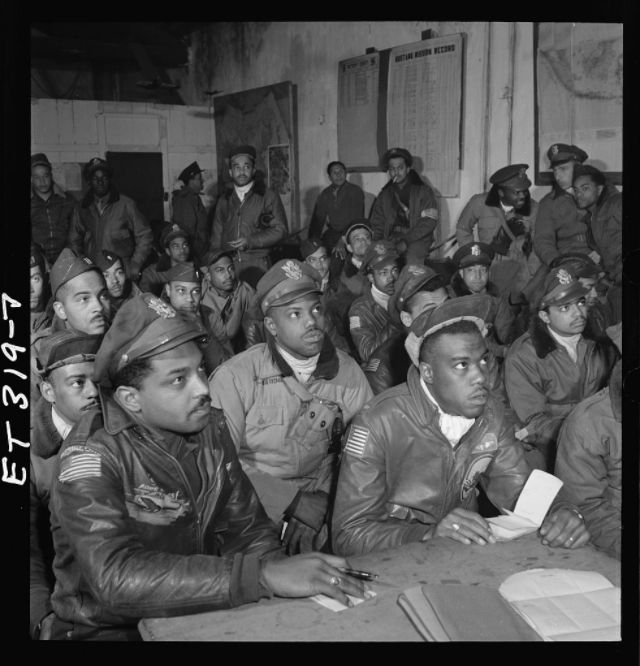
These intimate portraits were taken by Toni Frissell, a high-fashion photographer who volunteered her photographic services to the American Red Cross, Women’s Army Corps, and Eighth Army Air Force during WWII. On volunteering for the American Red Cross in 1941, Frissell said: “I became so frustrated with fashions that I wanted to prove to myself that I could do a real reporting job.” Take a look:

Subscribe to continue reading
Become a paid subscriber to get access to the rest of this post and other exclusive content.
