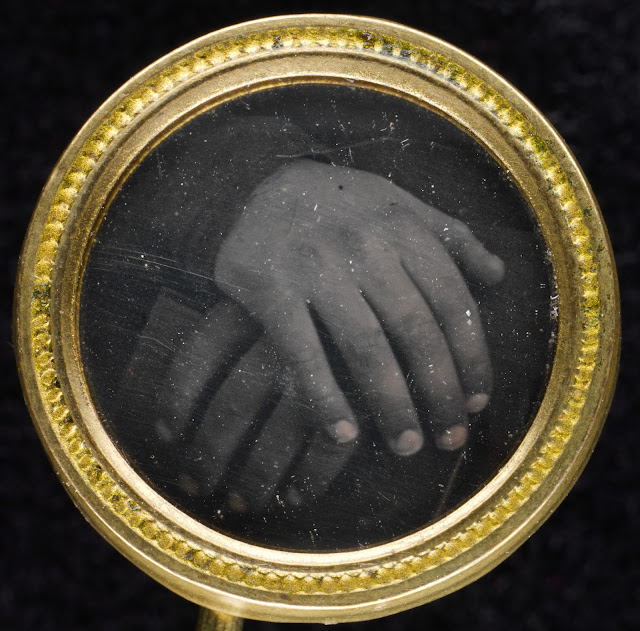
Abolitionist Button is an early photography daguerreotype and gold photographic print created from between the 1840s to the 1850s. It lives at the Metropolitan Museum of Art in New York. The image is in the public domain, and tagged jewelry and political work.
This miniature daguerreotype shows two hands resting on a book. The photograph is set into a two-piece gold-washed brass frame with a loop on the reverse for sewing to a garment. The case design with its simple, raised ornamental border is typical of the gilt-metal buttons mass-produced from 1830 to 1850 in several New England factories such as the Scovill Manufacturing Company in Waterbury, Connecticut, which also manufactured daguerreotype plates. The button was discovered in the early 1980s in a flea market in Massachusetts.
Subscribe to continue reading
Become a paid subscriber to get access to the rest of this post and other exclusive content.
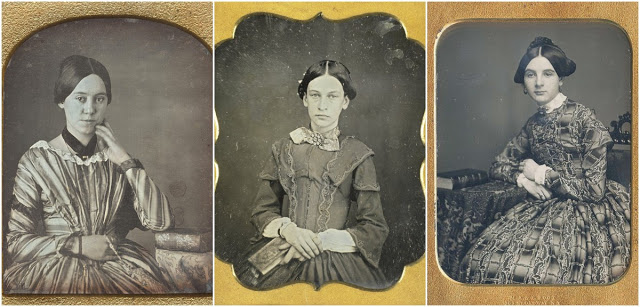
Women formed a large and increasing part of the new novel-reading public. The traditional discrepancy between male and female literacy rates was narrowed, and finally eliminated by the end of the 19th century. The gap had always been the widest at the lowest end of the social scale.
Perhaps more women than we realize could already read. The signature test, commonly used by historians to measure literacy, hides from view all those who could read, but were still unable to sign their own name. This group was essentially female. The Catholic Church had tried as far as possible to encourage people to read, but not to write. It was useful for parishioners to be able to read the Bible and their catechism, but the ability to write as well might have given peasants an undesirable degree of independence in the eyes of the clergy. Perhaps for this reason, many women could read but not sign or write. In some families, there was a rigid sexual division of literary labour, according to which the women would read to the family, while the men would do the writing and account-keeping.
Although feminist movements at the end of the 18th century had tried to set up precedents for women’s reading, 19th century models for the ideal women concentrated on activity, for instance charity work and above all motherhood. The only reading advocated for women was as part of educating their children or running their households. Mrs. Beeton’s Book of Household Management was first published in 1861. Although novel reading was common among leisured women, it was somewhat looked down on, unless the text was of a serious or ‘improving’ nature.
Subscribe to continue reading
Become a paid subscriber to get access to the rest of this post and other exclusive content.
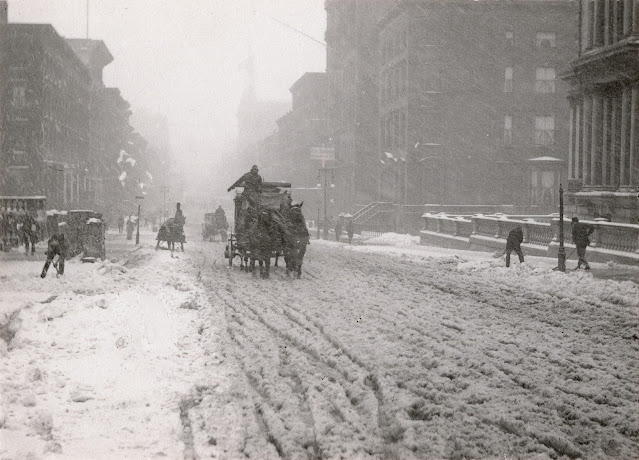
Winter, Fifth Avenue is a black and white photograph taken by Alfred Stieglitz in 1893. The photograph was made at the corner of the Fifth Avenue and the 35th Street in New York. It was one of the first pictures that Stieglitz took using a more practical hand camera after his return from Europe.
Subscribe to continue reading
Become a paid subscriber to get access to the rest of this post and other exclusive content.
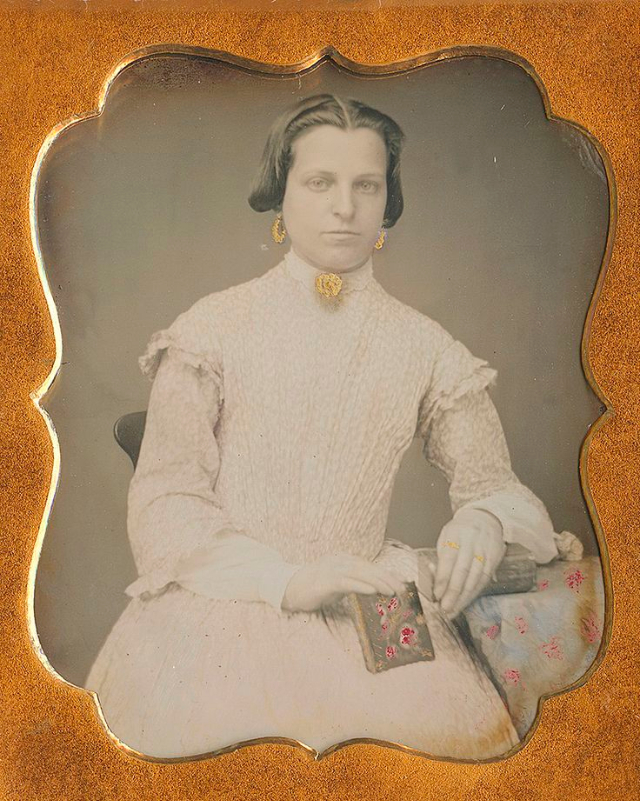
Daguerreotypes, the first commercial form of photography, appeared in America around the year 1839. These were produced by first sensitizing a polished silvered copper plate with iodine vapor, and then exposing the plate to light. The image was developed over hot mercury, fixed, and rinsed. This was a direct positive process, meaning that no negatives were produced, and so each daguerreotype is unique. Daguerreotypes can be easily distinguished from other early photographs by their reflective, mirror-like surface.
Animals are not well represented in daguerreotypes, yet their visage within them is quite informative. The inclusion of animals was inhibited by their penchant for movement, which confounded the capabilities of the daguerreotype. Nonetheless, people sought to incorporate animals into portraits, the result often being a smeared image of the being. Rather than viewing this outcome as a failure, the smeared images should be viewed as theoretically and philosophically insightful.
On the one hand, the smears suggest the frailty of existence during an era in which disease and death were common, a condition that instigated the creation of lasting daguerreotypes. The smears indicate the transient character of life in all ages, a condition that points toward an altered conception of animal ontology. These social and ontological insights have ramifications for present-day relations.
Subscribe to continue reading
Become a paid subscriber to get access to the rest of this post and other exclusive content.
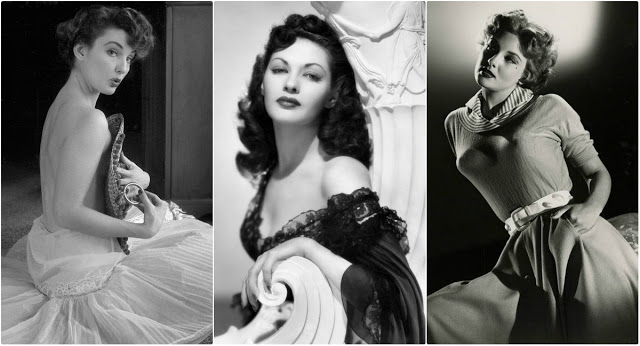
Born 1930 in Charleston, West Virginia, American actress and model Allison Hayes made her film debut in the 1954 comedy Francis Joins the WACS. Her second film, Sign of the Pagan, provided her with an important role in a relatively minor film. Released from her contract, she was signed by Columbia Pictures in 1955.
Chicago Syndicate is her first film for Columbia. Count Three and Pray gave her the role that she later described as the best of her career. Hayes played with Van Heflin, co-starring with Raymond Burr and Joanne Woodward in her debut.
Hayes appeared in films such as Steel Jungle, Mohawk, and Gunslinger (all 1956), but a fall from a horse during the filming of the latter left Hayes with a broken arm and unable to work. After she recovered, she began appearing in supporting roles in television productions.
During 1963 and 1964, Hayes played a continuing role in the General Hospital but by this time her movie career was virtually over.
As her acting career declined, she began to experience severe health problems and was unable to walk without a cane. In severe pain, her usually good-natured personality began to change and she became emotional and volatile, making it difficult for her to secure acting work. She was given a minor role in the 1965 Elvis Presley film Tickle Me, making her final appearances in a guest role on Gomer Pyle, U.S.M.C. in 1967.
Hayes died in 1977 at the University of California Medical Center in San Diego, California, one week before her 47th birthday.
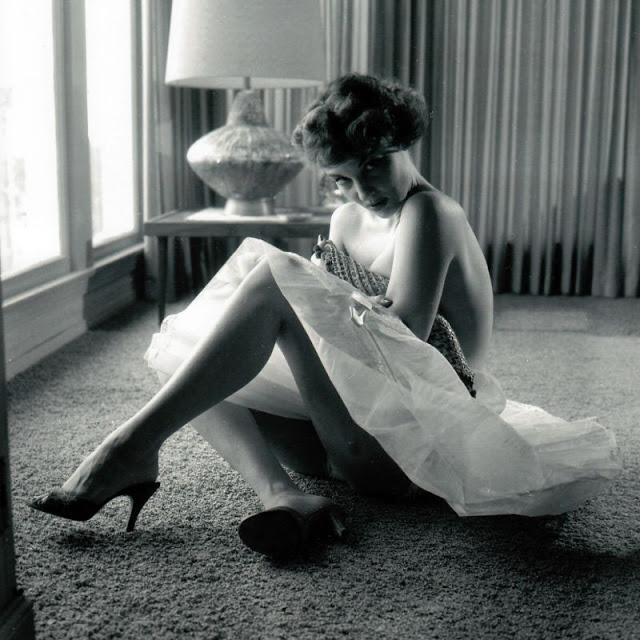
Take a look at these glamorous photos to see the beauty of Allison Hayes in the 1950s.
Subscribe to continue reading
Become a paid subscriber to get access to the rest of this post and other exclusive content.
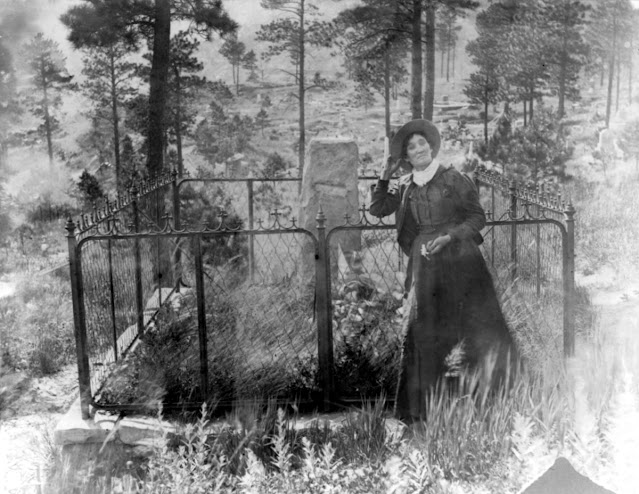
A historic photo of Martha Jane Cannary, better known as Calamity Jane, mugging at the grave of James Butler “Wild Bill” Hickok in Mt. Moriah Cemetery, Deadwood, South Dakota, ca. 1903.
This photo by J. A. Kumpf, is believed to be from 1903 which would have been shortly before her death. (Library of Congress)
Subscribe to continue reading
Become a paid subscriber to get access to the rest of this post and other exclusive content.
Following World War II, the United States emerged as one of the two dominant superpowers, turning away from its traditional isolationism and toward increased international involvement.
The United States became a global influence in economic, political, military, cultural, and technological affairs. The unprecedented growth of the U.S. economy translated into prosperity that resulted in millions of office and factory workers being lifted into a growing middle class that moved to the suburbs and embraced consumer goods.
The role of women in U.S. society became an issue of particular interest in the post-war years, with marriage and feminine domesticity depicted as the primary goal for the American woman. The post-war baby boom embraced the role of women as caretakers and homemakers.
The post-World War II prosperity did not extend to everyone. Many Americans continued to live in poverty throughout the 1950s, especially older people and African Americans.
Voting rights discrimination remained widespread in the south through the 1950s. Although both parties pledged progress in 1948, the only major development before 1954 was integration of the military.
Here below is a set of amazing color photos that shows everyday life of the United States in the late 1940s.
Subscribe to continue reading
Become a paid subscriber to get access to the rest of this post and other exclusive content.
Mabel Love (16 October 1874 – 15 May 1953), was a British dancer and stage actress. She was considered to be one of the great stage beauties of her age, and her career spanned the late Victorian era and the Edwardian period. In 1894, Winston Churchill wrote to her asking for a signed photograph. Among her West End stage roles were Francoise in La Cigale and Pepita in Little Christopher Columbus. Later, she appeared in Man and Superman on Broadway.
Mabel Love was born Mabel Watson in Folkestone, England, the granddaughter of entertainer and ventriloquist William Edward Love, and the second of actress Kate Watson’s three daughters (another was Blanche Watson). Love made her stage debut at the age of twelve, at the Prince of Wales Theatre, playing The Rose, in the first stage adaptation of Lewis Carroll’s Alice in Wonderland.
In 1887, she played one of the triplet children in Masks and Faces at London’s Opera Comique, and the same year, she appeared in the Christmas pantomime at Covent Garden. Still only 14, she enjoyed widespread popularity in George Edwardes’s Burlesque Company at the Gaiety Theatre playing the dancing role of Totchen, the vivandière (camp follower) in Faust Up To Date (1888–89).
In March 1889, under the headline “Disappearance of a Burlesque Actress”, The Star newspaper reported that Love had disappeared. It was later reported that she had gone to the Thames Embankment, considering suicide. This publicity served merely to increase the public’s interest in her. When photographer Frank Foulsham had the idea of selling the images of actresses on postcards, Love proved to be a popular subject leading one writer to christen her “the pretty girl of the postcard”.
Over the following 30 years, she starred in a series of burlesques, pantomimes and musical comedies. Among her successes were Francoise in La Cigale and Pepita in Ivan Caryll’s Little Christopher Columbus. Later, she appeared at the Folies Bergère in Paris and as Violet Robinson in Man and Superman on Broadway (1912). Love retired from the stage in 1918, and, in 1926, she opened a school of dancing in London. Her only return to the stage was in 1938, as Mary Goss in Profit and Loss at the Embassy Theatre.
Love died at Weybridge, Surrey, England at the age of 78, leaving an illegitimate daughter, Mary Loraine (1913–1973), £2,600 in government bonds. Mary, an actress, worked as a British Special Operations Executive during the Second World War and married first Richard Emrys Thomas in 1935, the general manager of the Egyptian State Railways (they had a son, Richard (1936–2001)), and later BOAC pilot Anthony Loraine in 1948; she died in poverty in a fire at her flat, not knowing that her mother had left her the valuable bonds.
These beautiful photos captured portraits of Mabel Love in November 1910.
Subscribe to continue reading
Become a paid subscriber to get access to the rest of this post and other exclusive content.