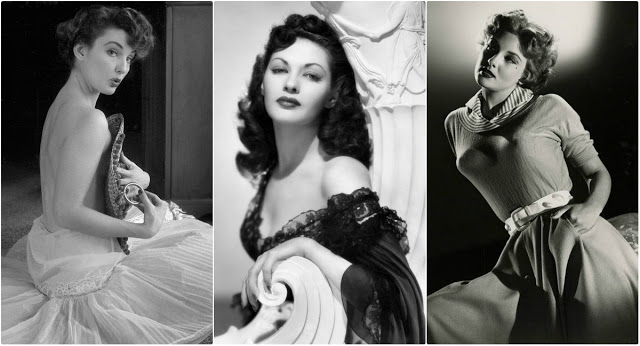
Born 1930 in Charleston, West Virginia, American actress and model Allison Hayes made her film debut in the 1954 comedy Francis Joins the WACS. Her second film, Sign of the Pagan, provided her with an important role in a relatively minor film. Released from her contract, she was signed by Columbia Pictures in 1955.
Chicago Syndicate is her first film for Columbia. Count Three and Pray gave her the role that she later described as the best of her career. Hayes played with Van Heflin, co-starring with Raymond Burr and Joanne Woodward in her debut.
Hayes appeared in films such as Steel Jungle, Mohawk, and Gunslinger (all 1956), but a fall from a horse during the filming of the latter left Hayes with a broken arm and unable to work. After she recovered, she began appearing in supporting roles in television productions.
During 1963 and 1964, Hayes played a continuing role in the General Hospital but by this time her movie career was virtually over.
As her acting career declined, she began to experience severe health problems and was unable to walk without a cane. In severe pain, her usually good-natured personality began to change and she became emotional and volatile, making it difficult for her to secure acting work. She was given a minor role in the 1965 Elvis Presley film Tickle Me, making her final appearances in a guest role on Gomer Pyle, U.S.M.C. in 1967.
Hayes died in 1977 at the University of California Medical Center in San Diego, California, one week before her 47th birthday.
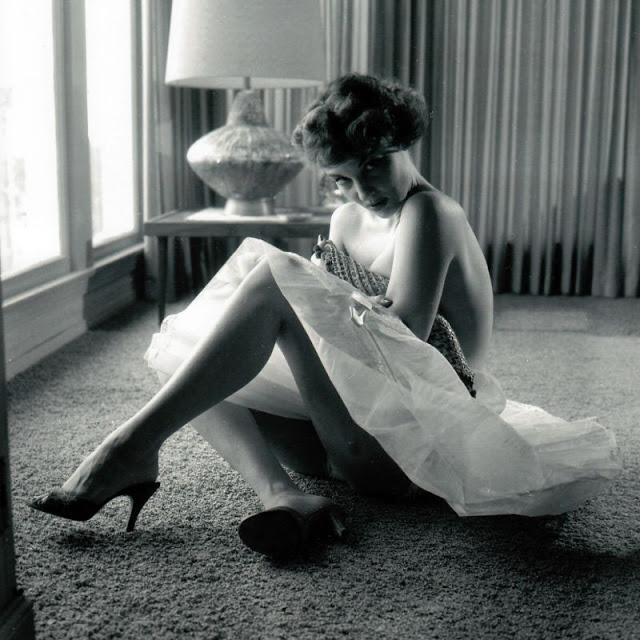
Take a look at these glamorous photos to see the beauty of Allison Hayes in the 1950s.
Subscribe to continue reading
Become a paid subscriber to get access to the rest of this post and other exclusive content.
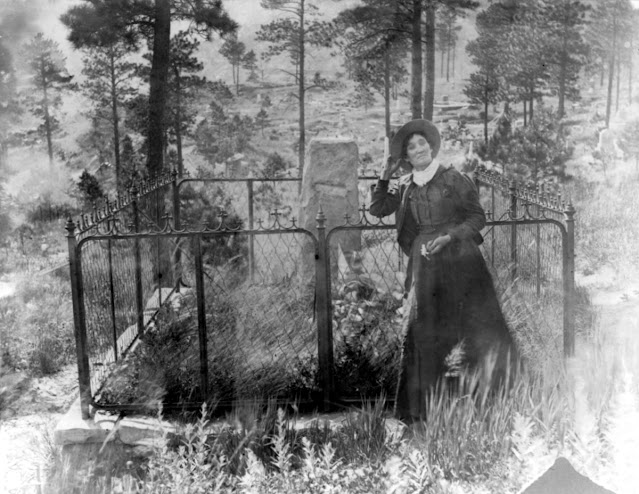
A historic photo of Martha Jane Cannary, better known as Calamity Jane, mugging at the grave of James Butler “Wild Bill” Hickok in Mt. Moriah Cemetery, Deadwood, South Dakota, ca. 1903.
This photo by J. A. Kumpf, is believed to be from 1903 which would have been shortly before her death. (Library of Congress)
Subscribe to continue reading
Become a paid subscriber to get access to the rest of this post and other exclusive content.
Following World War II, the United States emerged as one of the two dominant superpowers, turning away from its traditional isolationism and toward increased international involvement.
The United States became a global influence in economic, political, military, cultural, and technological affairs. The unprecedented growth of the U.S. economy translated into prosperity that resulted in millions of office and factory workers being lifted into a growing middle class that moved to the suburbs and embraced consumer goods.
The role of women in U.S. society became an issue of particular interest in the post-war years, with marriage and feminine domesticity depicted as the primary goal for the American woman. The post-war baby boom embraced the role of women as caretakers and homemakers.
The post-World War II prosperity did not extend to everyone. Many Americans continued to live in poverty throughout the 1950s, especially older people and African Americans.
Voting rights discrimination remained widespread in the south through the 1950s. Although both parties pledged progress in 1948, the only major development before 1954 was integration of the military.
Here below is a set of amazing color photos that shows everyday life of the United States in the late 1940s.
Subscribe to continue reading
Become a paid subscriber to get access to the rest of this post and other exclusive content.
Mabel Love (16 October 1874 – 15 May 1953), was a British dancer and stage actress. She was considered to be one of the great stage beauties of her age, and her career spanned the late Victorian era and the Edwardian period. In 1894, Winston Churchill wrote to her asking for a signed photograph. Among her West End stage roles were Francoise in La Cigale and Pepita in Little Christopher Columbus. Later, she appeared in Man and Superman on Broadway.
Mabel Love was born Mabel Watson in Folkestone, England, the granddaughter of entertainer and ventriloquist William Edward Love, and the second of actress Kate Watson’s three daughters (another was Blanche Watson). Love made her stage debut at the age of twelve, at the Prince of Wales Theatre, playing The Rose, in the first stage adaptation of Lewis Carroll’s Alice in Wonderland.
In 1887, she played one of the triplet children in Masks and Faces at London’s Opera Comique, and the same year, she appeared in the Christmas pantomime at Covent Garden. Still only 14, she enjoyed widespread popularity in George Edwardes’s Burlesque Company at the Gaiety Theatre playing the dancing role of Totchen, the vivandière (camp follower) in Faust Up To Date (1888–89).
In March 1889, under the headline “Disappearance of a Burlesque Actress”, The Star newspaper reported that Love had disappeared. It was later reported that she had gone to the Thames Embankment, considering suicide. This publicity served merely to increase the public’s interest in her. When photographer Frank Foulsham had the idea of selling the images of actresses on postcards, Love proved to be a popular subject leading one writer to christen her “the pretty girl of the postcard”.
Over the following 30 years, she starred in a series of burlesques, pantomimes and musical comedies. Among her successes were Francoise in La Cigale and Pepita in Ivan Caryll’s Little Christopher Columbus. Later, she appeared at the Folies Bergère in Paris and as Violet Robinson in Man and Superman on Broadway (1912). Love retired from the stage in 1918, and, in 1926, she opened a school of dancing in London. Her only return to the stage was in 1938, as Mary Goss in Profit and Loss at the Embassy Theatre.
Love died at Weybridge, Surrey, England at the age of 78, leaving an illegitimate daughter, Mary Loraine (1913–1973), £2,600 in government bonds. Mary, an actress, worked as a British Special Operations Executive during the Second World War and married first Richard Emrys Thomas in 1935, the general manager of the Egyptian State Railways (they had a son, Richard (1936–2001)), and later BOAC pilot Anthony Loraine in 1948; she died in poverty in a fire at her flat, not knowing that her mother had left her the valuable bonds.
These beautiful photos captured portraits of Mabel Love in November 1910.
Subscribe to continue reading
Become a paid subscriber to get access to the rest of this post and other exclusive content.
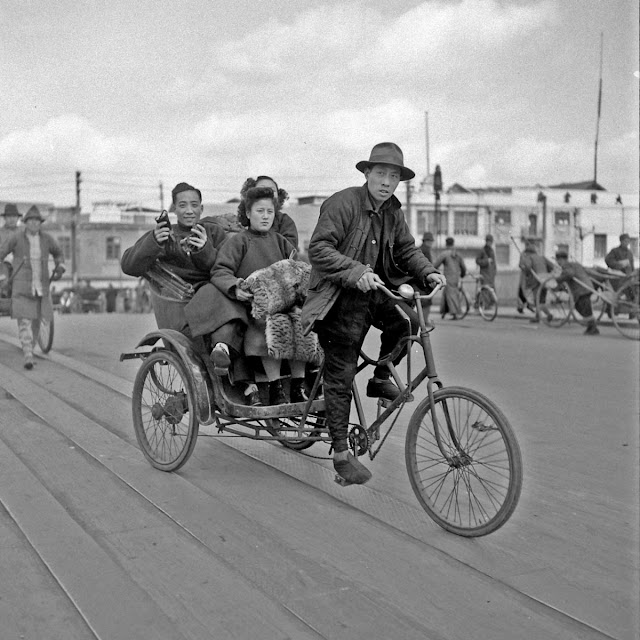
“A great, wicked and quite extraordinary city” was how, in 1947, LIFE described Shanghai. In 1947, four million people had made the City their residence (today, that number is 26 million). It seemed that at any one time, a very substantial proportion of the population was on the Shanghai streets.
“The traffic has become a monstrous, screaming blend of rickshaws, coolie-powered push carts, limousines, three-wheeled pedicabs, jeeps and six-ton trucks,” exclaimed LIFE.
These vintage photographs, taken by Mark Kauffman (1921-1994), depict some of the many and various human-powered vehicles to be found on the streets of Shanghai in 1947.
Kauffman was an award-winning photographer for LIFE magazine. At 17, he became the youngest photographer ever to shoot a cover for the magazine, when he did a photo portrait of Eleanor Roosevelt. He was a staff photographer for over 30 years, covering events in the United States, Europe and the Far East. He received the White House News Photographers’ Grand Award in 1953. He later served as director of photography for Playboy magazine for five years and was a professor of photography at California Polytechnic State University.
Subscribe to continue reading
Become a paid subscriber to get access to the rest of this post and other exclusive content.
The 1960s were the time of the hippies, “Make love, not war”, The Beatles and Woodstock. It brings images of cultural revolution, peace symbols, flower power, beach culture, short skirts, flares and lots of hair.
Girls looked like Twiggy or Lulu. The decade finishes with the opening of the musical Hair and its shocking (for the time) nudity. The 1960s were the carefree and colorful years.
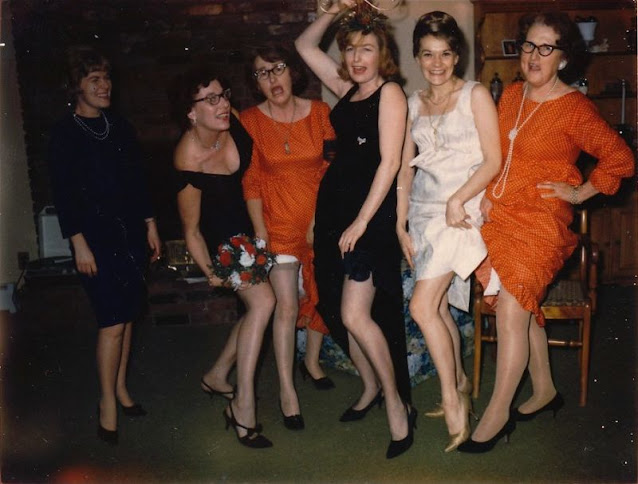
Cool photos show what house parties looked like during the Sixties.
Subscribe to continue reading
Become a paid subscriber to get access to the rest of this post and other exclusive content.
Vivid colorized images have revealed the evolution of the automobile and motorcycle throughout history.
The re-imagined pictures show the first woman to obtain a motorcycle license in Washington DC in 1937, a Maxwell car in 1916 and the first official Austrian Formula 1 mechanic in his custom-made motor. Other shots also show an Alfa Romeo race car in 1922, men observing a car wreck in America in 1923 and a postman using a motorbike in 1915.
The original black and white images were colorized over a period of 40 to 50 hours by Austrian photographer Mario Unger.
“Color reduces the time distance to the photographed object I think,” he said. “It also adds mood and feeling while black and white somehow reduces this. I thought this would be a very nice and interesting project.”
The history of the motorcycle begins in the second half of the 19th century. Motorcycles are descended from the “safety bicycle,” a bicycle with front and rear wheels of the same size and a pedal crank mechanism to drive the rear wheel.
Senator Wetmore in “horseless Carriage,” 1905.
Subscribe to continue reading
Become a paid subscriber to get access to the rest of this post and other exclusive content.
Born in Pittsburgh, Pennsylvania in 1937, Grady Stiles Jr., aka “Lobster Boy”, was one in a long line of people in the Stiles family, dating back to 1840, who suffered from a rare and strange physical condition known as ectrodactyly. This genetic condition was one in which the fingers and toes are fused together to form claw-like extremities.
Grady Stiles Sr. was a sideshow attraction in a traveling carnival when his son was born and he jumped at the opportunity to add his son to the freak show act at the age of seven. Stiles Sr. married twice and had four children, two of whom also had ectrodactyly.
Many have viewed this disorder as a handicap, yet for the Stiles family it was seen, and used as, an opportunity. As far back as the 1800s, as the family grew and produced more children with unusual hands and feet, they developed a circus act: The Lobster Family, which became a carnival freak show staple throughout the early 20th century.
Grady Stiles, the Lobster Boy, as an adult (L) and as a child (R).
Subscribe to continue reading
Become a paid subscriber to get access to the rest of this post and other exclusive content.
Paris is the capital and most populous city of France, with an estimated population of 2,165,423 residents in 2019 in an area of more than 105 km² (41 sq mi), making it the 34th most densely populated city in the world in 2020. Since the 17th century, Paris has been one of the world’s major centres of finance, diplomacy, commerce, fashion, gastronomy, science, and arts, and has sometimes been referred to as the capital of the world. The City of Paris is the centre and seat of government of the region and province of Île-de-France, or Paris Region, with an estimated population of 12,997,058 in 2020, or about 18% of the population of France, making it in 2020 the second largest metropolitan area in the OECD, and 14th largest in the world in 2015. The Paris Region had a GDP of €709 billion ($808 billion) in 2017. According to the Economist Intelligence Unit Worldwide Cost of Living Survey, in 2021 Paris was the city with the second-highest cost of living in the world, tied with Singapore, and after Tel Aviv.
Paris is a major railway, highway, and air-transport hub served by two international airports: Paris–Charles de Gaulle (the second-busiest airport in Europe) and Paris–Orly. Opened in 1900, the city’s subway system, the Paris Métro, serves 5.23 million passengers daily; it is the second-busiest metro system in Europe after the Moscow Metro. Gare du Nord is the 24th-busiest railway station in the world and the busiest located outside Japan, with 262 million passengers in 2015. Paris is especially known for its museums and architectural landmarks: the Louvre received 2.8 million visitors in 2021, despite the long museum closings caused by the COVID-19 virus. The Musée d’Orsay, Musée Marmottan Monet and Musée de l’Orangerie are noted for their collections of French Impressionist art. The Pompidou Centre Musée National d’Art Moderne has the largest collection of modern and contemporary art in Europe. The Musée Rodin and Musée Picasso exhibit the works of two noted Parisians. The historical district along the Seine in the city centre has been classified as a UNESCO World Heritage Site since 1991; popular landmarks there include the Cathedral of Notre Dame de Paris on the Île de la Cité, now closed for renovation after the 15 April 2019 fire. Other popular tourist sites include the Gothic royal chapel of Sainte-Chapelle, also on the Île de la Cité; the Eiffel Tower, constructed for the Paris Universal Exposition of 1889; the Grand Palais and Petit Palais, built for the Paris Universal Exposition of 1900; the Arc de Triomphe on the Champs-Élysées, and the hill of Montmartre with its artistic history and its Basilica of Sacré-Coeur.
Paris hosts several United Nations organisations: the UNESCO, the Young Engineers / Future Leaders, the World Federation of Engineering Organizations, and other international organisations such as the OECD, the OECD Development Centre, the International Bureau of Weights and Measures, the International Energy Agency, the International Federation for Human Rights, the International Organisation of La Francophonie; along with European bodies such as the European Space Agency, the European Banking Authority or the European Securities and Markets Authority. Other international organisations were founded in Paris such as the CIMAC in 1951 (International Council on Combustion Engines | Conseil International des Machines à Combustion), or the modern Olympic Games in 1894 which was then moved to Lausanne, Switzerland.
Tourism recovered in the Paris region in 2021, increasing to 22.6 million visitors, thirty percent more than in 2020, but still well below 2019 levels. The number of visitors from the United States increased by 237 percent over 2020. Museums re-opened in 2021, with limitations on the number of visitors at a time and a requirement that visitors wear masks.
The football club Paris Saint-Germain and the rugby union club Stade Français are based in Paris. The 80,000-seat Stade de France, built for the 1998 FIFA World Cup, is located just north of Paris in the neighbouring commune of Saint-Denis. Paris hosts the annual French Open Grand Slam tennis tournament on the red clay of Roland Garros. The city hosted the Olympic Games in 1900, 1924 and will host the 2024 Summer Olympics. The 1938 and 1998 FIFA World Cups, the 2007 Rugby World Cup, as well as the 1960, 1984 and 2016 UEFA European Championships were also held in the city. Every July, the Tour de France bicycle race finishes on the Avenue des Champs-Élysées in Paris.
Subscribe to continue reading
Become a paid subscriber to get access to the rest of this post and other exclusive content.