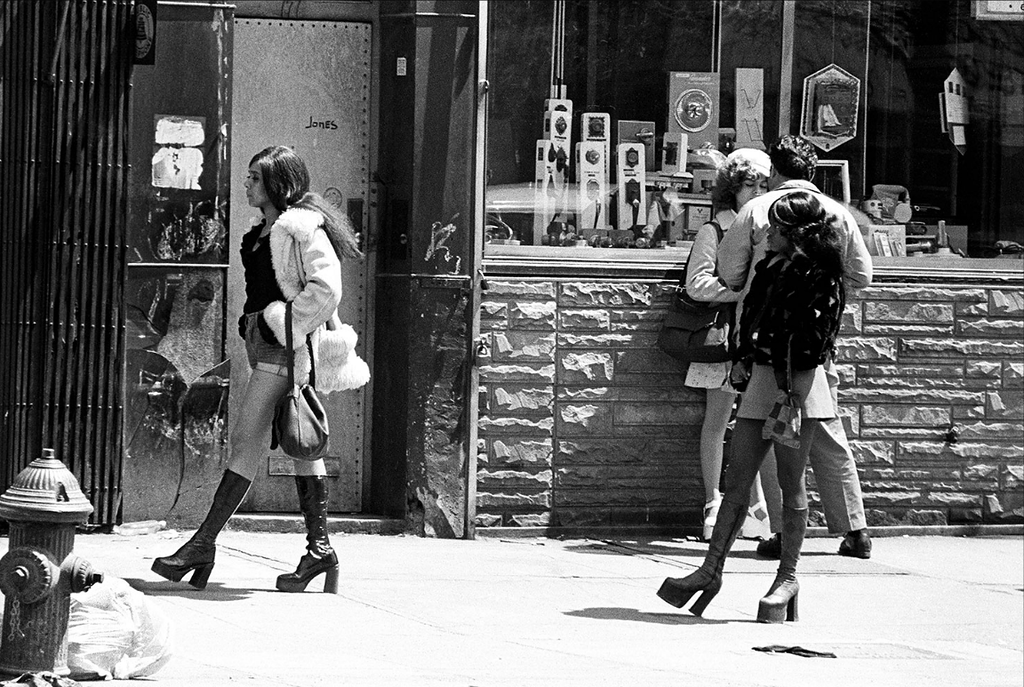
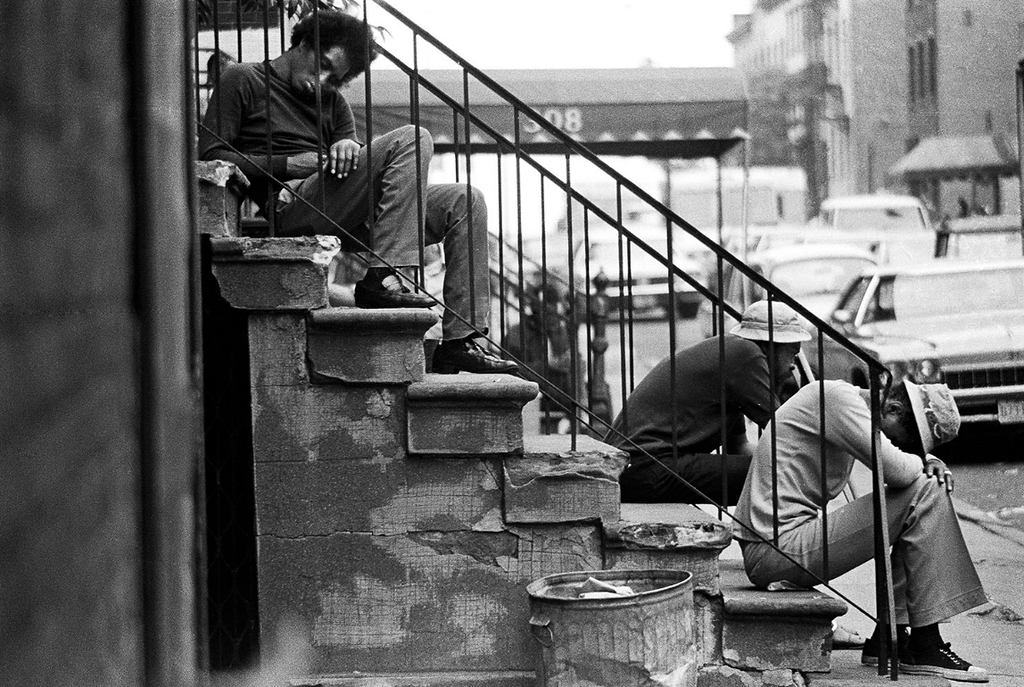
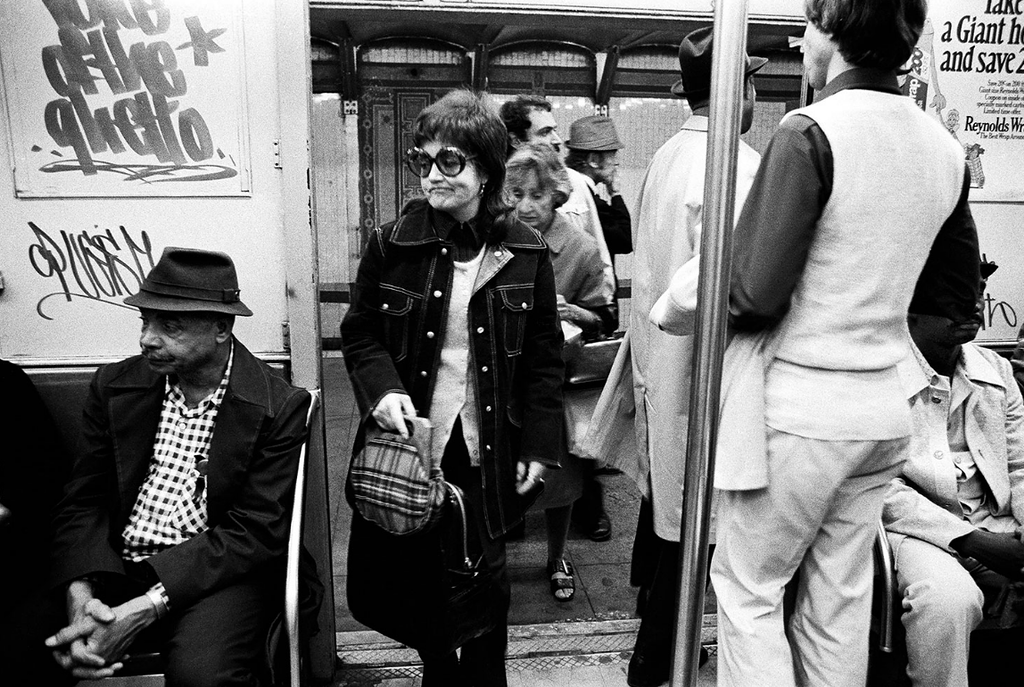
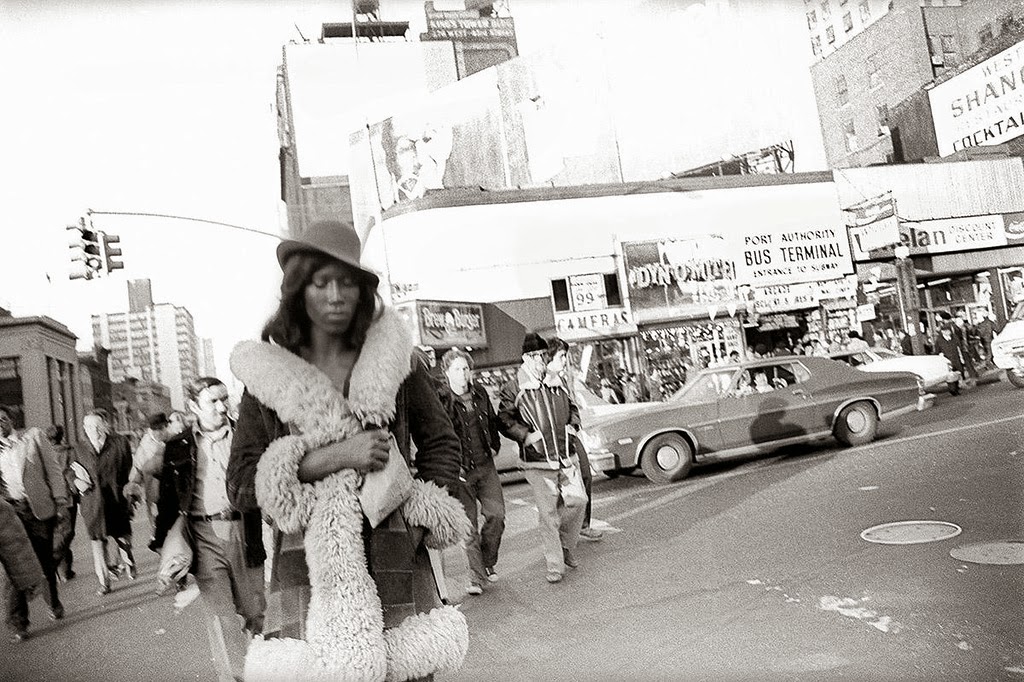
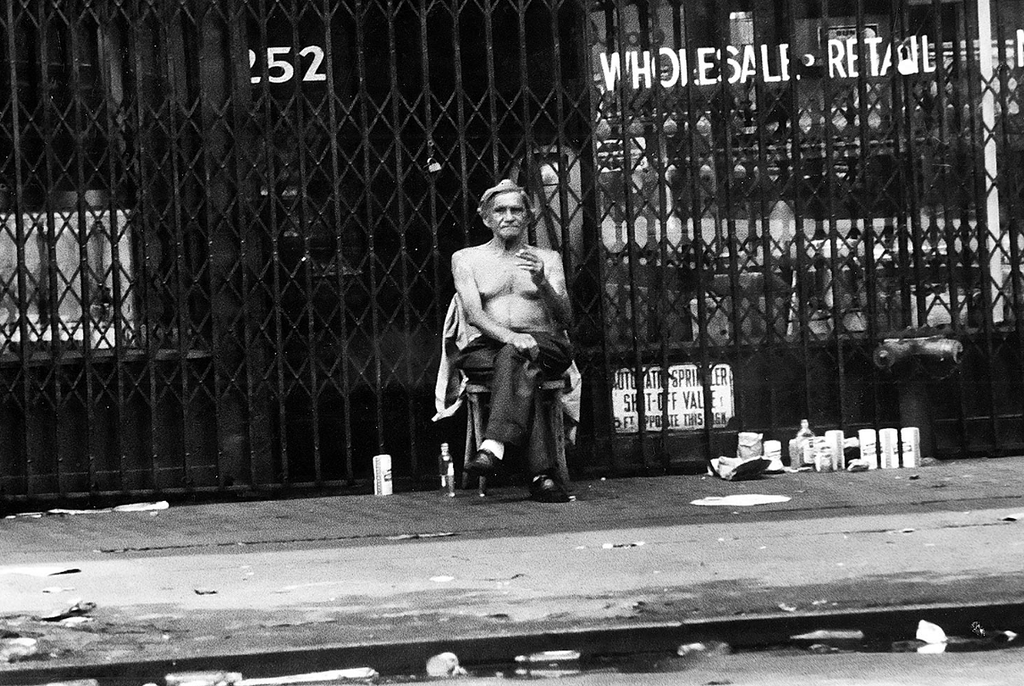
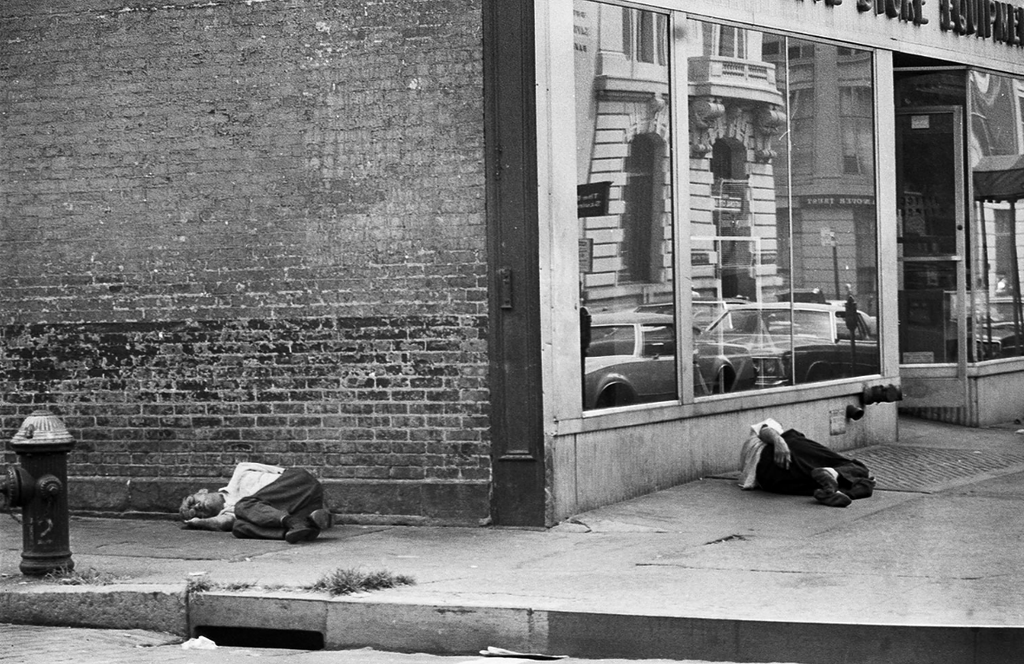
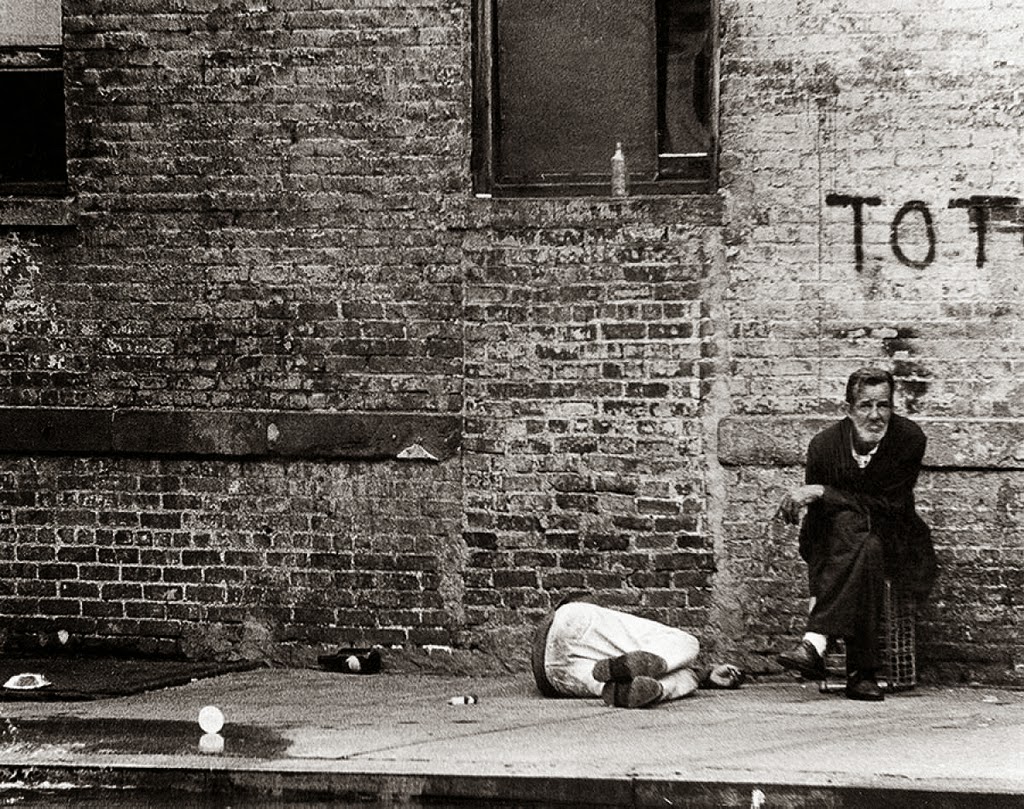
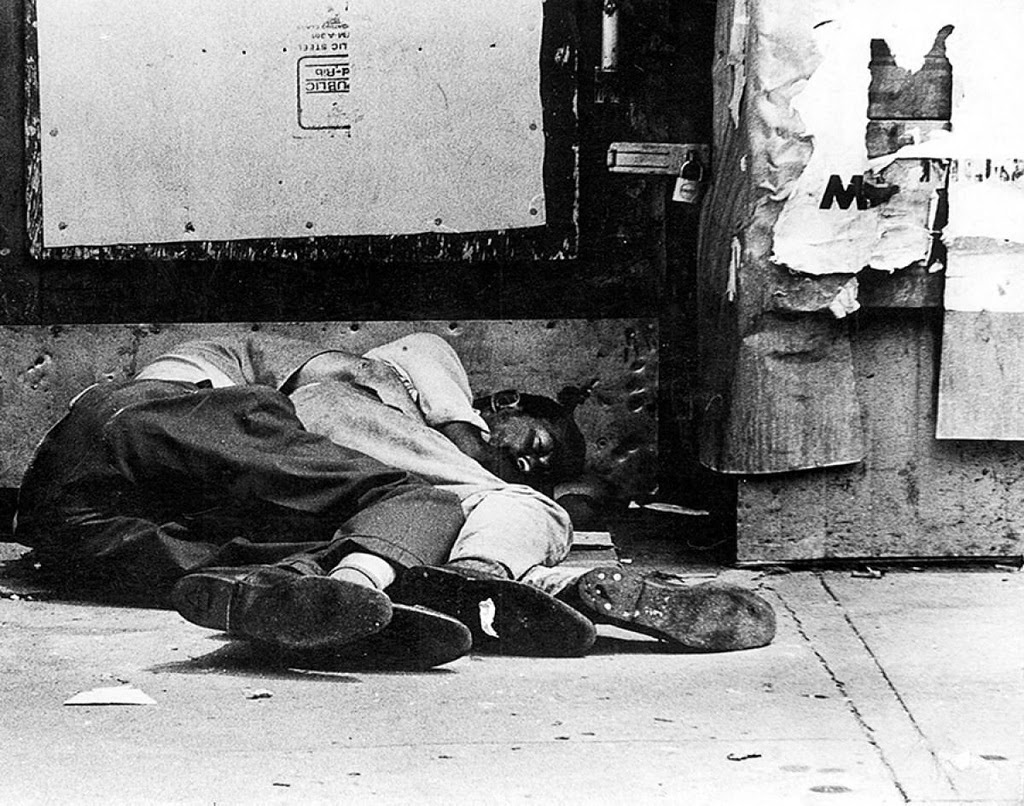
18 Amazing Black & White Photographs of Street Scenes in New York City in the 1970s

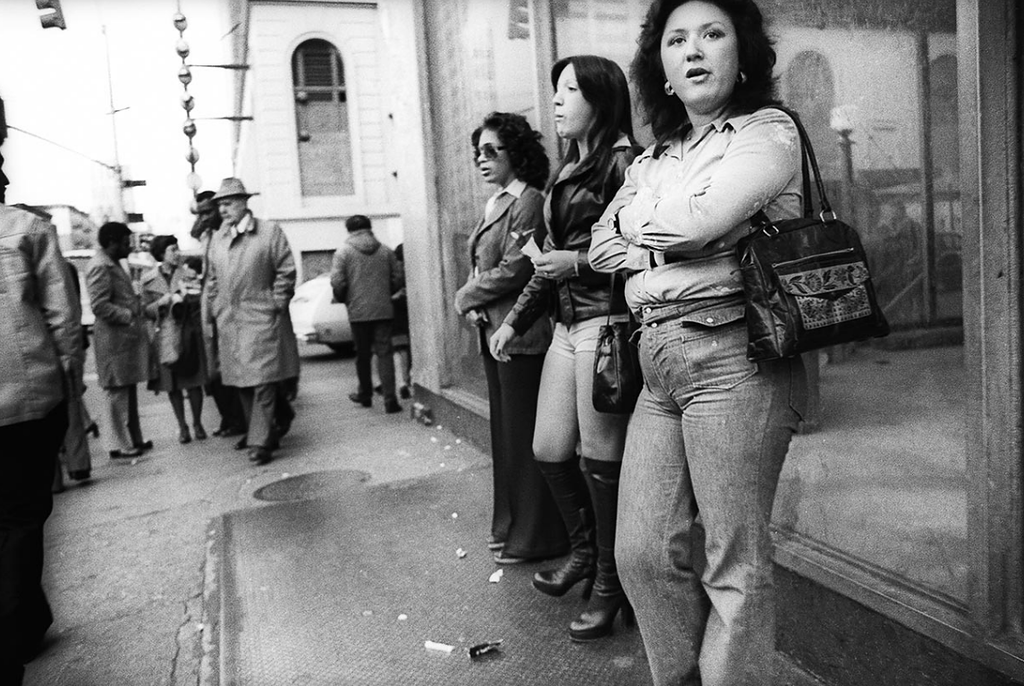
Forget the disco era, the 1970s in New York City was all about danger. With pimps and prostitutes populating the streets, an economic collapse and a crime-filled subway system, the streets of Manhattan were gritty and dark. Check out photographer Leland Bobbe’s shots of New York during a period when it hit an all-time low…

New York, often called New York City (NYC) to distinguish it from the state of New York, is the most populous city in the United States. With a 2020 population of 8,804,190 distributed over 300.46 square miles (778.2 km2), New York City is also the most densely populated major city in the United States. Located at the southern tip of the state of New York, the city is the center of the New York metropolitan area, the largest metropolitan area in the world by urban area. With over 20.1 million people in its metropolitan statistical area and 23.5 million in its combined statistical area as of 2020, New York is one of the world’s most populous megacities. New York City has been described as the cultural, financial, and media capital of the world, significantly influencing commerce, entertainment, research, technology, education, politics, tourism, dining, art, fashion, and sports, and is the most photographed city in the world. Home to the headquarters of the United Nations, New York is an important center for international diplomacy, and has sometimes been called the capital of the world.

Situated on one of the world’s largest natural harbors, New York City is composed of five boroughs, each of which is coextensive with a respective county of the state of New York. The five boroughs—Brooklyn (Kings County), Queens (Queens County), Manhattan (New York County), the Bronx (Bronx County), and Staten Island (Richmond County)—were created when local governments were consolidated into a single municipal entity in 1898. The city and its metropolitan area constitute the premier gateway for legal immigration to the United States. As many as 800 languages are spoken in New York, making it the most linguistically diverse city in the world. New York is home to more than 3.2 million residents born outside the United States, the largest foreign-born population of any city in the world as of 2016. As of 2018, the New York metropolitan area is estimated to produce a gross metropolitan product (GMP) of nearly $1.8 trillion, ranking it first in the United States. If the New York metropolitan area were a sovereign state, it would have the eighth-largest economy in the world. New York is home to the second highest number of billionaires of any city in the world.

New York City traces its origins to a trading post founded on the southern tip of Manhattan Island by Dutch colonists in approximately 1624. The settlement was named New Amsterdam (Dutch: Nieuw Amsterdam) in 1626 and was chartered as a city in 1653. The city came under English control in 1664 and was renamed New York after King Charles II of England granted the lands to his brother, the Duke of York. The city was regained by the Dutch in July 1673 and was renamed New Orange for one year and three months; the city has been continuously named New York since November 1674. New York City was the capital of the United States from 1785 until 1790, and has been the largest U.S. city since 1790. The Statue of Liberty greeted millions of immigrants as they came to the U.S. by ship in the late 19th and early 20th centuries, and is a symbol of the U.S. and its ideals of liberty and peace. In the 21st century, New York has emerged as a global node of creativity, entrepreneurship, and environmental sustainability, and as a symbol of freedom and cultural diversity. In 2019, New York was voted the greatest city in the world per a survey of over 30,000 people from 48 cities worldwide, citing its cultural diversity.

Many districts and monuments in New York City are major landmarks, including three of the world’s ten most visited tourist attractions in 2013. A record 66.6 million tourists visited New York City in 2019. Times Square is the brightly illuminated hub of the Broadway Theater District, one of the world’s busiest pedestrian intersections, and a major center of the world’s entertainment industry. Many of the city’s landmarks, skyscrapers, and parks are known around the world, as is the city’s fast pace, spawning the term New York minute. The Empire State Building has become the global standard of reference to describe the height and length of other structures. Manhattan’s real estate market is among the most expensive in the world. Providing continuous 24/7 service and contributing to the nickname The City That Never Sleeps, the New York City Subway is the largest single-operator rapid transit system worldwide, with 472 rail stations. The city has over 120 colleges and universities, including Columbia University, New York University, Rockefeller University, and the City University of New York system, which is the largest urban public university system in the United States. Anchored by Wall Street in the Financial District of Lower Manhattan, New York City has been called both the world’s leading financial center and the most financially powerful city in the world, and is home to the world’s two largest stock exchanges by total market capitalization, the New York Stock Exchange and Nasdaq. (Wikipedia)
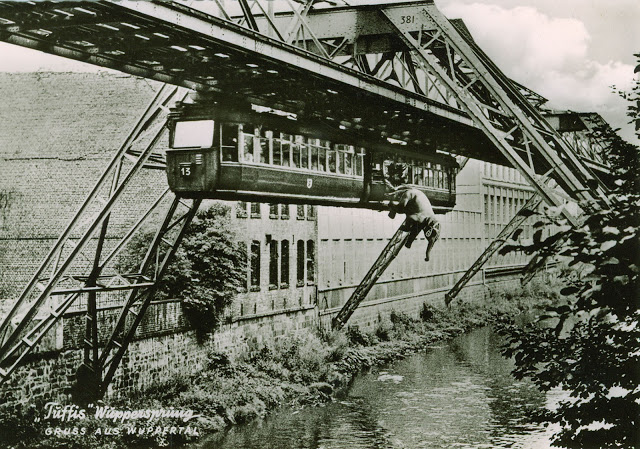
Tuffi the Elephant and Her 1950 Train Jump

In 1950, a 4-year-old elephant named Tuffi was forced to ride a public monorail in Wuppertal, Germany. The animal was loaded aboard as a promotion for the Althoff Circus. This ride was supposed to be a lighthearted affair, but the world quickly learned that pachyderms and monorails simply do not mix.

Even though Tuffi was accustomed to train rides, the swaying tram upset the elephant such that she trumpeted, charged, and sent passengers scrambling for cover. 40 feet above the Wupper River, Tuffi decided that she had enough. The animal burst through a window and plummeted into the water below.

Miraculously, Tuffi survived, and lived a long life until 1989 when she died like many legends did, in Paris. Because she did become a local legend, with souvenirs of her being available in Wuppertal up to this day.

10 Women Behind the Worst Men in History

There’s an old saying that goes: “Behind every great man, there’s an even better woman.” This statement, however, also rings true for bad men.

From Adolf Hitler’s long-term companion Eva Braun, to other so-called “dictator wives,” each of the ladies on this list either willingly or unwittingly spent their lives with very bad guys. Take a look at the women behind the worst men in history.

Eva Braun
Wife of Adolf Hitler

Eva Braun began seeing Adolf Hitler in 1929, when she was 19 years old. At 42, he was 23 years her senior. During their 16-year relationship, Braun would attempt suicide on two occasions, though most believe these attempts were not to escape Hitler, but rather to get his attention and bring him closer to her. Reportedly, while the couple were quite close, Hitler did not like Braun appearing in public because he believed being seen in a relationship would diminish his sex appeal to women.

In 1945, as Allied forces zeroed in on his bunker in Berlin, Braun and Hitler were married, then sealed themselves in a room and committed suicide together.

Mae Capone
Wife of Al Capone

While infamous Chicago mobster Al Capone, who is largely considered to be the mastermind behind the St. Valentine’s Day Massacre, was a ruthless and feared criminal, his wife Mae lived a fairly quiet, normal life. She reportedly married Capone three weeks after the birth of their child, Sonny Capone. Apart from this scandal, however,Mae was known as a doting wife and mother, attending church with her family, and dutifully visiting her husband while he served out the remainder of his years in Alcatraz. Marcella Lentz-Pope plays Mae on the HBO series Boardwalk Empire, where she is portrayed as being mostly oblivious to her husband’s criminal activities.

Clara Petacci
Long-Term Mistress of Benito Mussolini

Although Italian Prime Minister Benito Mussolini had many wives and mistresses, as well as a reputation for sleeping with female journalists, only one woman was killed alongside him by members of the Italian resistance in 1945. That was Clara (“Claretta”) Petacci, daughter of the Pope’s doctor and long-time other woman to Mussolini. After the two were executed by gunshot, their bodies were strung up at a petrol station in Milan, Italy, after which a large crowd gathered around and took out their anger on the bodies.

Carmen Polo, 1st Lady of Meirás
Wife of Francisco Franco

María del Carmen Polo y Martínez-Valdés, wife of long-time Spanish Military Dictator Francisco Franco, was essential to his regime, which disappeared tens of thousands of his political opponents, was an essential part of his rule. She almost never let him travel without her and stood alongside him in even his most insidious decisions. Even after his death, she continued to receive a large public pension.

Sajida Talfah
Wife of Saddam Hussein

Sajida Talfah was the wife of former Iraqi dictator Saddam Hussein. She was also his biological cousin, and her marriage to Hussein was arranged between their families in 1963. After fifty years of marriage, in 1986 Hussein took another bride, Samira Shahbandar, though he also remained married to Talfah. This enraged both Hussein’s first wife and their son, Uday Hussein.

Two years later, in 1988, Uday stabbed and killed his father’s bodyguard, Kamel Hana Gegeo, believing this man to have been responsible for introducing Hussein to Shabandar. Some speculate this murder was at the request of Talfah.

Following the US invasion of Iraq in 2003, and Hussein’s subsequent execution in 2006, it is believed Talfah fled to Qatar, where she lives in relative isolation.

Ko Young Hee
Wife of Kim Jong-il

Because of a supposed “lowly” status in North Korean society, little is known about Ko Young Hee (also spelled Ko Young-hui), the wife of Kim Jong-il and mother of the North Korea’s current leader, Kim Jong-un. Despite the secrecy surrounding her identity, it is believed she held a great influence over her dictator husband, often advising him on political matters. Ko Young Hee died in 2004 of complications related to breast cancer.

Safia Farkash
Wife of Muammar Gaddafi

Safia Farkash was the long-time wife of extremist Libya leader Muammar Gaddafi and mother to seven of his eight children. She reportedly met Gaddafi sometime around 1970 while working as a nurse; she treated Gaddafi while he recovered from an appendicitis. While Farkash lived a mostly quiet life away from the public eye during Gaddafi’s rule, after his assassination she became an outspoken proponent for investigations into her husband’s death.

Amal al-Sadah
Wife of Osama bin Laden

While Amal al-Sadah was not Osama bin Laden’s only wife, she is thought to have been the terrorist mastermind’s favorite. She allegedly stood by bin Laden during the September 11, 2001, attacks, all the way up to his death in 2012. Al-Sadah was apparently herself wounded in the leg by SEALS during the raid that ultimately claimed bin Laden’s life. It is said she is currently residing somewhere in Pakistan, where she is kept mostly in confinement due to her declining health.

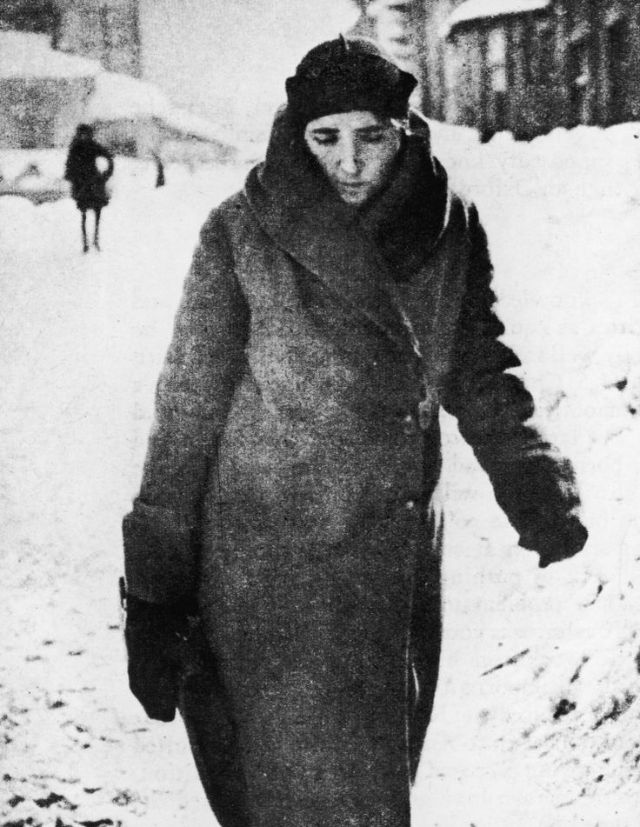
Nadezhda Alliluyeva
Wife of Joseph Stalin

Nadezhda Alliluyeva first met Joseph Stalin in when she was ten years old, while her father, Sergei Alliluyev, sheltered the future Soviet leader after escaping Siberian exile. She and Stalin wed in 1919, when she was 18 years old and he was 42. Their marriage was apparently quite tense, as the couple argued constantly. Alliluyeva also suffered from serious mental problems, which ultimately led to her suicide in 1932.

Khieu Ponnary
Wife of Pol Pot

Khieu Ponnary was one quarter of the “Cambodian Gang of Four” (which references a prominent Chinese Communist group). The other members were Ponnary’s sister Khieu Thirith, her husband Ieng Sary, and Ponnary’s husband Saloth Sar, who was later known as Pol Pot. Ponnary’s involvement with her husband’s regime following his seizing of control of Cambodia in 1975 is unclear, though she did hold a few key political roles during this time.

By 1978, however, Ponnary became gripped by paranoia related to schizophrenia, leading Pol Pot to divorce her and marry another woman. Not long after this, Pol Pot retreated into the jungle and lived out his remaining years under house arrest.

In 1996, Ponnary, her sister, and her brother-in-law were granted amnesty from prosecution by the Cambodian government. She was cared for by Thirith and leng Sary until her death in 2003.

20 Interesting Facts You Might Not Know About the Woodstock Music Festival of 1969

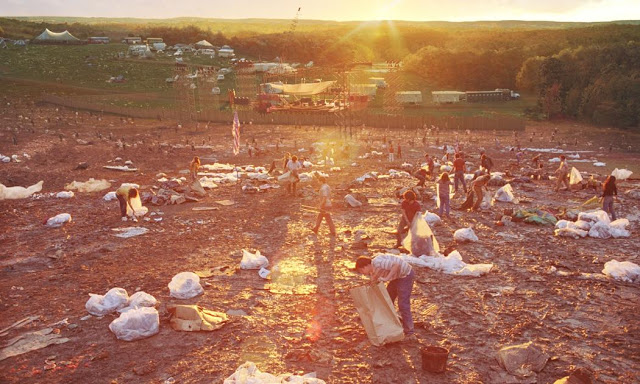
Woodstock Music and Art Fair, commonly referred to simply as Woodstock, was a music festival held August 15–18, 1969, on Max Yasgur’s dairy farm in Bethel, New York, 40 miles (65 km) southwest of the town of Woodstock. Billed as “an Aquarian Exposition: 3 Days of Peace & Music” and alternatively referred to as the Woodstock Rock Festival, it attracted an audience of more than 400,000. Thirty-two acts performed outdoors despite sporadic rain.

The festival has become widely regarded as a pivotal moment in popular music history as well as a defining event for the counterculture generation. The event’s significance was reinforced by a 1970 documentary film, an accompanying soundtrack album, and a song written by Joni Mitchell that became a major hit for both Crosby, Stills, Nash & Young and Matthews Southern Comfort. Music events bearing the Woodstock name were planned for anniversaries, which included the tenth, twentieth, twenty-fifth, thirtieth, fortieth, and fiftieth. In 2004, Rolling Stone magazine listed it as number 19 of the 50 Moments That Changed the History of Rock and Roll. In 2017, the festival site became listed on the National Register of Historic Places. (Wikipedia)
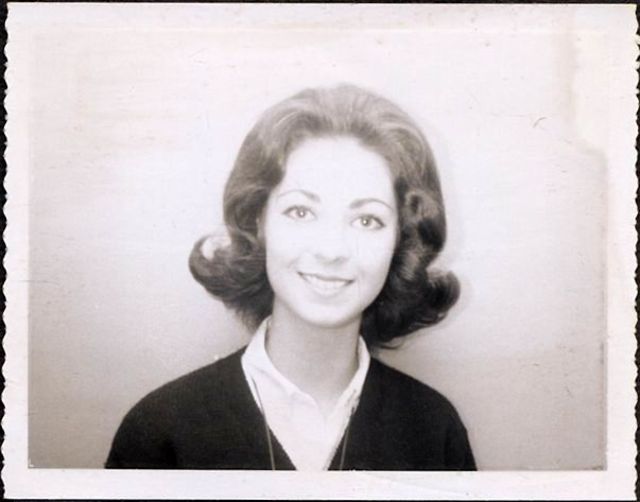
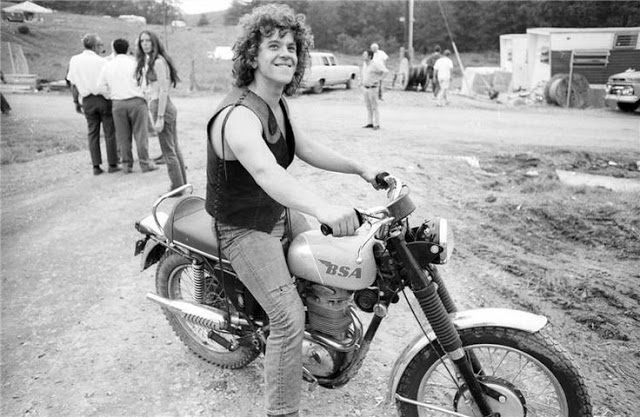
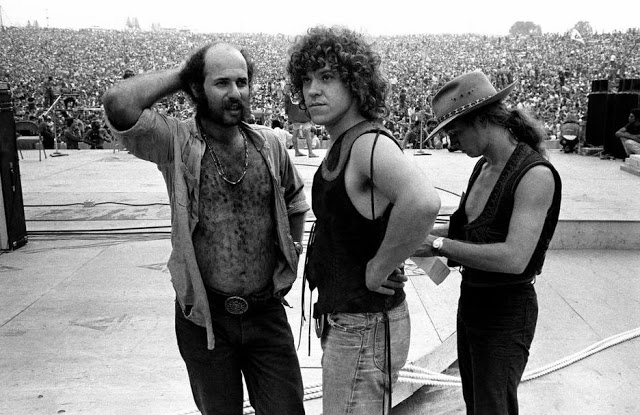
The festival was organized in six months by Michael Lang, John Roberts, Joel Rosenman, and Artie Kornfield.

Michael Lang aboard his BSA. The easiest way to get around the festival grounds.

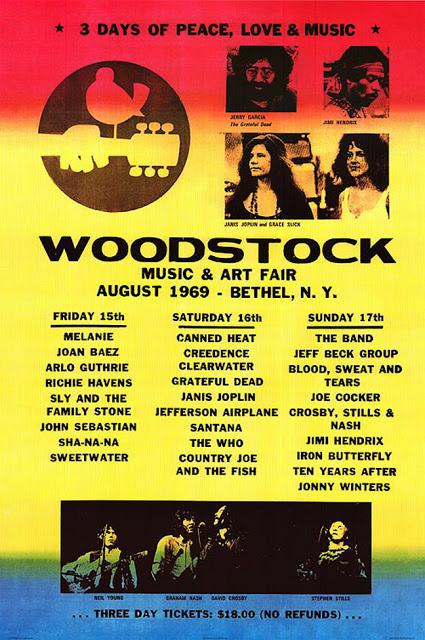
There was a total of 32 bands who performed under the sun, beneath the stars, and in the rain.

Woodstock line-up music poster.

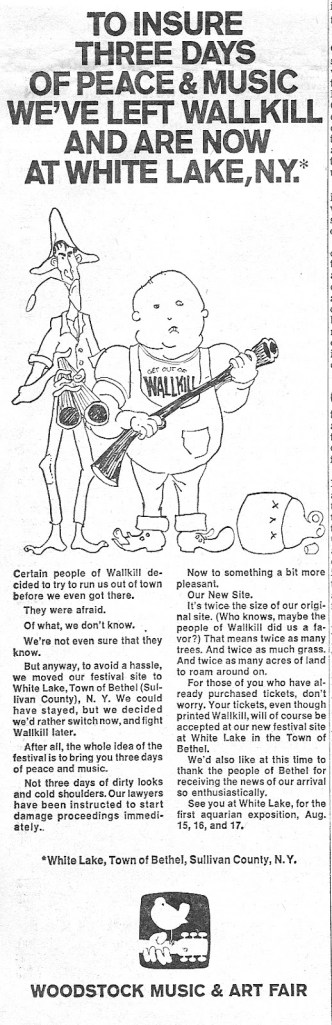
The festival was originally scheduled to take place in Woodstock, NY but since there weren’t any suitable ground sites, it was moved to a town called Wallkill.

Michael Lang festival organiser and his crew

Wallkill then decided they didn’t want a sea of drugged-out hippies in their town, so they enforced a law that banned the festival from happening.

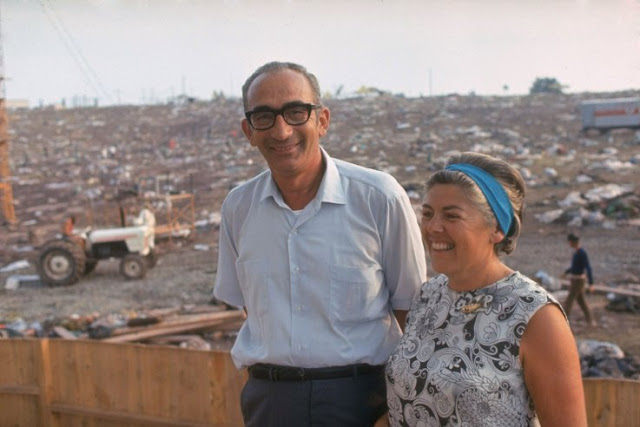
In mid-July, only a month before the festival, Max Yasgur offered his dairy farm in Bethel, NY to be the official location for the Woodstock Music & Arts Fair.

Max & Miriam Yasgur, owners of the farm Woodstock was held on. Photo taken at their farm on the day after Woodstock.

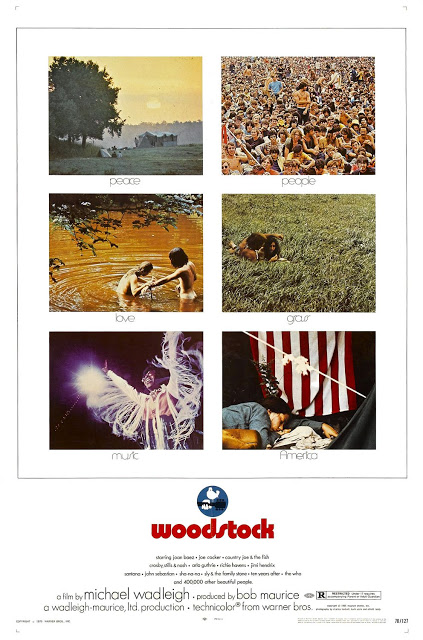
The Woodstock Festival was released as a documentary in 1970 and was a great commercial success. It won the Academy Award for Best Documentary Feature.

Woodstock movie poster (1970)
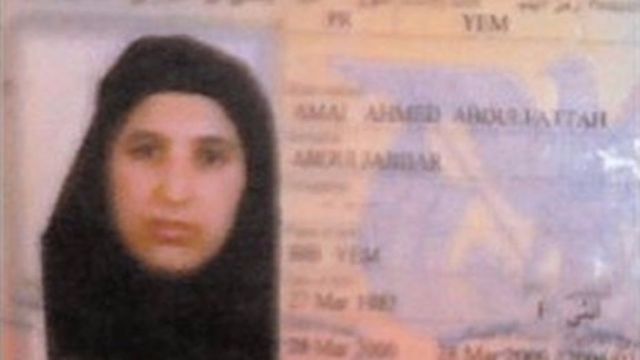
A live album of the concert was also released in 1970.

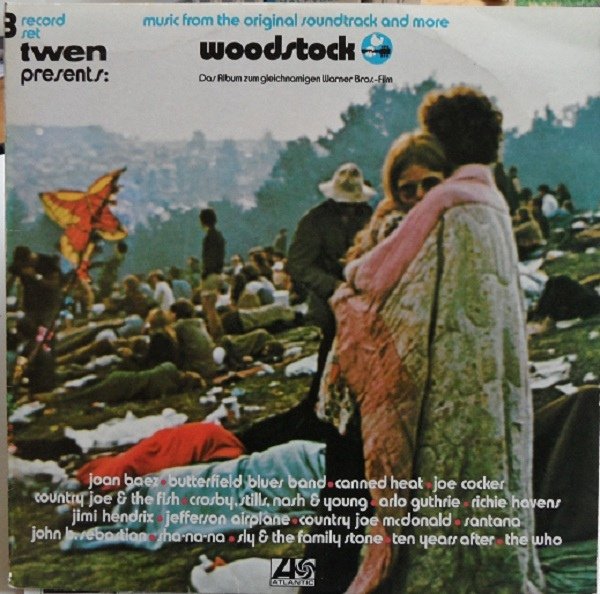
Woodstock album cover

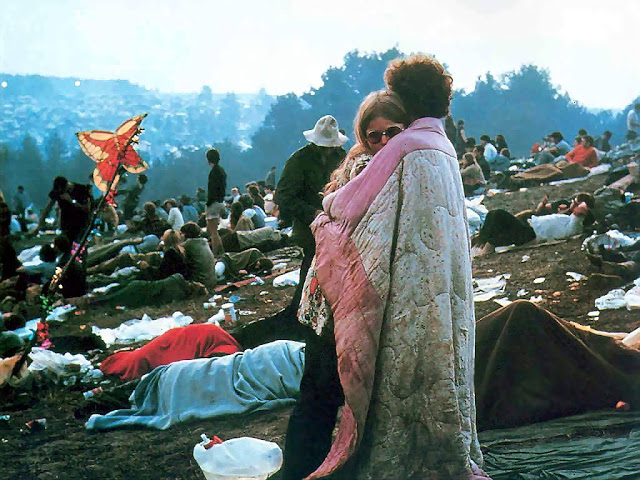
The couple featured on Woodstock’s live album cover, Nick and Bobbi Ercoline, are married.

Nick and Bobbi Ercoline

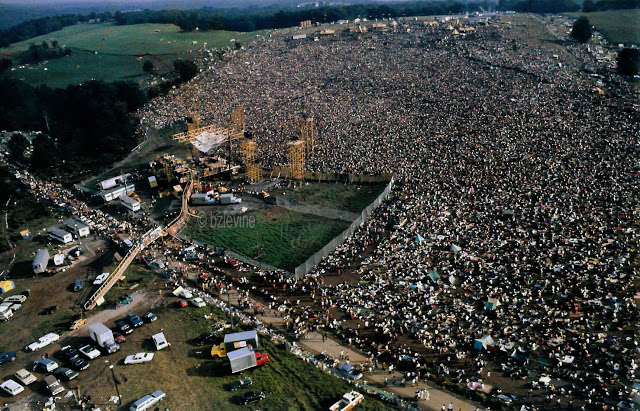
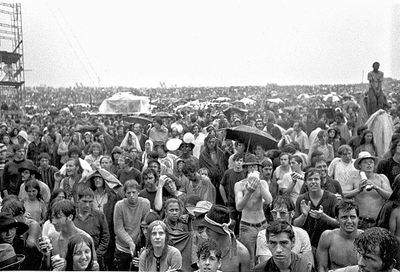
An estimated number of 400,000 people attended the Woodstock Music & Arts Fair.

View from the helicopter by Woodstock photographer Barry Z Levine.

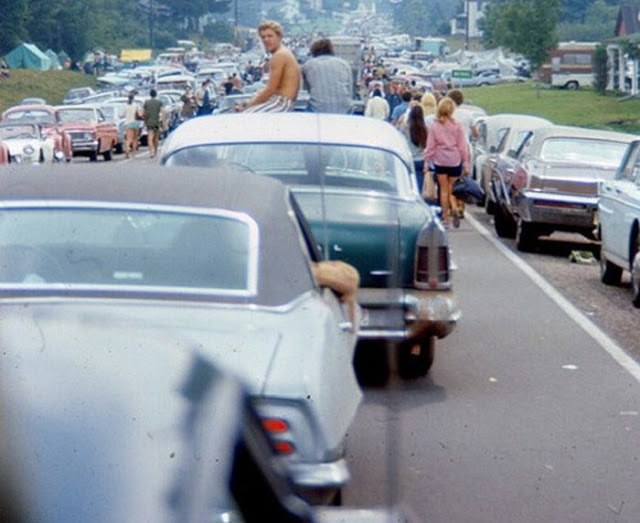
The thousands of flower children who flooded Bethel created a huge traffic jam.

On the road to Woodstock, 1969.

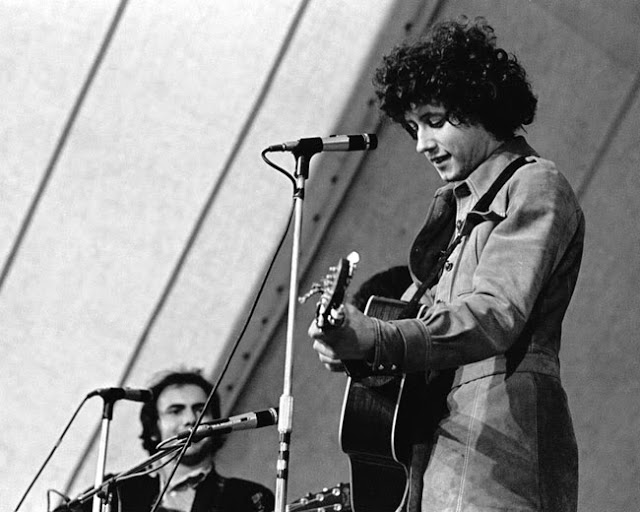
Arlo Guthrie announced during his set that the New York State Thruway was officially closed.

Arlo Guthrie performing at Woodstock Aug 15, 1969. He was the 7th performer on the first day of Woodstock.

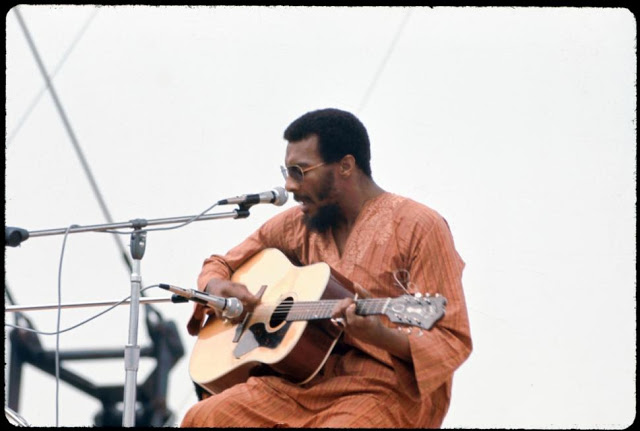
Richie Havens wasn’t supposed to be the opening act, but the bands that were initially scheduled were late because of traffic. Richie improvised a song that would be forever associated with the Woodstock Festival: “Freedom.”

Richie Havens performs his legendary set at at Woodstock in 1969.

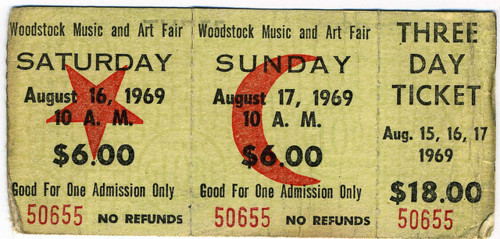
Tickets for the three day event were sold for $18 in advance and $24 at the site. But due to the unexpected invasion of flower children, the festival became free.

Woodstock tickets

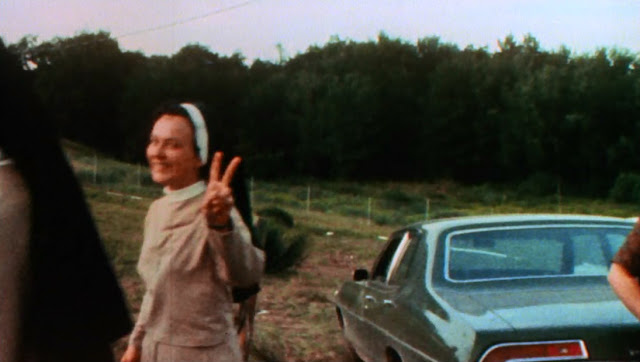
A Jewish Community made 200 sandwiches for the attendees. These hearty sandwiches, served with pickles, were handed out by nuns.

A nun at Woodstock 1969.

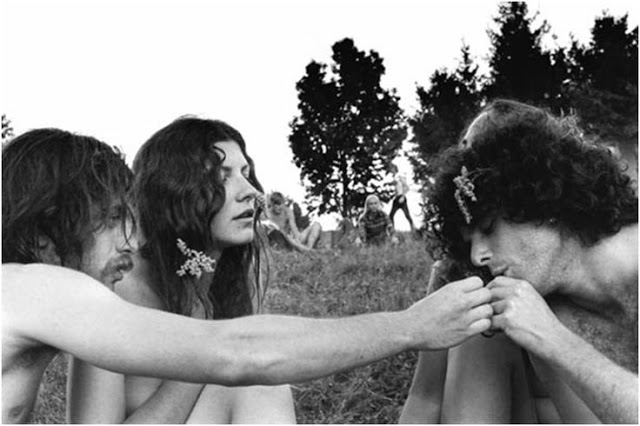
90% of concert-goers smoked marijuana.

Hippies smoking weed at the 1969 Woodstock Festival.

These groovy signs were made so attendees wouldn’t get lost.

Sign “Gentle Path / Groovy Way / High Way”

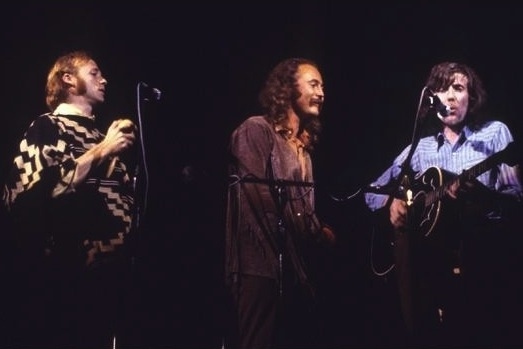
Neil Young refused to be filmed for the movie while performing with Crosby, Stills & Nash.

Crosby, Stills & Nash at Woodstock

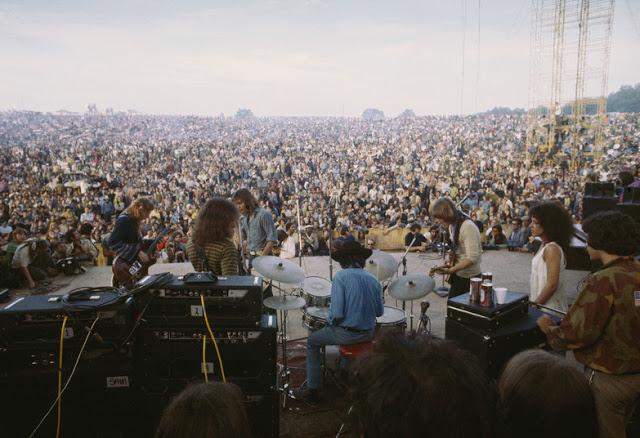
Jefferson Airplane demanded $12,000 for their set, and The Who, Janis Joplin, and the Grateful Dead also wouldn’t perform until they were paid.

Woodstock Jefferson Airplane crowd scene

Joni Mitchell was set to perform at the festival, but her manager advised her to stay back and appear on The Dick Cavett Show the next day.

Joni Mitchell in 1969

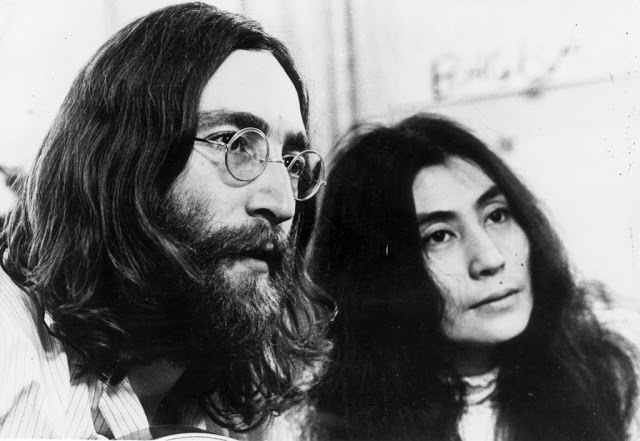
John Lennon had an interest in performing at Woodstock, but he told organizers his entry into the U.S. was denied by President Nixon.

John Lennon and Yoko Ono

There was a total of 80 lawsuits against Michael Lang and the organizers, which were eventually paid off from the Woodstock film.

There was a notorious thunderstorm toward the middle of the weekend, in which attendees chanted “No rain, no rain” to stop the rain fall.

Woodstock rain

Jimi Hendrix closed the event on Monday morning, performing a two-hour set. By then there were only 30,000 attendees because of the rain.

Rare Vintage Photos Capture Student Life at the World’s First Medical College for Women From the Late 19th Century

Subscribe to continue reading

Become a paid subscriber to get access to the rest of this post and other exclusive content.

How “White Death” Simo Häyhä Became The Deadliest Sniper In History

Simo Häyhä has the most confirmed kills of any sniper on record — and he endured astonishing conditions to earn that title.

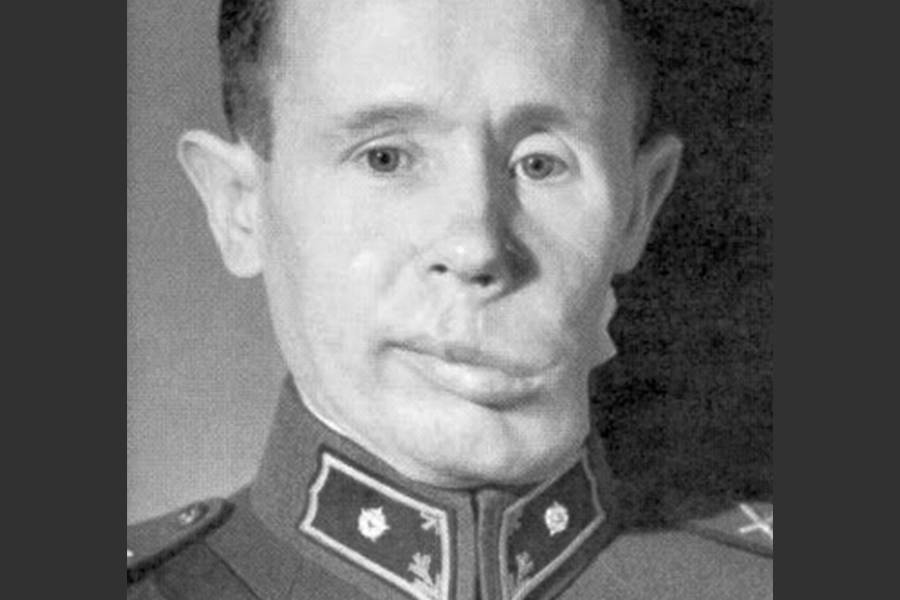
Simo Häyhä, after the war. His face was scarred by his wartime injury.

At the dawn of World War II in 1939, Josef Stalin sent over half a million men across Russia’s western border to invade Finland. It was a move that would cost tens of thousands of lives — and it was the beginning of the legend of Simo Häyhä.

For three months, the two countries fought in the Winter War, and in an unexpected turn of events, Finland — the underdog — emerged victorious.

The defeat was a stunning blow to Russia. Stalin, upon invading, had believed that Finland was an easy mark. His reasoning was sound; after all, the numbers were decidedly in his favor.

The Russian army marched into Finland with roughly 750,000 soldiers, while Finland’s army was just 300,000 strong. The the smaller Nordic nation had just a handful of tanks and a little over 100 aircraft.

The Russians, by contrast, had nearly double everything, with almost 6,000 tanks and over 3,000 aircraft. It seemed there was simply no way they would lose.

But the Finnish had something that the Russians didn’t: a diminutive farmer-turned-sniper named Simo Häyhä.

Simo Häyhä Becomes The White Death

Simo Häyhä and his new rifle, a gift from the Finish army.

Standing just five feet tall, the mild-mannered Häyhä was far from intimidating and actually quite easy to overlook, which is perhaps what made him so suited for sniping.

As many citizens did, he completed his requisite year of military service when he was 20, and then he returned to his quiet life of farming, skiing, and hunting small game. He was noted in his small community for his ability to shoot, and he liked to enter competitions in his free time — but his real test was yet to come.

When Stalin’s troops invaded, as a former military man, Häyhä was called into action. Before reporting for duty, he pulled his old gun out of storage. It was an antique, Russian-made rifle, a bare-bones model with no telescopic lens.

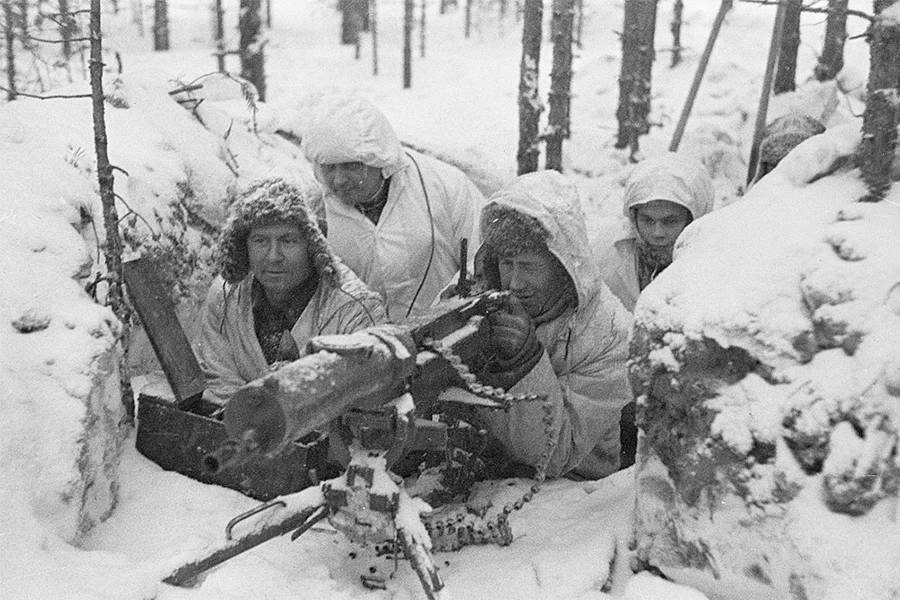
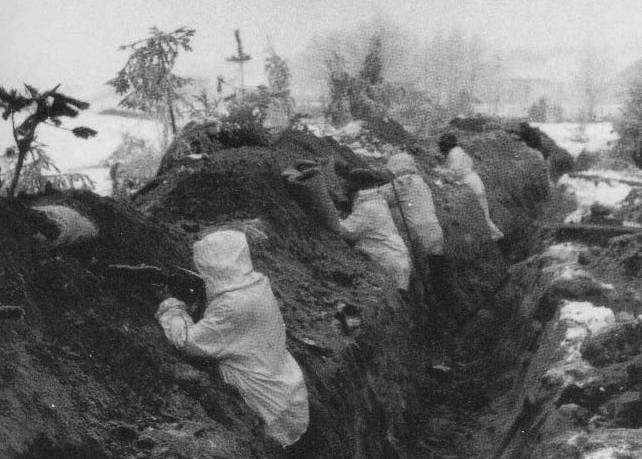
Along with his fellow Finnish military men, Häyhä was given heavy, all-white camouflage, a necessity in the snow that blanketed the landscape several feet deep. Wrapped from head to toe, the soldiers could blend into snowbanks without a problem.

Armed with his trusty rifle and his white suit, Häyhä did what he did best. Preferring to work alone, he supplied himself with a day’s worth of food and several clips of ammunition, then snuck quietly through the woods. Once he found a spot with good visibility, he would lie in wait for the Russians to stumble across his path.

And stumble they did.

Simo Häyhä’s Winter War

Finnish snipers hiding behind snowbanks in a fox hole.

Over the course of the Winter War, which lasted roughly 100 days, Häyhä killed between 500 and 542 Russian soldiers, all with his antiquated rifle. While his comrades were using state-of-the-art telescopic lenses to zoom in on their targets, Häyhä was fighting with an iron sight, which he felt gave him a more precise target.

He also noted that several targets had been tipped off by the glint of light on the newer sniper lenses, and he was determined not to go down that way.

He’d also developed an almost foolproof way of not being sighted.

On top of his white camouflage, he would build up snow drifts around his position to further obscure himself. The snow banks also served as padding for his rifle and prevented the force of his gunshots from stirring up a puff of snow that an enemy could use to locate him.

As he lay on the ground in wait, he would hold snow in his mouth to stop his steamy breaths from betraying his position.

Häyhä’s strategy kept him alive, but his missions were never easy. For one, conditions were brutal. The days were short, and when the sun set, temperatures rarely rose above freezing.

A Near-Miss As The War Draws To A Close

The Russian trenches were full of Simo Häyhä’s enemies — and it was only a matter of time before he was caught.

Before long, Häyhä had gained a reputation among the Russians as the “White Death,” the tiny sniper who lay in wait and could hardly be seen in the snow.

He also gained a reputation among the Finnish people: the White Death was frequently the subject of Finnish propaganda, and in the people’s minds, he became a legend, a guardian spirit who could move like a ghost through the snow.

When the Finnish High Command heard about Häyhä’s skill, they presented him with a gift: a brand-new, custom-built sniper rifle.

Unfortunately, 11 days before the Winter War ended, Simo Häyhä was finally struck. A Soviet soldier caught sight of him and shot him in the jaw, landing him in a coma for 11 days. He awoke as the peace treaties were being drawn up with half of his face missing.

However, the injury hardly slowed Simo Häyhä down. Though it did take several years to come back from being hit in the jaw with explosive ammunition, he eventually made a full recovery and lived to the ripe old age of 96.

In the years after the war, he continued to use his sniping skills and became a successful moose hunter, regularly attending hunting trips with Finnish president Urho Kekkonen.

50 Amazing Vintage Photos From the 1960s Volume 4

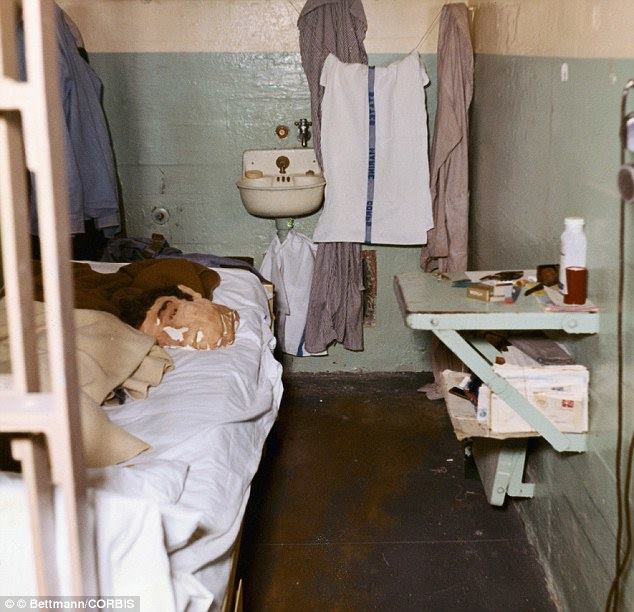
Dummy head used by John Anglin to fool prison guards while he and two other convicts escaped Alcatraz. 1962.
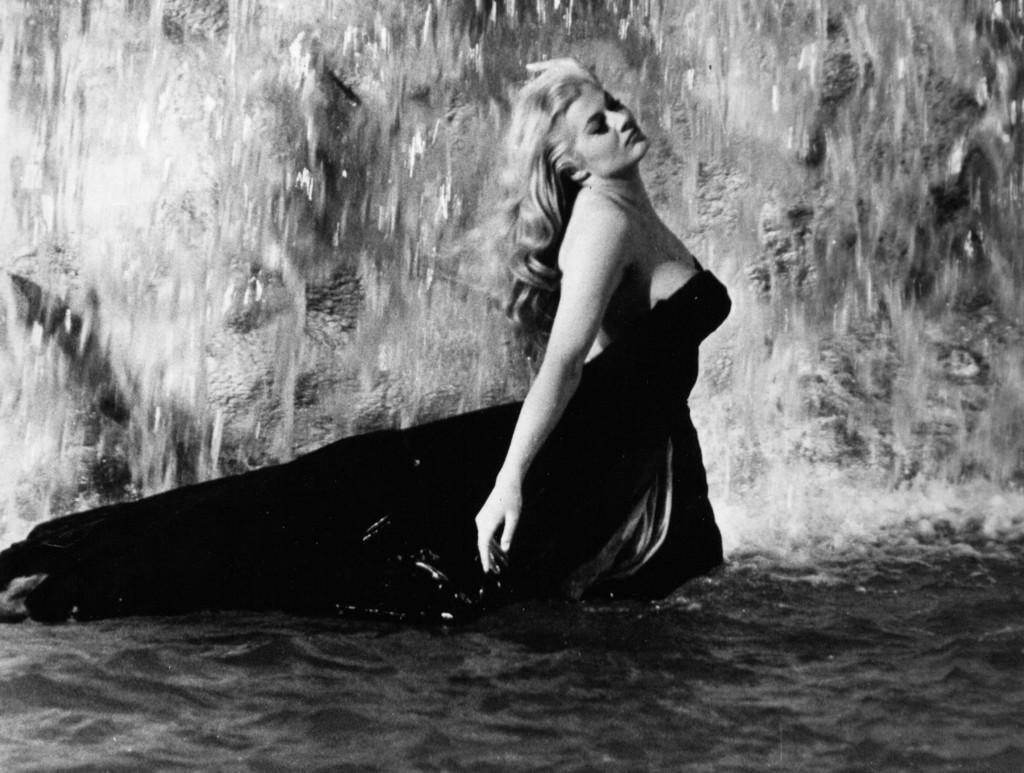
Anita Ekberg, 1960
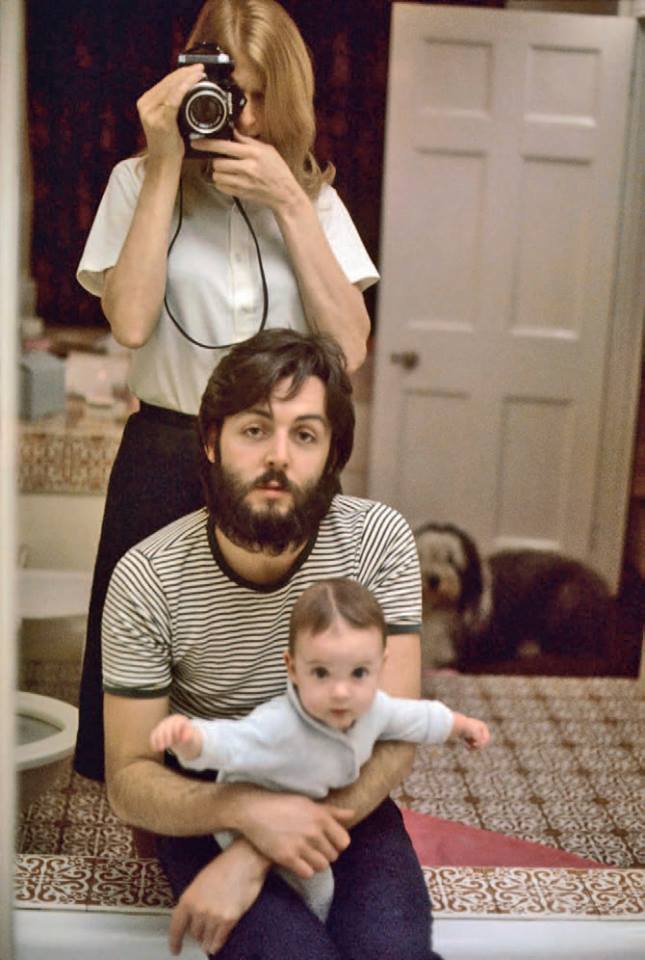
A Self-portrait of Linda, Paul and Mary McCartney, 1969.
John & Julian Lennon and George Harrison at home in 1965.
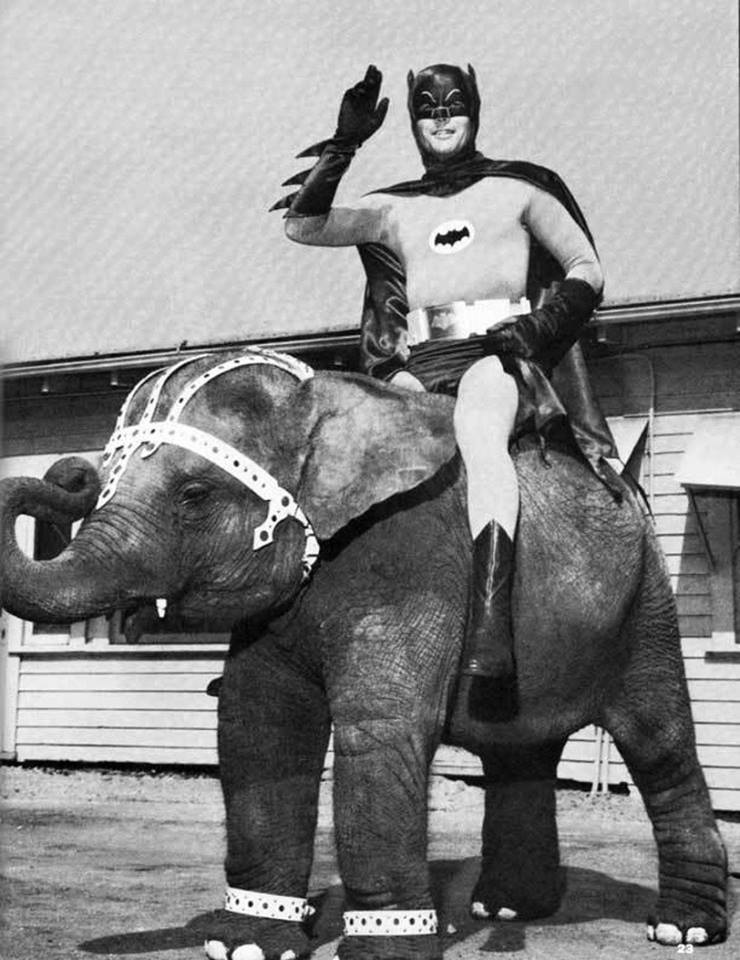
Batman riding a small elephant, 1967.
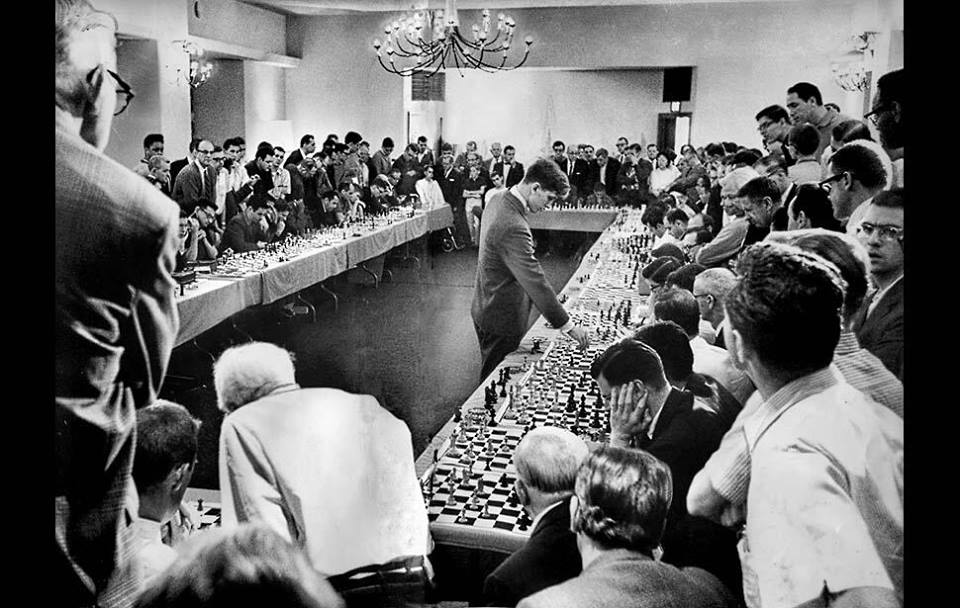
1964 U.S. chess prodigy Bobby Fisher playing 50 opponents at once. He won 47, lost 1, and drew 2. 1964
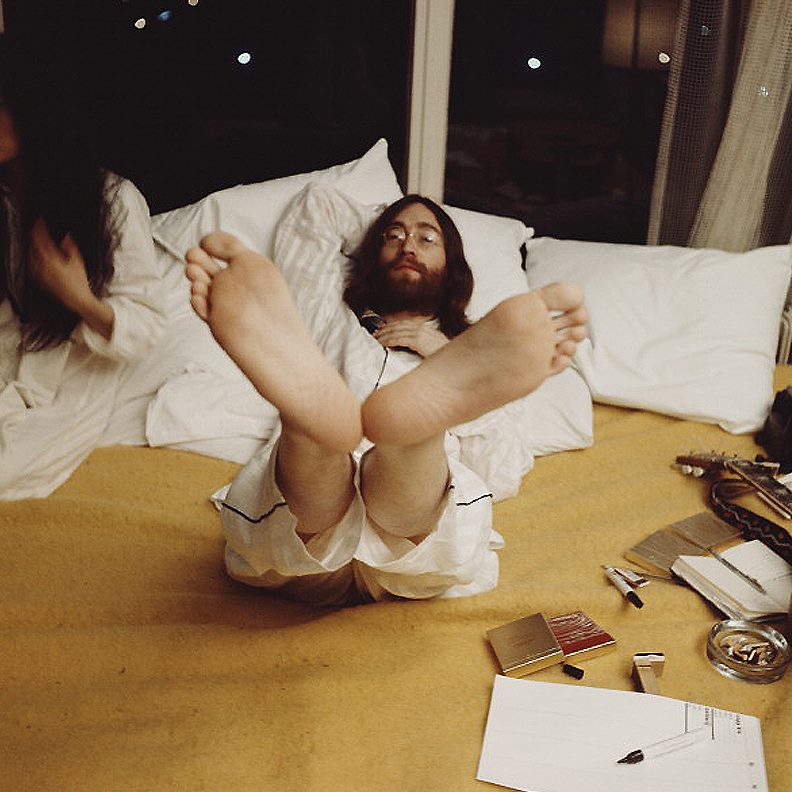
John Lennon and Yoko Ono’s Bed-In for Peace, 1969.
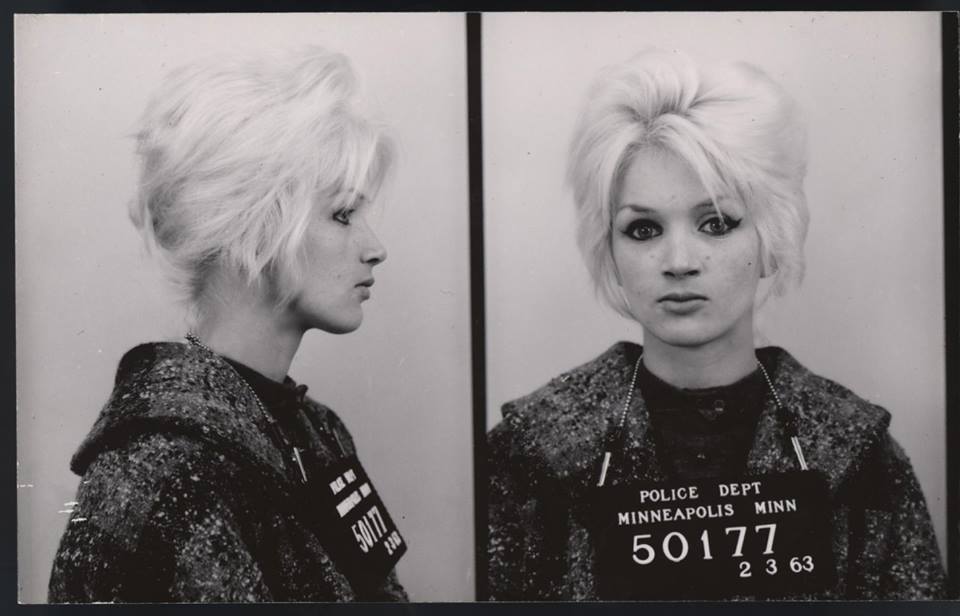
A woman with bleach-blonde hair and a stylish coat is a captured in a mugshot from Minneapolis, Minnesota, in 1963
Bratsk, Russia, 1967.
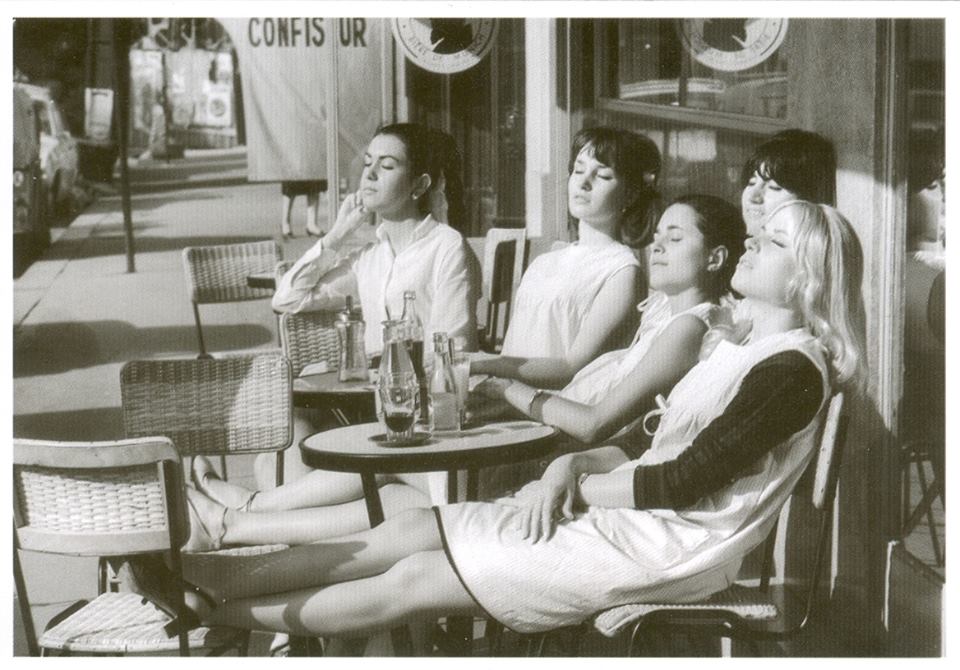
Hairdressers in the sunshine, Paris, 1966.
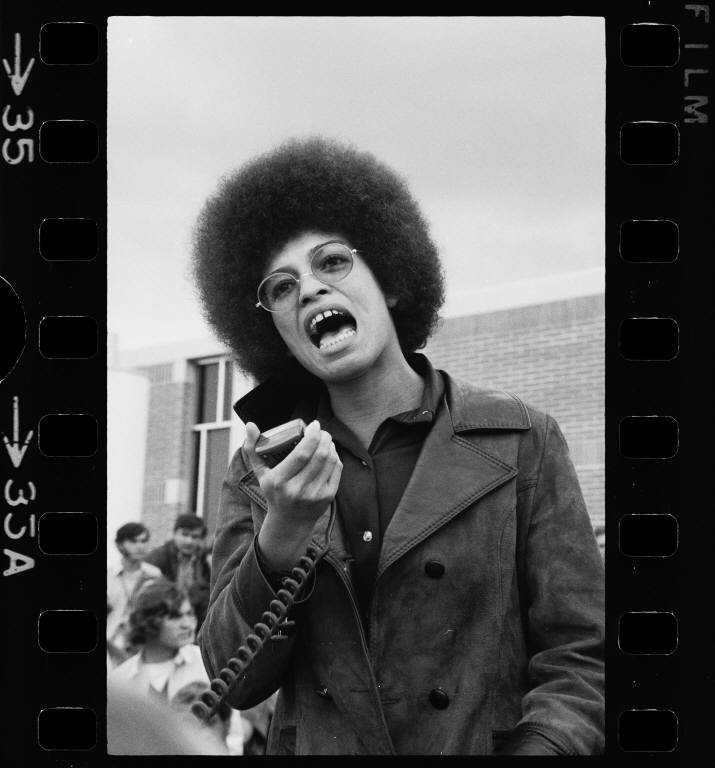
Angela Davis, 1960s
Photo Shoot for Vogue, January 1963.
Brigitte Bardot and Sean Connery on the set of “Shalako”, 1968.
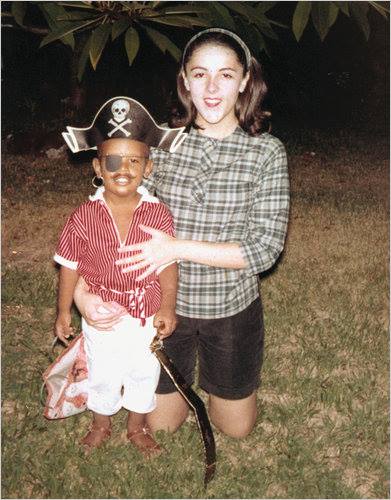
A young Barack Obama dressed up as a pirate with his late mother Ann Dunham in Hawaii, 1960s.
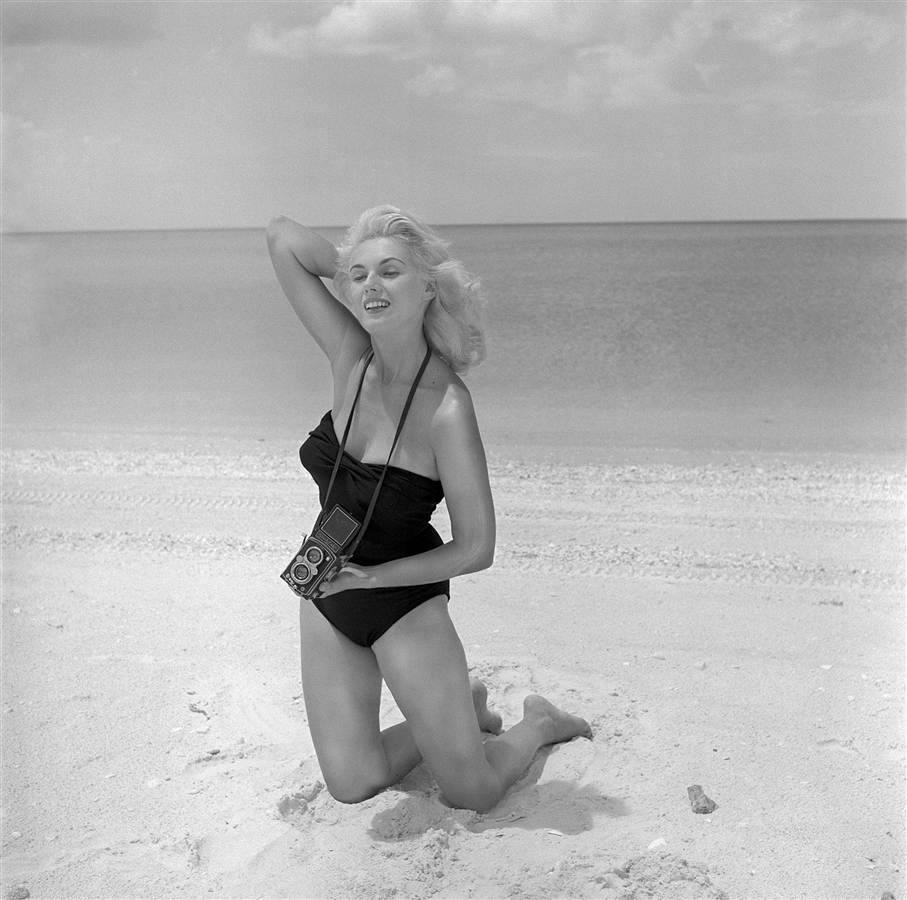
Bunny Yeager poses for a self portrait in Naples, Fla., in 1960.
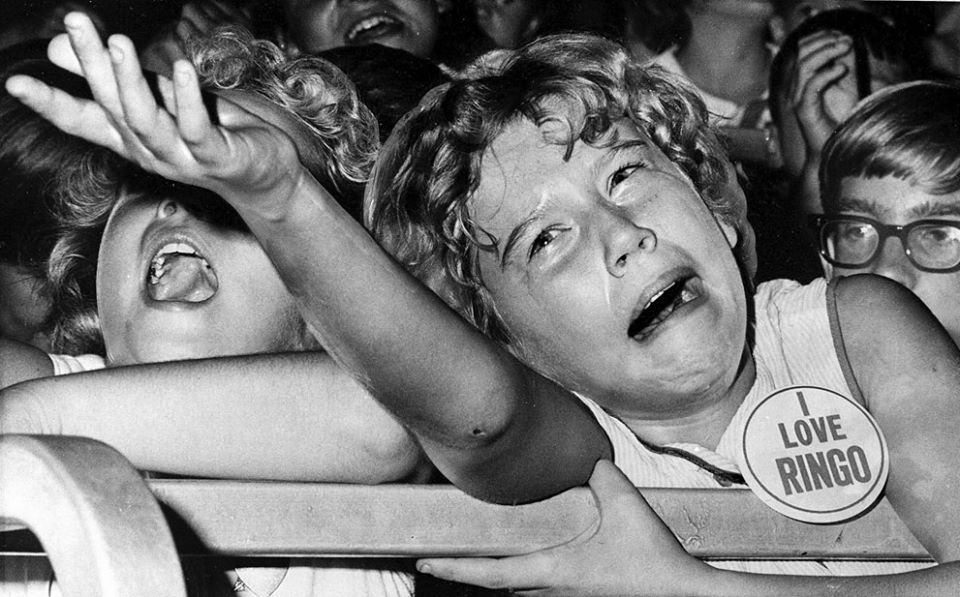
Beatles Fans, 1960s
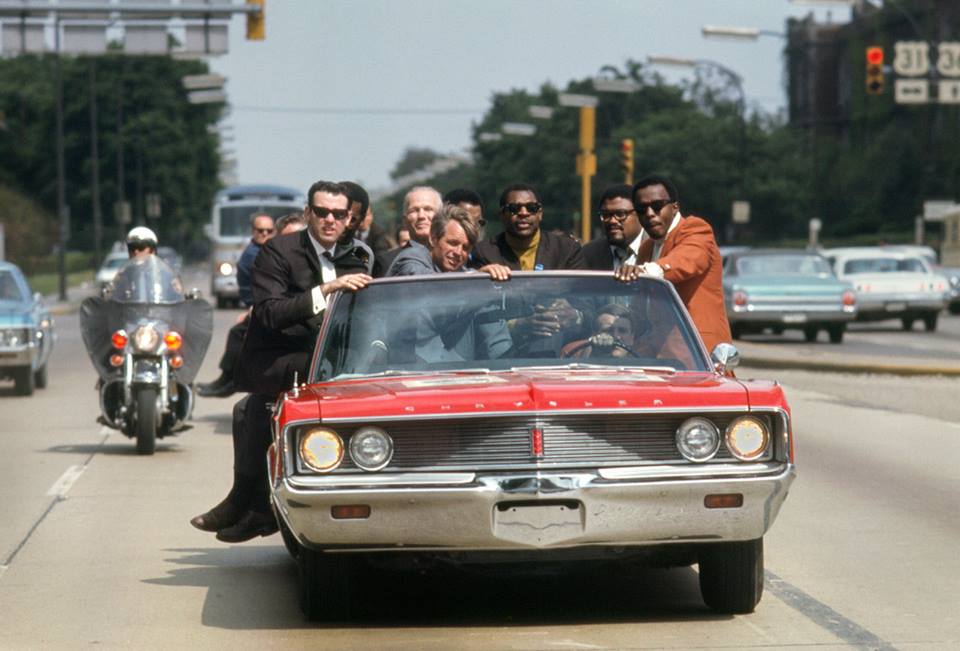
Bobby Kennedy campaigns in Indianapolis during May of 1968, with various aides and friends.
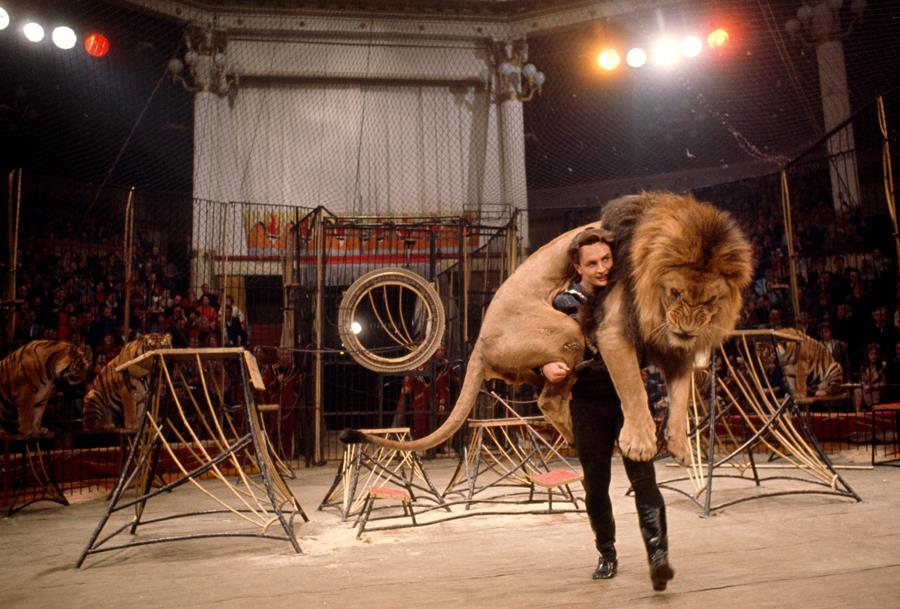
Bengal tigers crouch as animal trainer carries a 300-pound lion in Moscow, 1966.
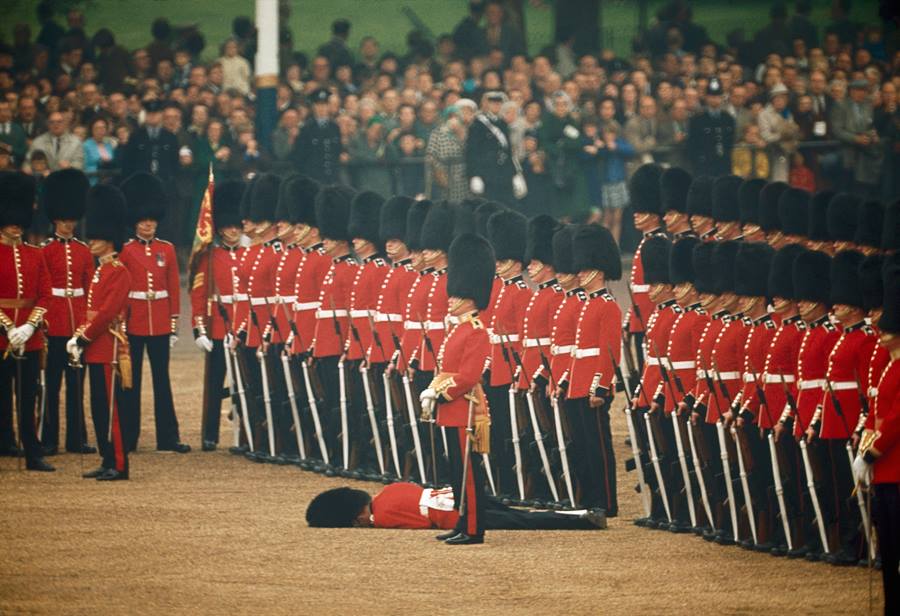
Irish Guards remain at attention after one guardsman faints in London, England, June 1966.
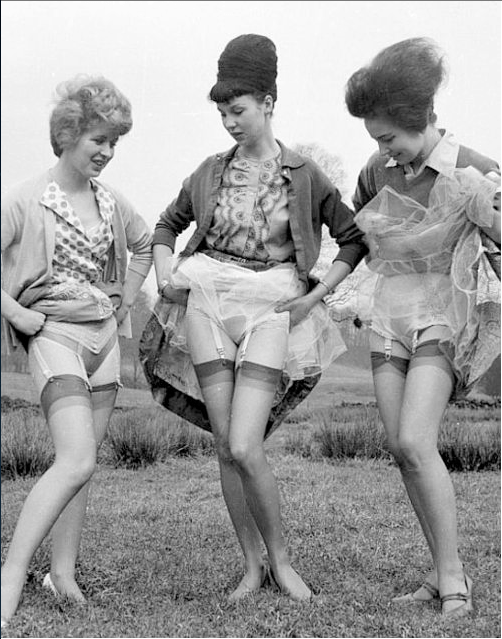
Girls showing their knickers, 1960s
A crowded cable trolley descends a cobblestone street in Lisbon, Portugal, 1965.
Two Americans car surfing during a flash flood in Mexico, 1967.
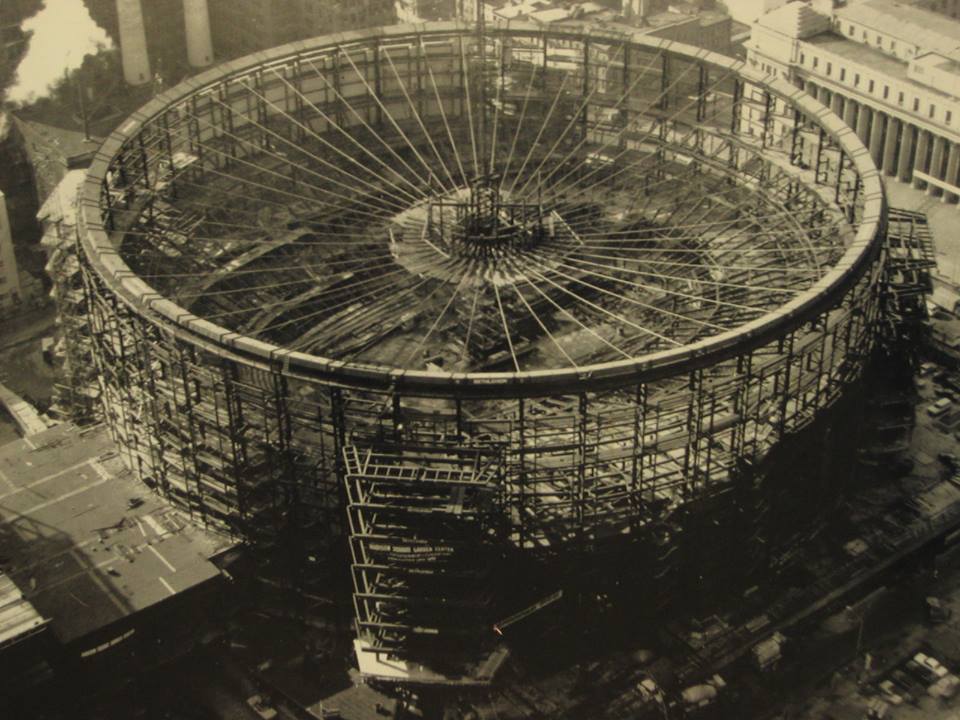
Madison Square Garden during construction, 1966.
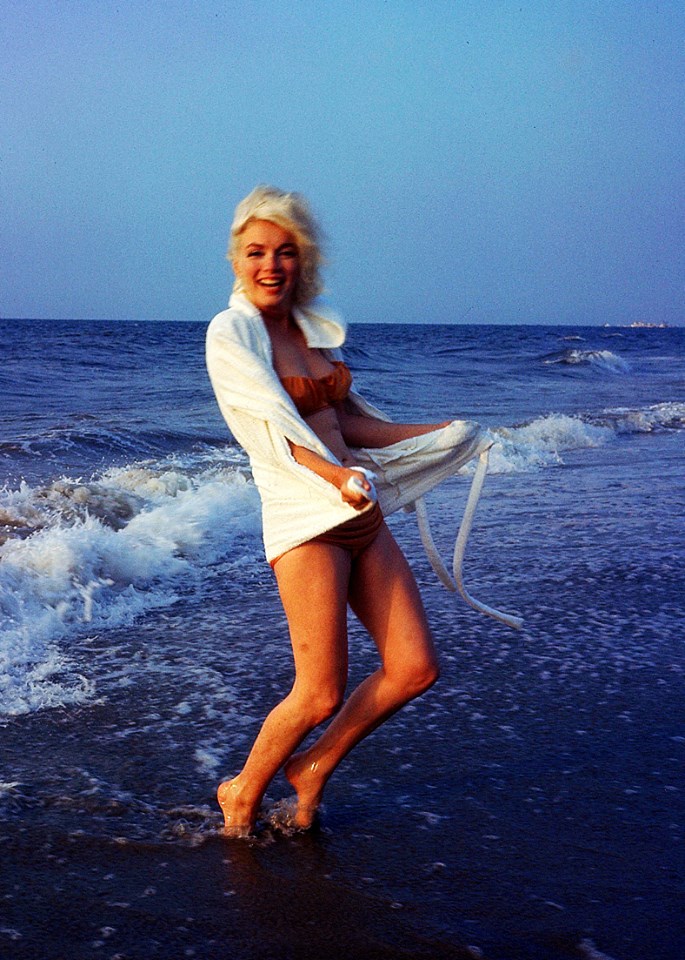
Marilyn Monroe, 1962
Brigitte Bardot in “A Very Private Affair”, 1961.
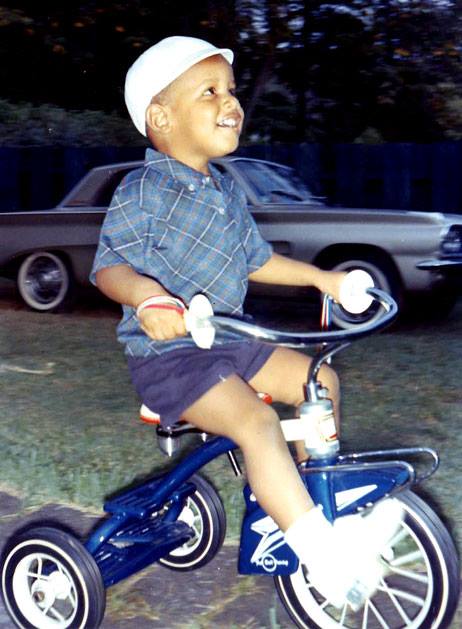
A young Barack Obama riding a tricycle during the early years in Hawaii, in the 1960s.
Paul Newman, Venice, Italy, 1963
James Brown, 1967
Mia Farrow in London during the mid-60s
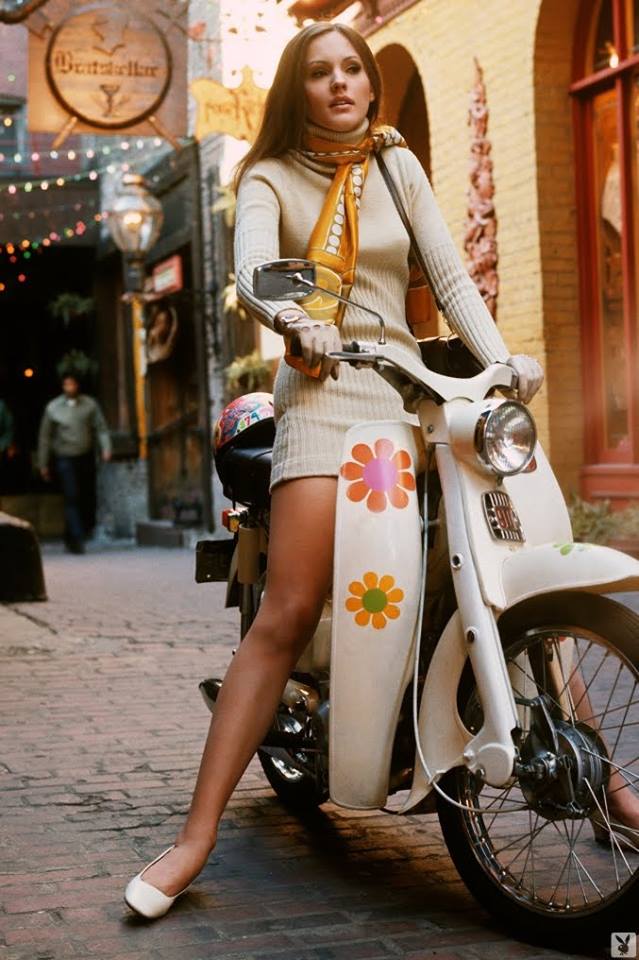
Girl on a Scooter, 1969.
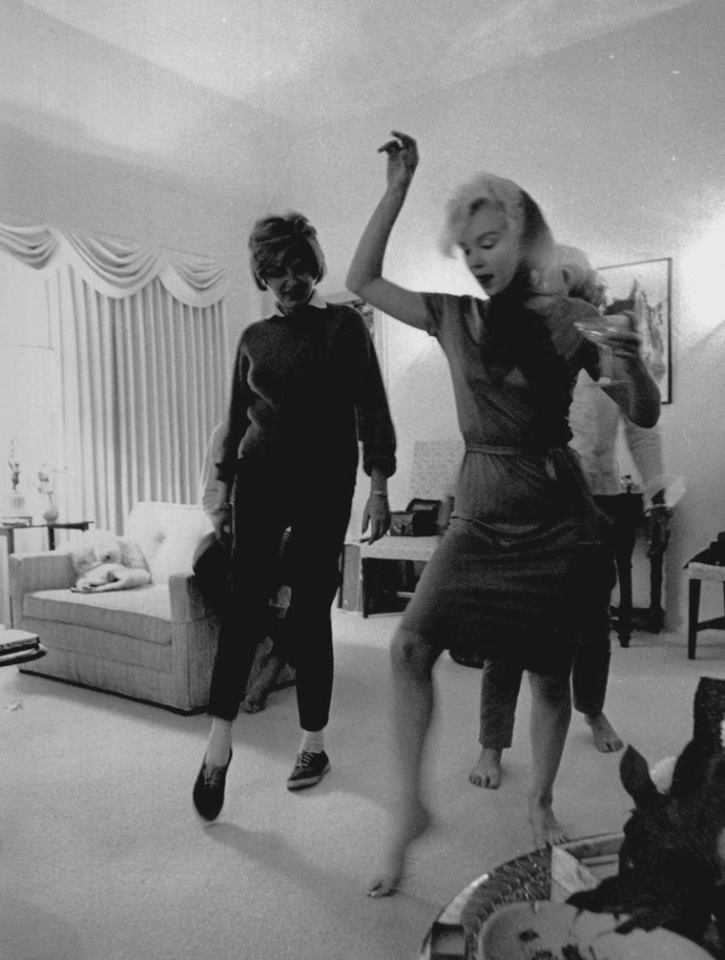
Marilyn Monroe teaching Pat Kennedy Lawford how to dance the “Swing” in 1962.
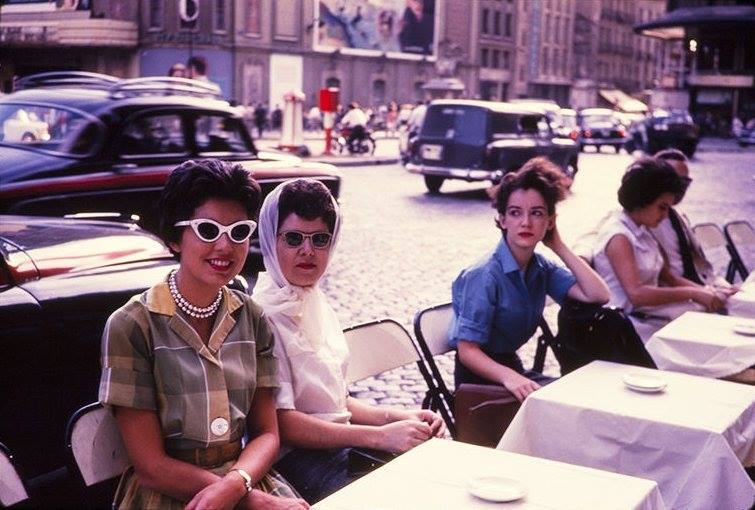
Ladies from 1962.
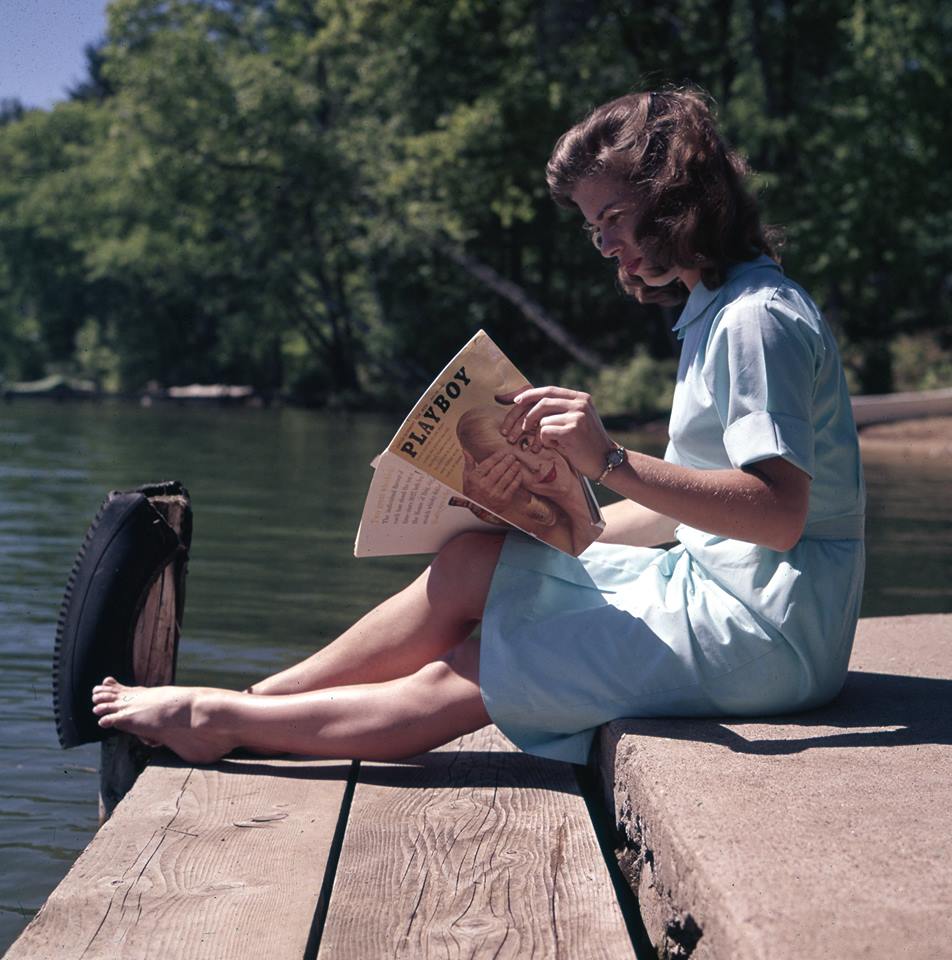
Reading Playboy, 1960s
The entrance to Disneyland in 1965, when parking was only $0.25.
Lee Radziwill and Jackie Kennedy on the Almafi Coast, 1962.
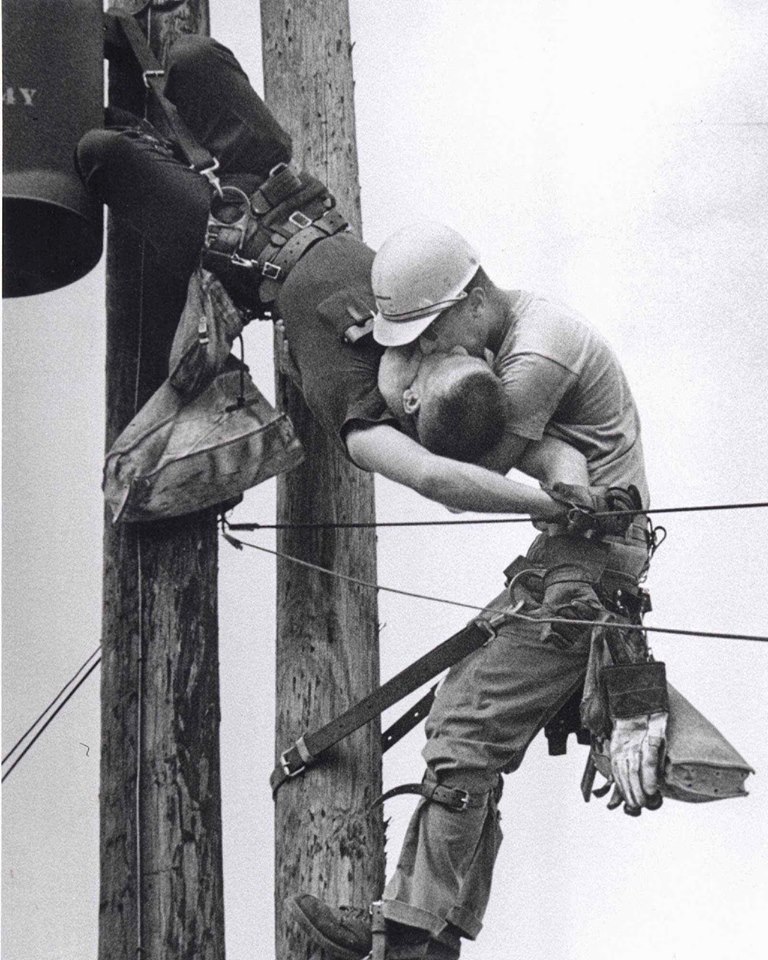
The Kiss of Life, 1967.
Residents of West Berlin show children to their grandparents who reside on the Eastern side, 1961.
Ringo Starr kissing the mirror, 1965.
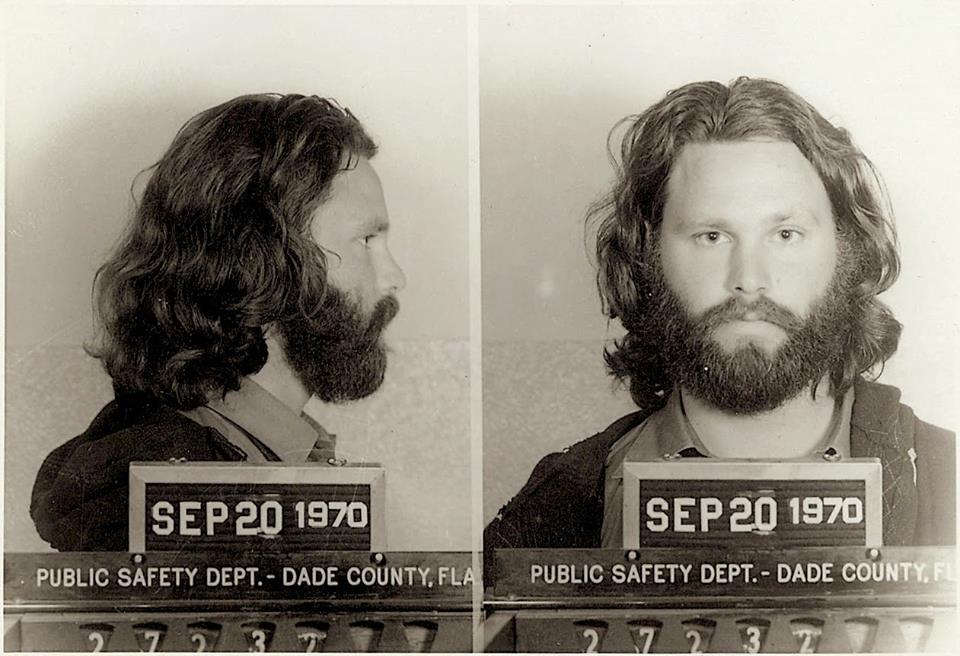
Jim Morrison arrest mugshot for warrant of exposing himself during a concert in Miami. March 1, 1969.
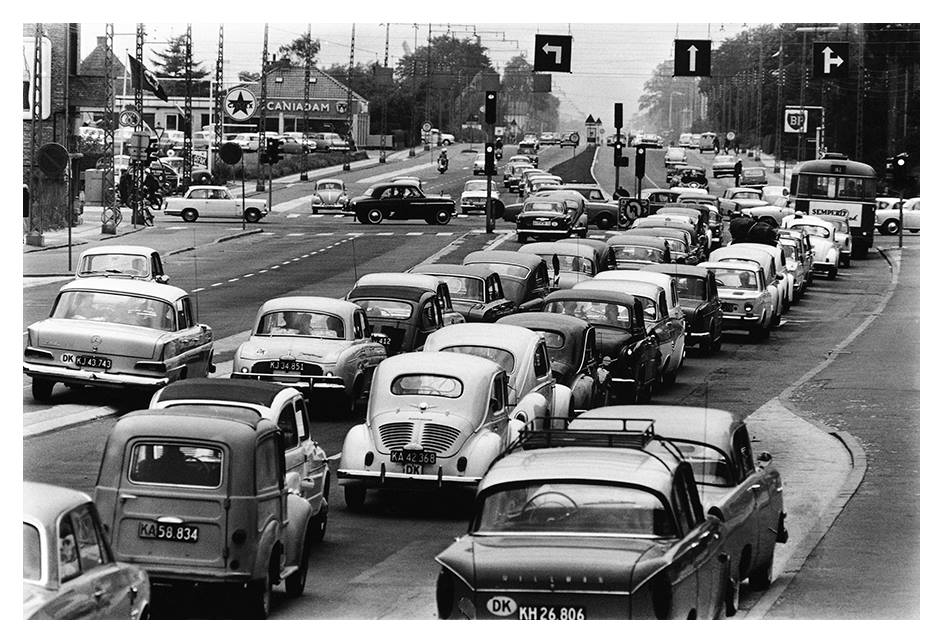
Rush hour in Copenhagen, 1963.
Brigitte Bardot, 1965
Enjoying some ice cream on King’s Road, London, August 1967.
Go-go boots, a piano, and a Christmas tree, 1960.
Mustang girl, 1969.
Harlem, New York City, 1964.
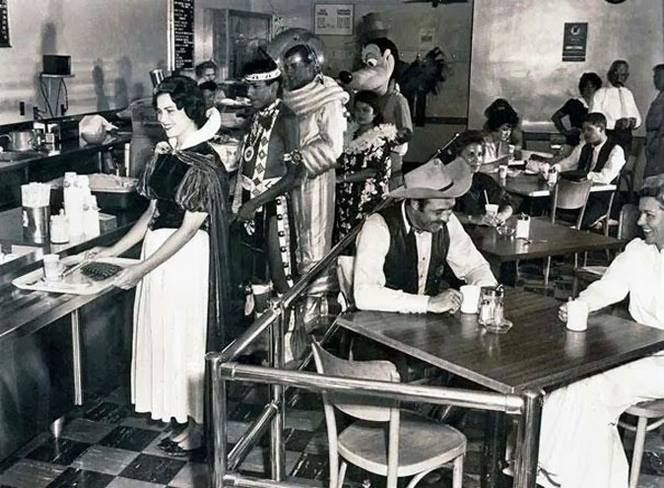
Disneyland employee cafeteria in 1961.
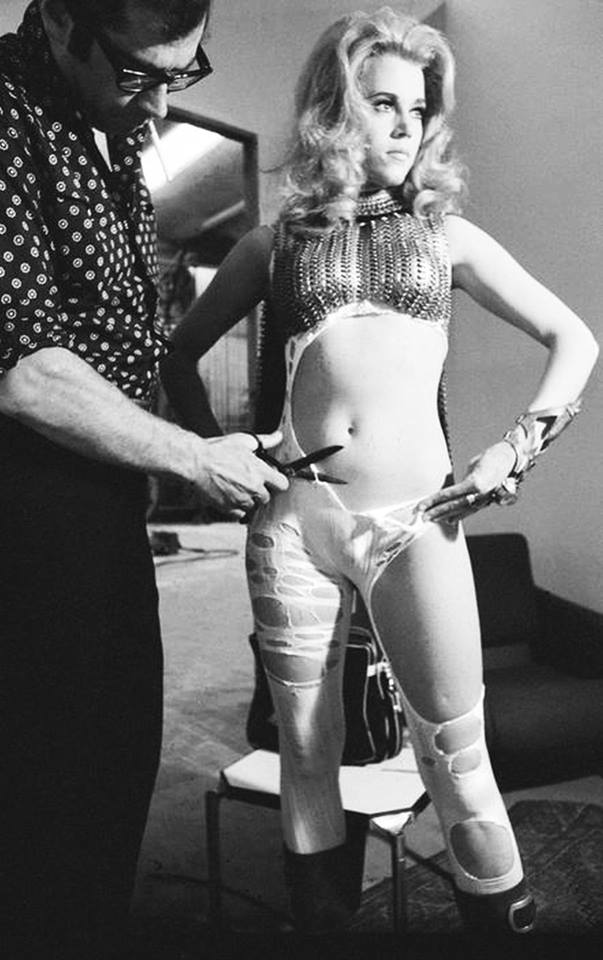
Roger Vadim preparing Jane Fonda’s outfit during the making film of Barbarella in 1967.
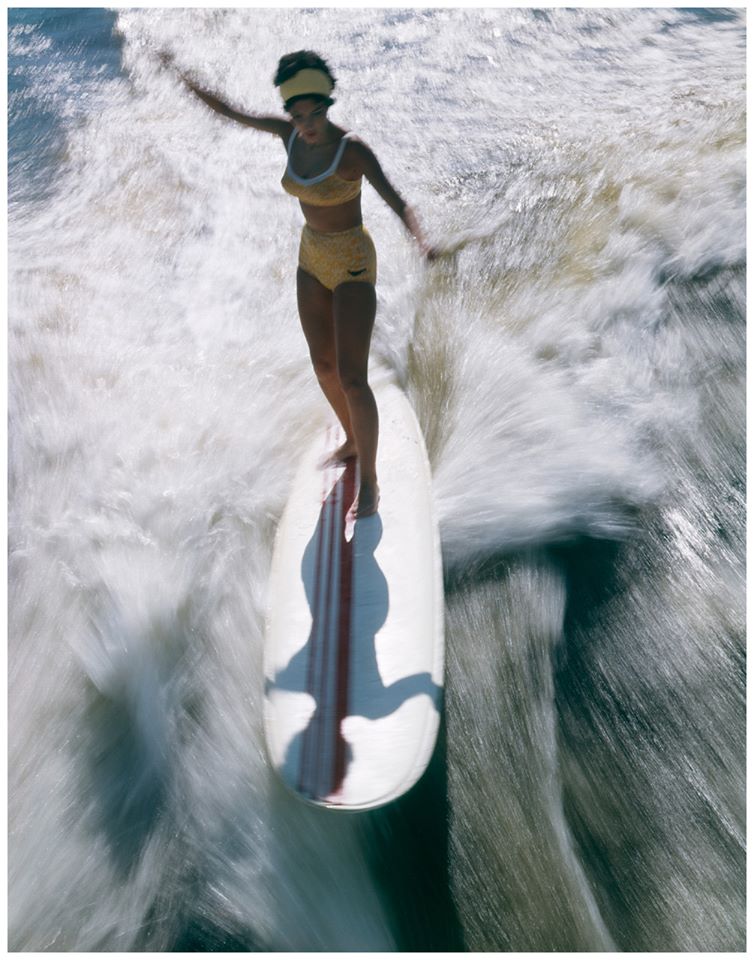
Woman in bathing suit standing balancing surfing on a surfboard, 1967.
Jimi Hendrix & Mick Jagger, New York, 1969.
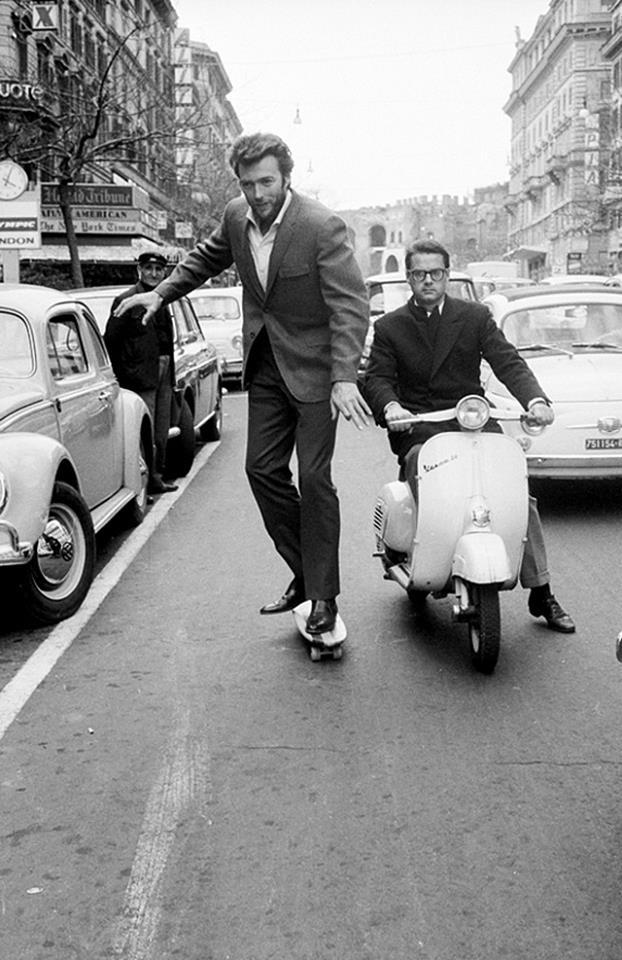
Clint Eastwood skatboarding on a street in Rome, 1960s.

33 Photos Of Lepke’s Murder Inc., The Mob’s Most Brutal Hit Squad

In the New York City of the 1930s, murder was big business. And the best killers in the industry were Murder Inc., a ring of murderers-for-hire working as mob enforcers who, in less than 10 years, killed an estimated 1,000 people.

Murder Inc. was formed by notorious Jewish-American gangsters Meyer Lansky and Benjamin “Bugsy” Siegel, and run by Louis “Lepke” Buchalter, a New York racketeer who figured out that he could make even more money contracting out killers to Sicilian mobsters. He set up shop inside of Rosie Gold’s Candy Store, a Brooklyn shop that catered to children through the front door and killers through the back.

A killer working for Lepke could count on $1,000 to $5,000 per job (as much as $70,000 today), depending on the target. Some made a small fortune off it. The hit squad’s most prolific killer, Harry Strauss, signed on for at least 100 jobs on his own, making enough to live comfortably for the rest of his life and single-handedly putting a minor dent in the population of New York City.

From Strauss on down, these killers were brutal. They didn’t just shoot their targets — they aimed to leave a message. They hacked up the bodies of their victims with meat cleavers and ice picks. One man was set on fire and left in a lot. Another was strapped to a slot machine and left in public view.

Murder Inc.’s reign of terror ran on like this throughout New York City until 1940. By then, they were so bold that they’d pull off their killings in broad daylight, sure that no one would even try to stop them.

Things came to an end, however, when one of their contract killers ratted them out to the police. Abraham “Kid Twist” Reles, a former Murder Inc. assassin, found himself in a police interrogation box, charged with multiple murders and realized the only way out was to tell the officers everything that they wanted to know about Lepke and his organization.

Working off of Reles’ tip, New York police arrested Lepke and some of his most prolific killers. The mob hitmen who’d terrorized the city were taken off the streets, most to face the electric chair in Sing Sing Prison in upstate New York.

After 10 years of tyranny and 1,000 body bags, Murder Inc. had come to an end.

But they didn’t go down without one last job. On November 12, 1941, the first day of the trial, Reles’ dead body was found outside his hotel room, crushed from a six-story fall out his hotel window. It was one last message from Murder Inc. — any canary who wanted to sing had better learn to fly.

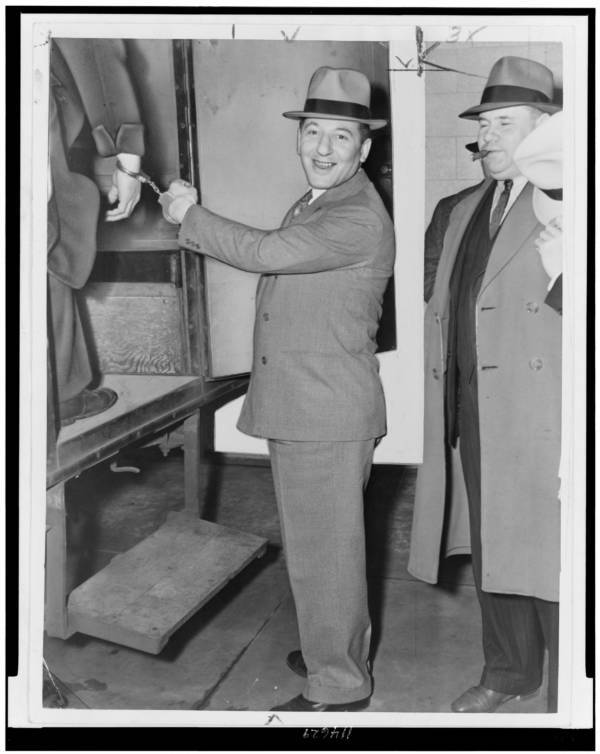
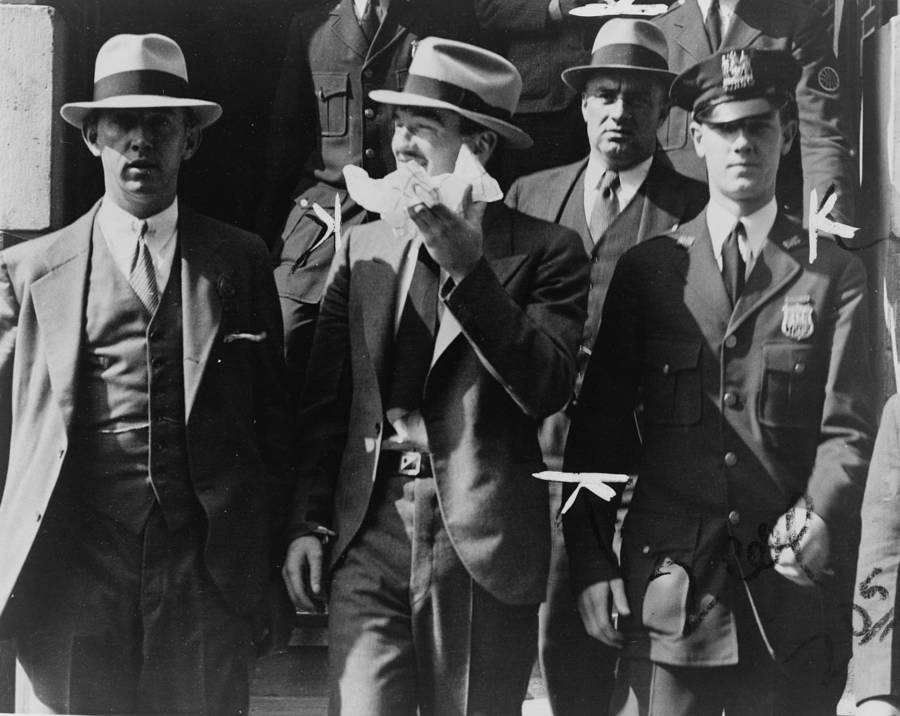
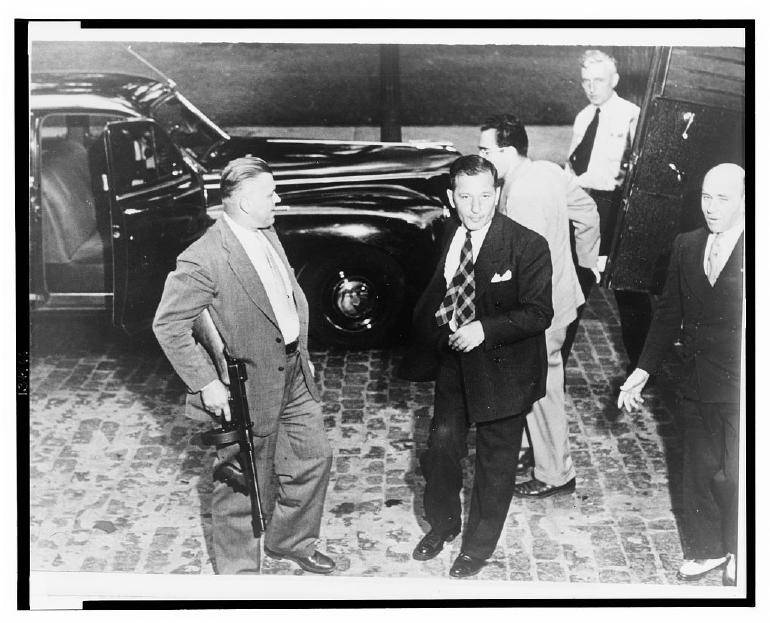
Louis “Lepke” Buchalter flashes a smile as he’s dragged, handcuffed, into a police van. New York City. 1939.
The burnt body of Irving Feinstein.
Feinstein was set on fire by Murder Inc. killers Harry Strauss and Martin Goldstein and left exposed in a lot.
New York City. October 5, 1938.
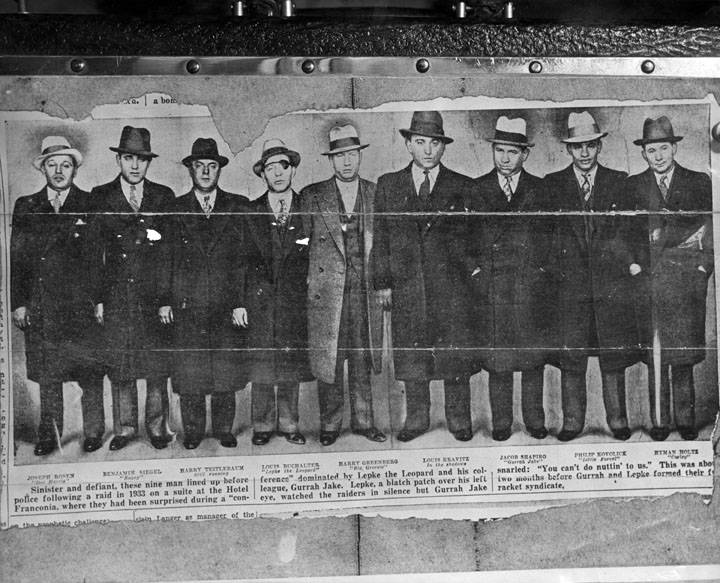
Nine of the most important men in Murder Inc. stand side-by-side in a police line-up.
While this photo was being taken, mobster Jacob “Gurrah” Shapiro was snarling at the police, “You can’t do nuttin’ to us.”
New York City. 1942.
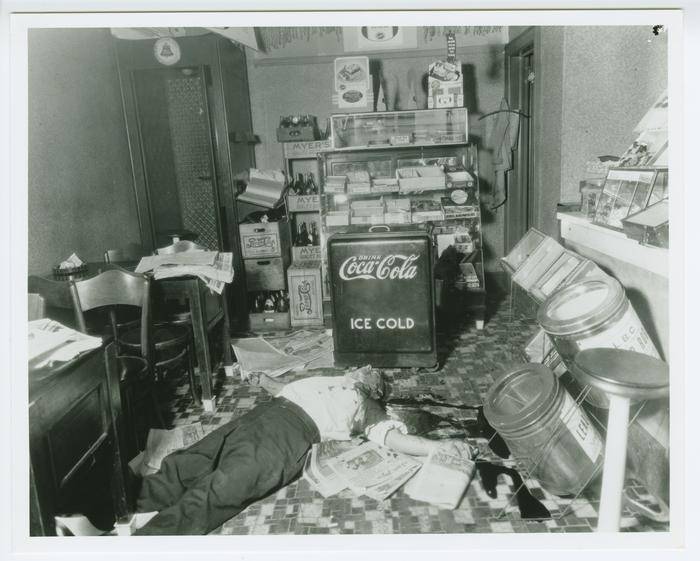
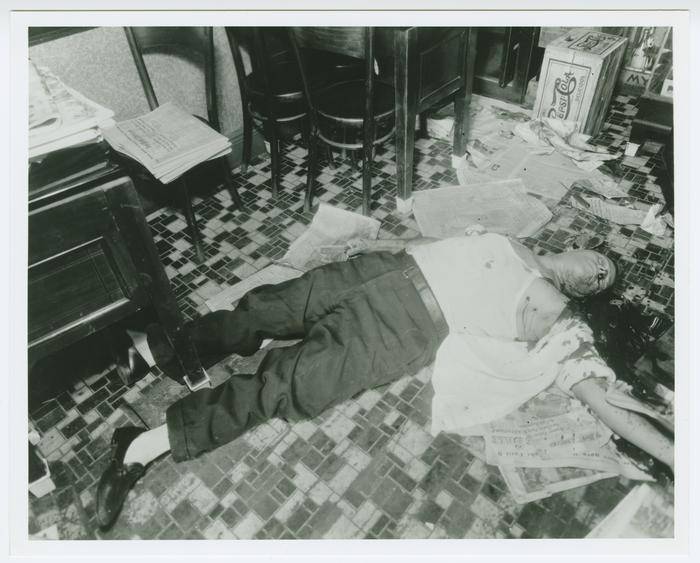
The dead body of Joseph Rosen, a candy shop owner who was killed in his own store.
Rosen’s death would ultimately lead to the downfall of Murder Inc. Their leader, Louis “Lepke” Buchalter would be convicted for this murder and sentenced to death.
Brooklyn. September 13, 1936.
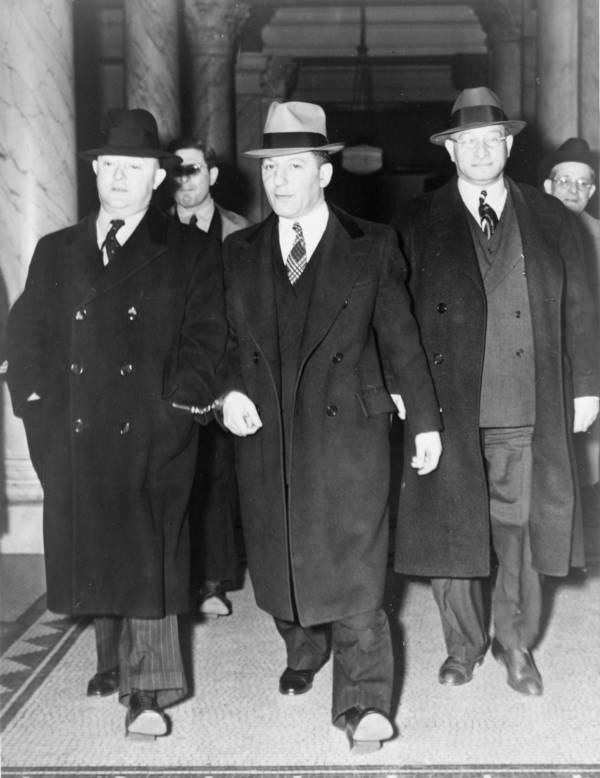
F.B.I. Director J. Edgar Hoover (left) drags Buchalter (center) to the courthouse, the pair handcuffed together.
New York City. Circa 1939-1940.
The dead body of Walter Sage.
Sage was a New York racketeer who ran afoul of the mob. He was hacked to death with an ice pick, tied up to a slot machine, and left out in public as a warning.
New York City. 1937.
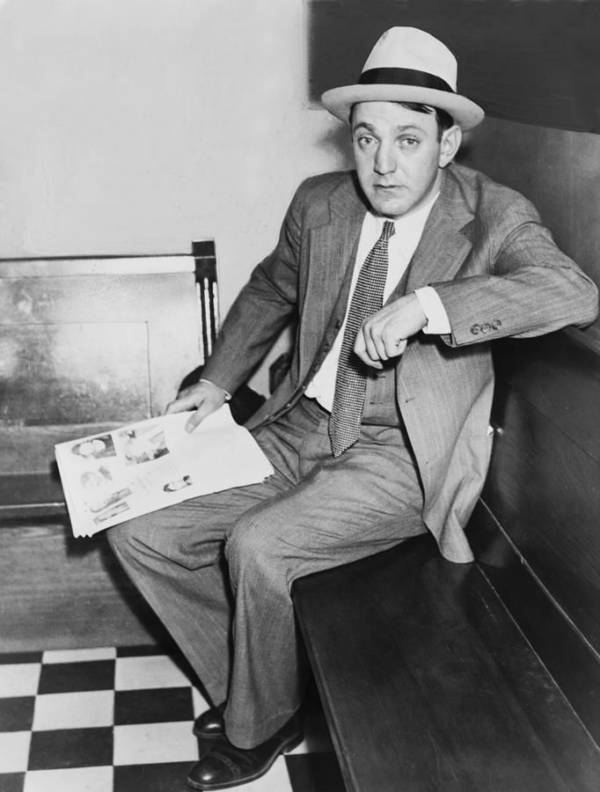
Infamous Jewish-American gangster Dutch Schultz sits outside the courtroom, waiting for the verdict in his tax evasion trial.
Schultz upset Murder Inc. and the rest of the New York underworld by attempting to order a hit on his prosecutor. They were afraid that his actions would turn the police against organized crime figures and thus had Schultz killed not long after this photo was taken.
New York. 1935.
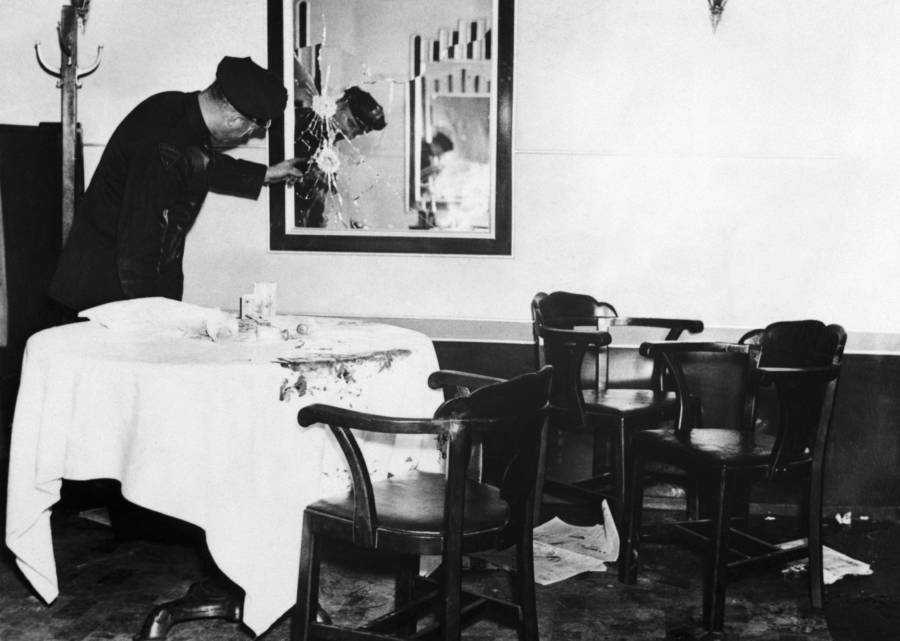
The crime scene after Dutch Schultz was shot by a Murder Inc. hitman.
Newark, New Jersey. 1935.
Dutch Schultz lies dying in his hospital bed.
Though Schultz looks relaxed, he would be dead within a matter of hours.
Newark, New Jersey. 1935.
Members of Murder Inc. enjoy a cake while celebrating a wedding.
New York City. Circa 1940.
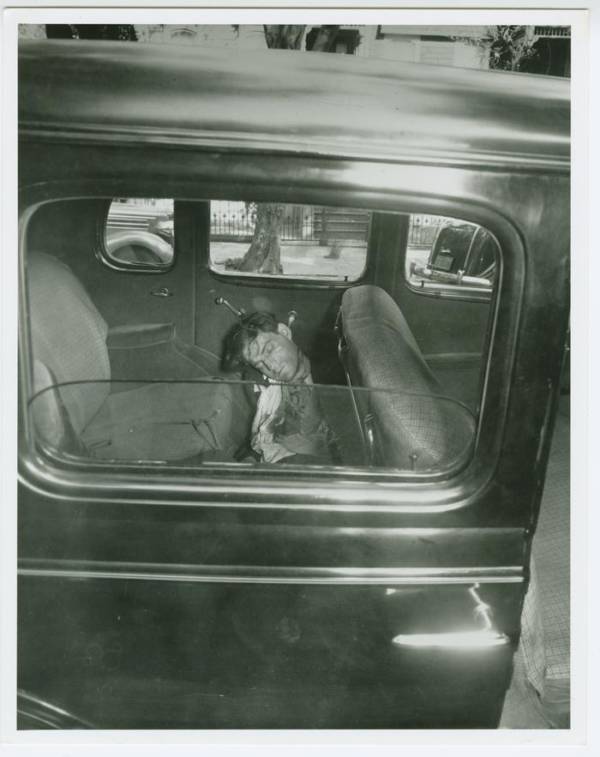
The body of George Rudnick lies in the back of a car.
Rudnick was accused of being a police informant. Whether he was or not, the accusation won him a visit from Harry Maione and Frank Abbandando of Murder Inc.
New York City. May 25, 1937.
George Rudnick’s body is pulled out of the car.
Rudnick’s death was particularly brutal. He was hacked apart with meat cleavers and ice picks.
New York City. May 25, 1937.
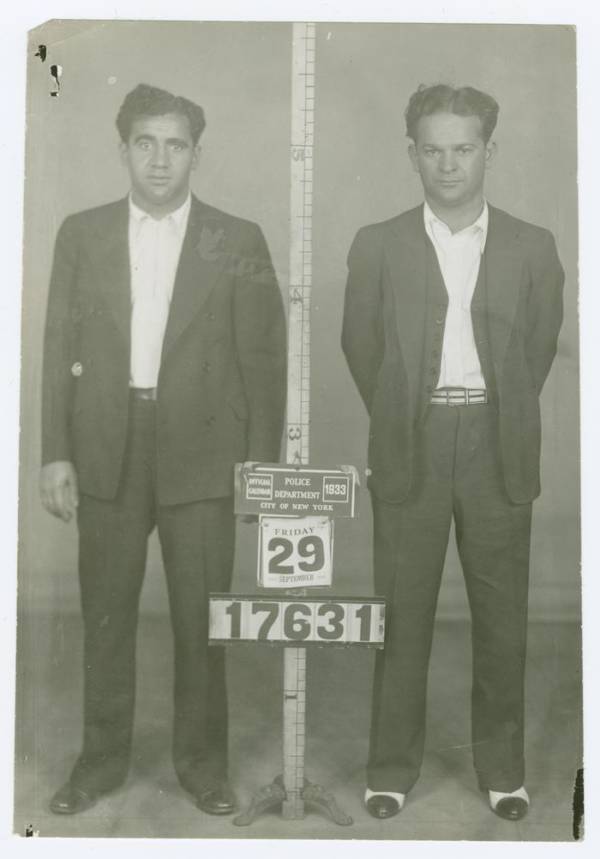
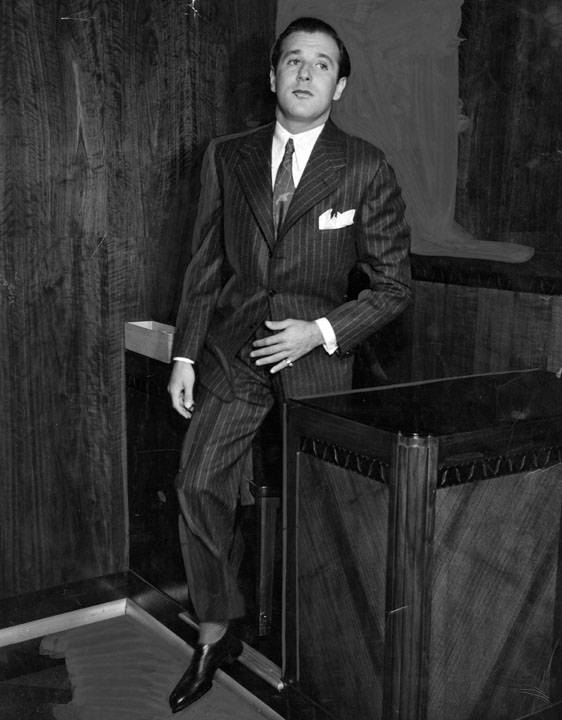
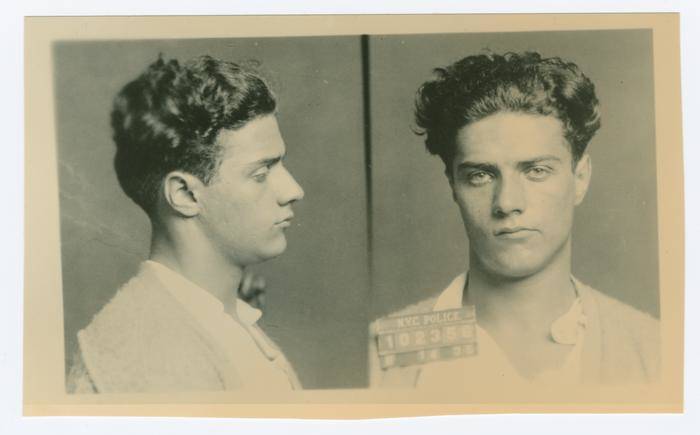
Mugshot of notorious Jewish-American gangster and Murder Inc. co-founder Benjamin “Bugsy” Siegel.
New York City. April 12, 1928.
Killer Vincent “Mad Dog” Coll steps out of the courtroom, on trial for homicide.
New York City. 1931.
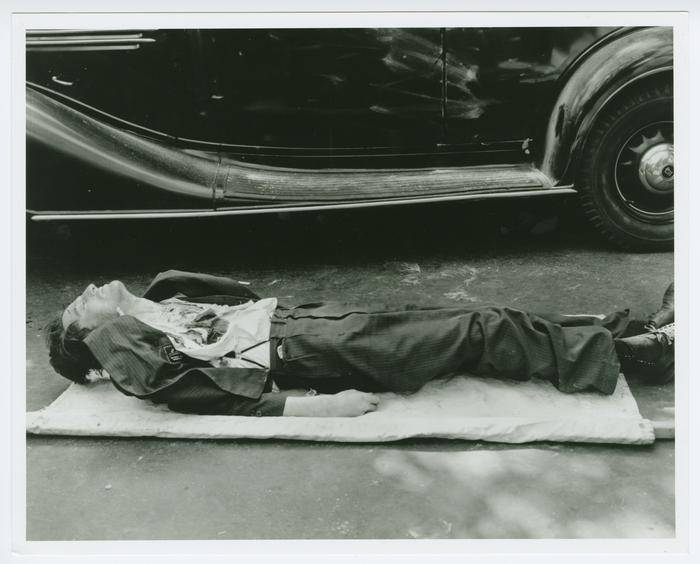
Harry Millman, a former big shot mobster in Detroit, lies dead on the ground after a visit from Murder Inc.
Chicago. 1937.
Louis Capone and Emanuel “Mendy” Weiss, two killers-for-hire, share a carefree laugh.
New York City. December 3, 1941.
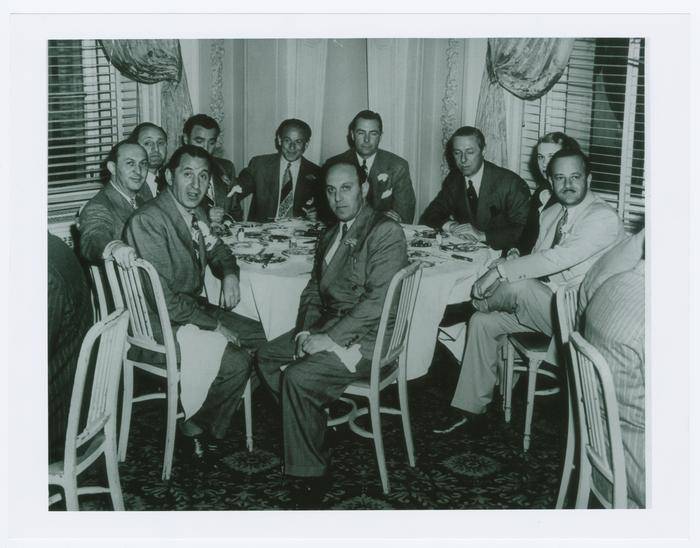
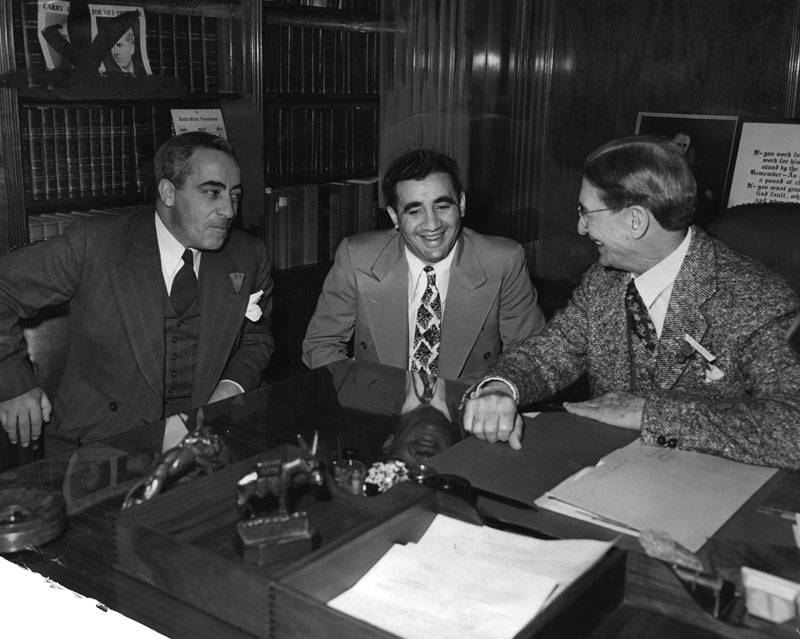
Jewish-American gangster and Murder Inc. co-founder Meyer Lansky sits down at a gathering with notorious Mafioso Charles “Lucky” Luciano.
New York City. Circa 1930-1940.
Candy store owner Joseph Rosen lies dead on his store’s cold floors.
Brooklyn. September 13, 1936.
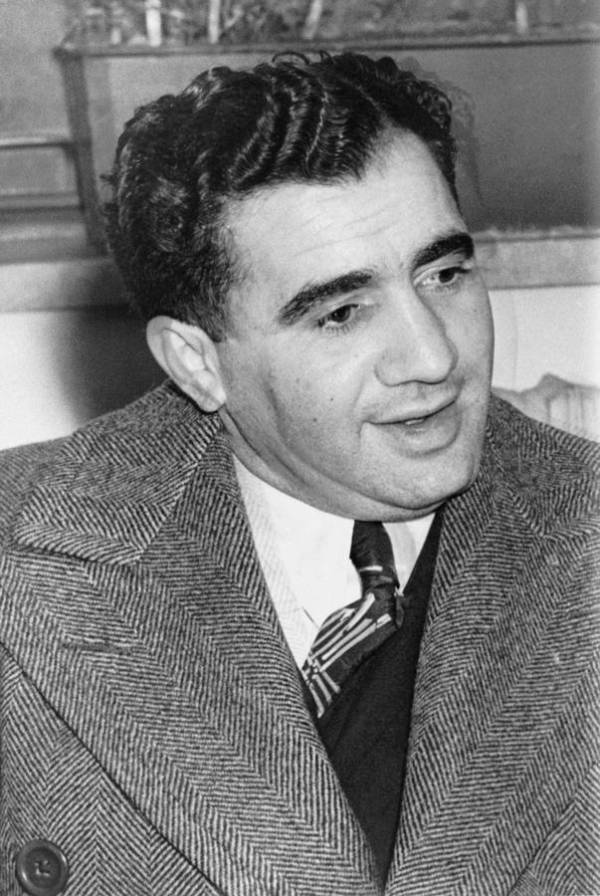
Abraham “Kid Twist” Reles, the assassin-turned-informant who would ultimately bring down Murder Inc.
New York City. Circa 1930-1940.
Abraham Reles (left) poses for a mugshot.
New York City. Circa 1930-1941.
Abraham Reles (center) talks to prosecutors, telling them everything they want to know about Buchalter.
New York City. Circa 1940-1941.
“Bugsy” Siegel hears the news that he’s been acquitted of murder. He is one of the few members of Murder Inc. who will not be convicted for his crimes.
New York City. December 13, 1940.
Buchalter stands in court, waiting to hear his sentence.
Brooklyn. December 2, 1941.
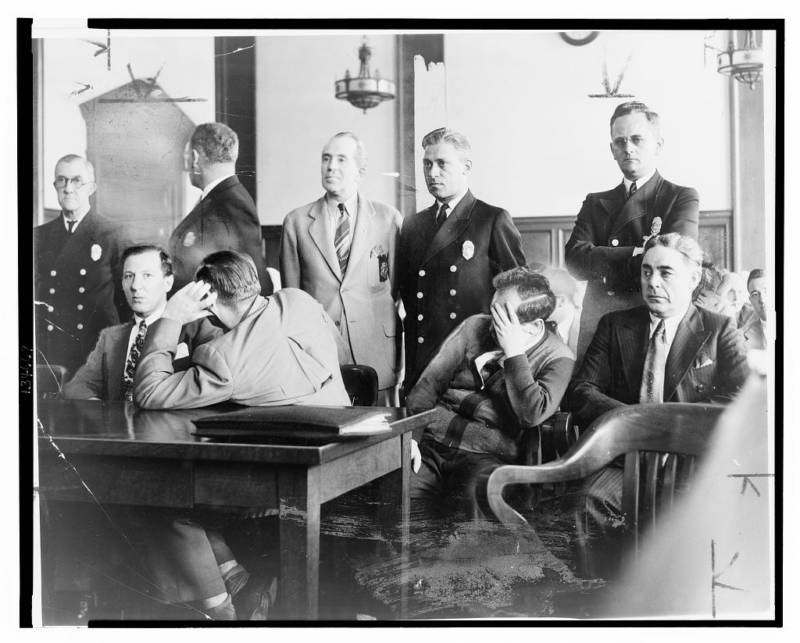
Buchalter, Emanuel “Mendy” Weiss, Phillip “Little Farvel” Cohen, and Louis Capone during their trial.
Brooklyn. August 1941.
Buchalter is informed that he will get the death sentence.
The man with the gun next to him is a police officer, there to make sure he doesn’t try to run.
New York City. July 20, 1943.
The mugshot of Abraham “Pretty “Levine, a contract killer for Murder Inc.
New York City. August 14, 1935.
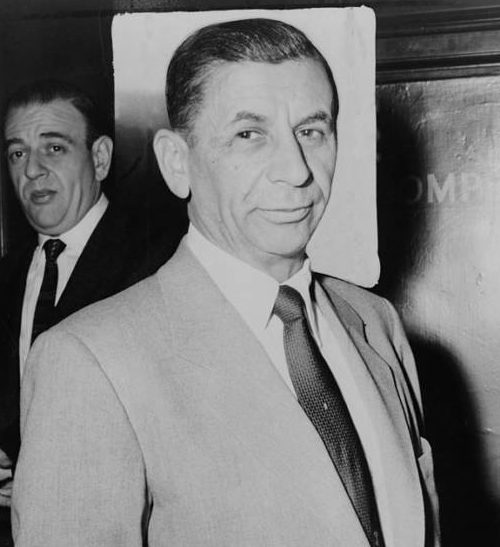
Meyer Lansky.1958.
Mugshot of mobster John Locascio.
New York City. September 24, 1935.
The ruined house of Virginia Hill, “Bugsy” Siegel’s mistress, after a mob assassin broke in looking for Siegel.
Though Lepke was executed thanks to Reles’ testimony, the other two big figures in the organization — Albert Anastasia and Bugsy Siegel — managed to avoid the electric chair. Their times would come, though, when they were eventually killed by mob assassins much like the ones they’d employed.
“Bugsy” Siegel lies dead, shot through the window by an assassin with an M1 carbine.
Beverly Hills, California. 1947.
The body of “Bugsy” Siegel lies in the morgue.
Beverly Hills, California. June 25, 1947.
“Bugsy” Siegel’s body lies in the morgue — the very place he and his men had sent some 1,000 people.
Beverly Hills, California. June 25, 1947.
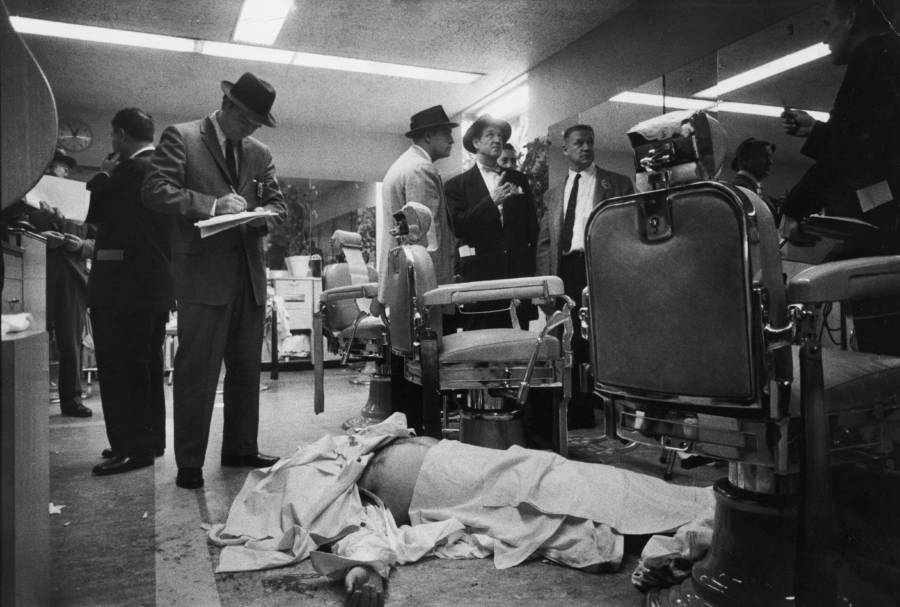
Albert Anastasia lies dead in a Manhattan barbershop.
With Anastasia’s death, the last traces of Murder Inc.’s upper echelon were wiped off the face of the Earth.
1957.

Yesterday Today

Bringing You the Wonder of Yesterday - Today

Skip to content ↓