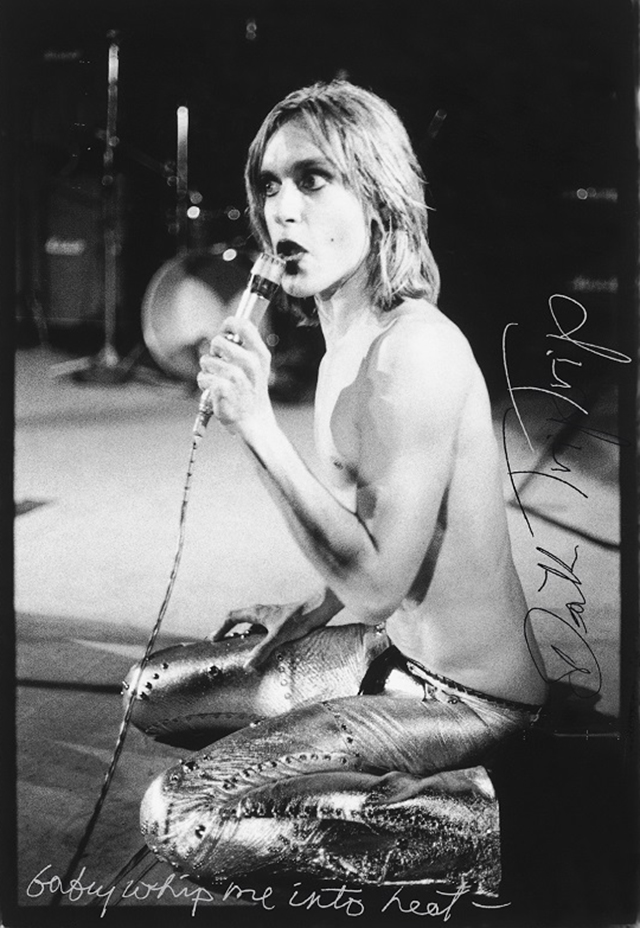
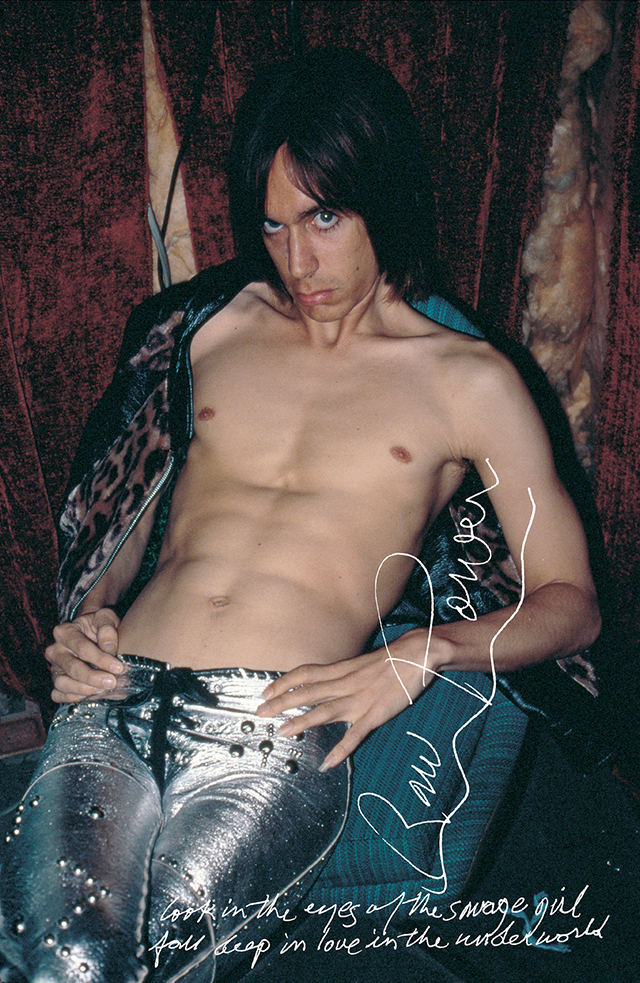
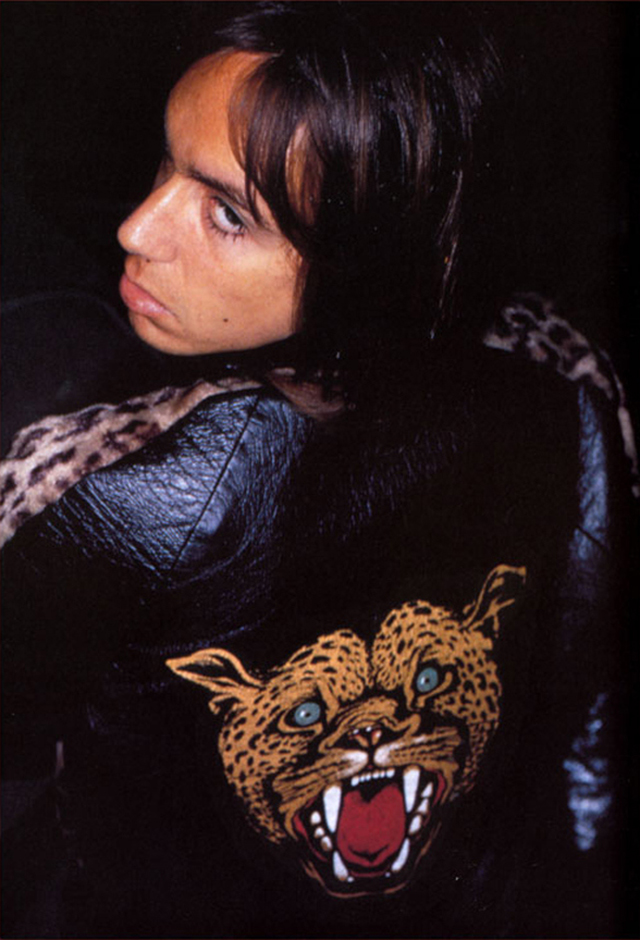
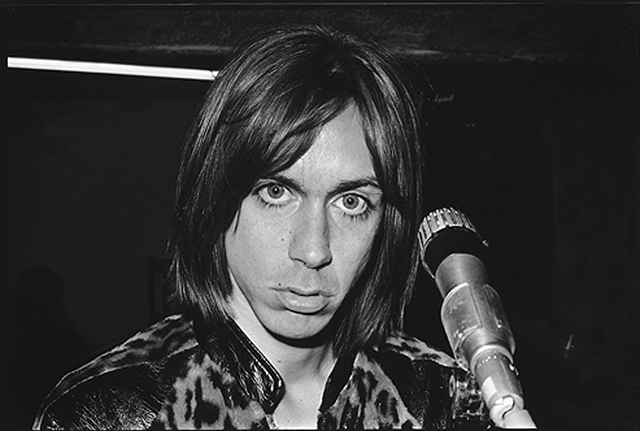
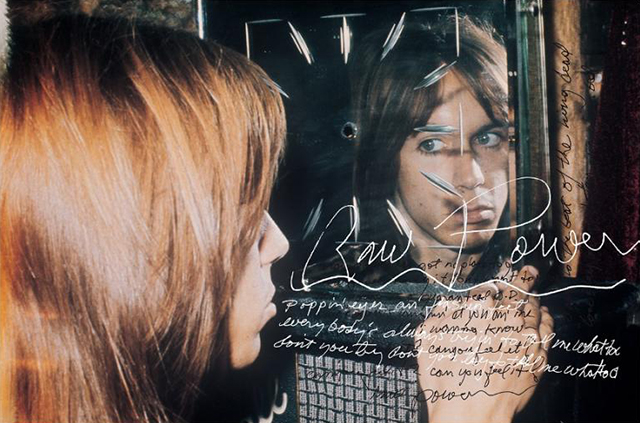
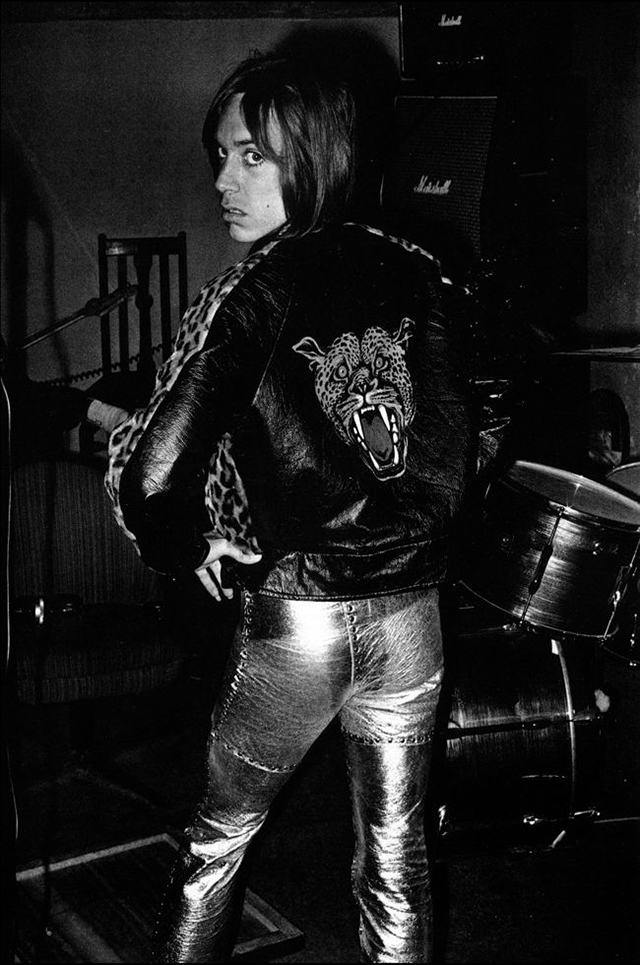
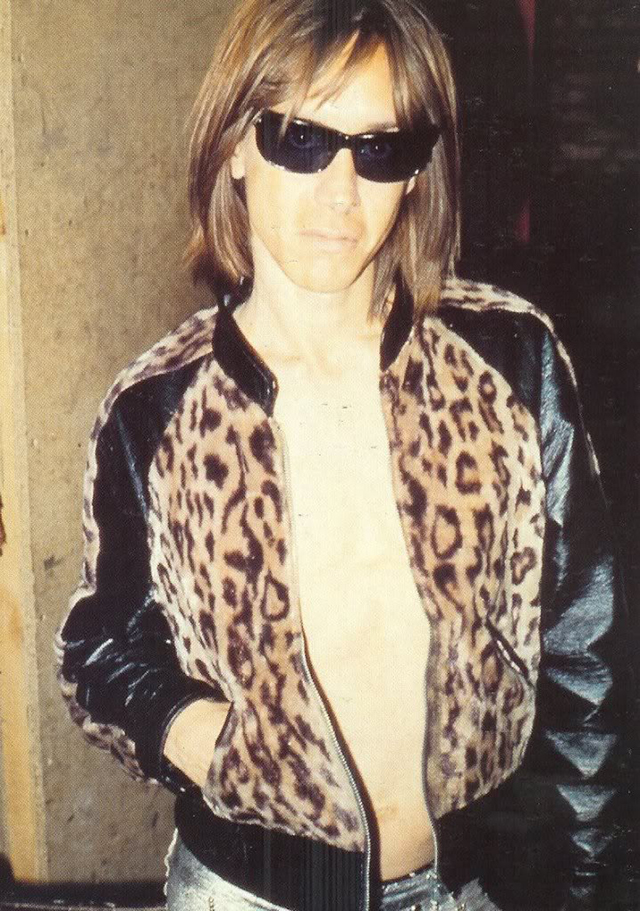
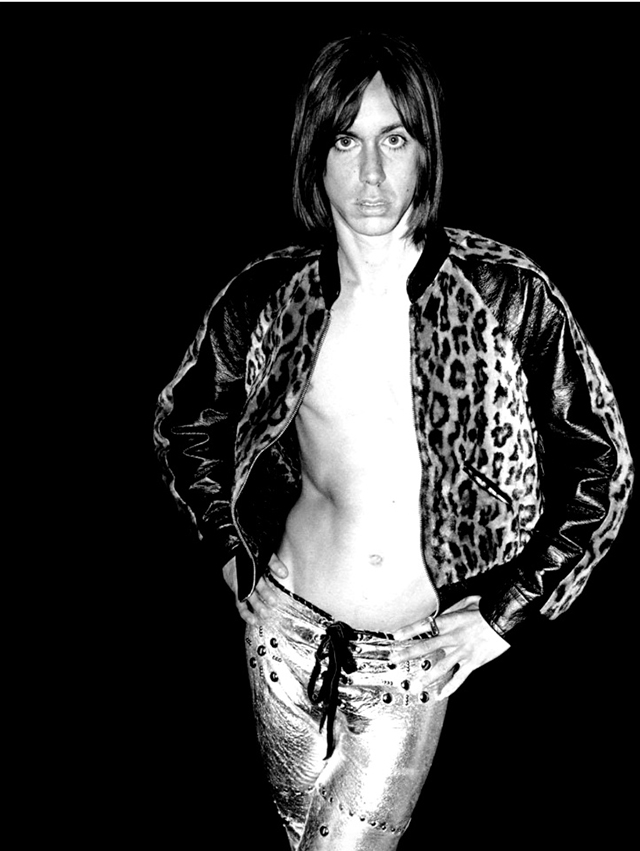
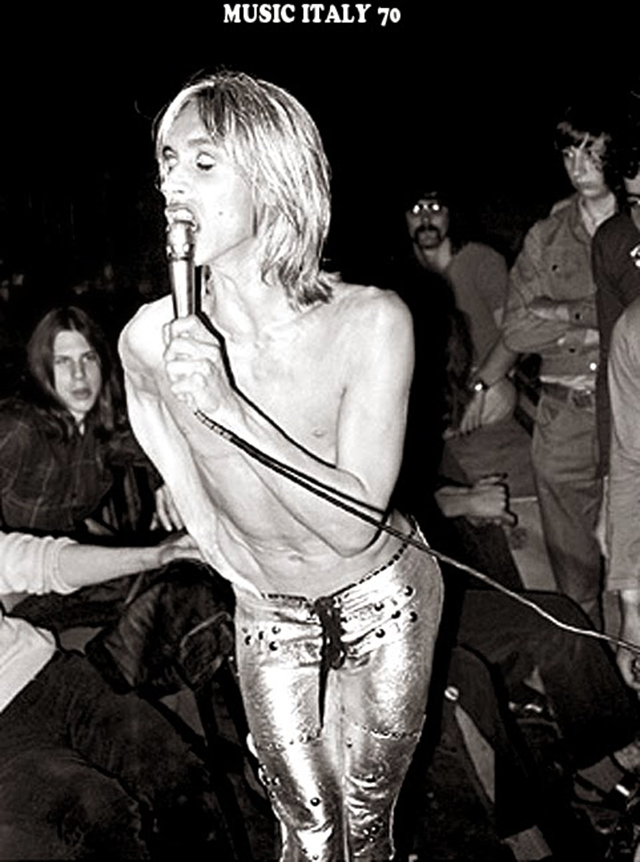
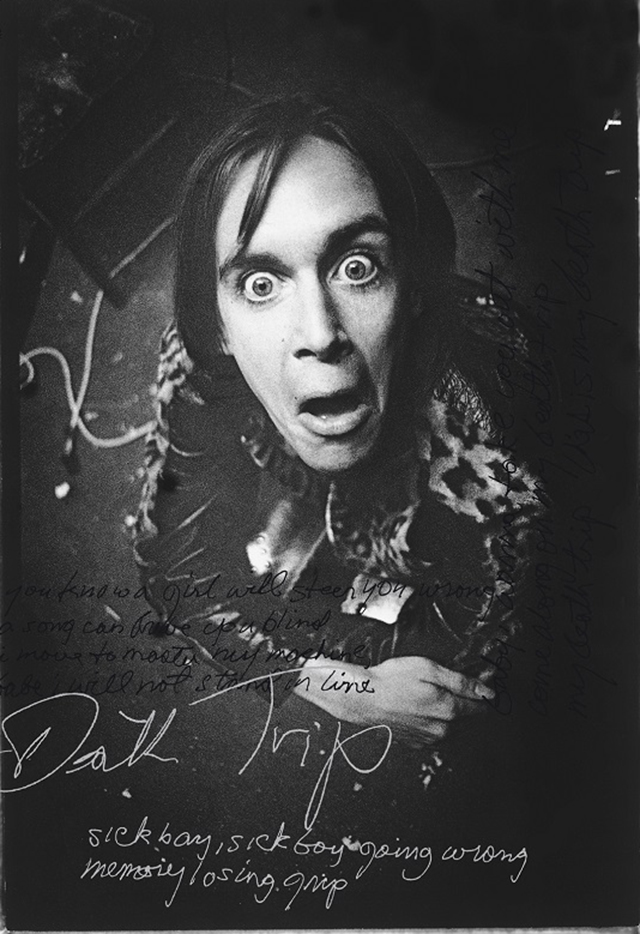
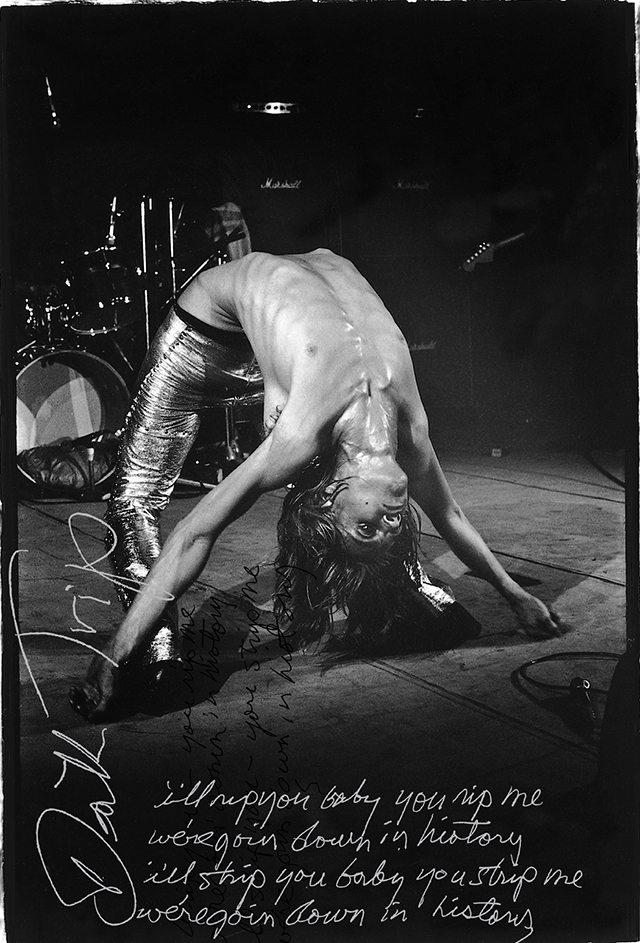
Rare Photos of Iggy Pop Taken by Photographer Mick Rock in 1972

In 1972 Iggy Pop & The Stooges flew into London to record a new LP Raw Power. With David Bowie as executive producer, Raw Power proved to be an instant classic. During this time The Stooges, perpetually wasted, performed a single concert in London’s Kings Cross. This whole crazed period of Iggy’s phenomenal career was captured on camera by one man – Mick Rock.

Mick’s career continued to soar with key 1970s images like Lou Reed’s Transformer, Iggy Pop’s Raw Power, Queen’s Queen II and many of the Sex Pistols’ infamous shots. In 1977, he moved permanently to New York, where he quickly became involved with the underground music scene pioneered by The Ramones, Talking Heads and Blondie. His pictures, including The Ramones’ End of the Century, captured the revolutionary spirit of this groundbreaking period and made him the one of the most sought-after photographers in the world.

These photographs stand out because of the seeming ease with which they capture the live-fast-die-young spirit of the band and its music. A uniquely intimate yet distanced insight into one of history’s most important group of musical misfits.

James Newell Osterberg Jr. (born April 21, 1947), known professionally as Iggy Pop, is an American musician, singer, and songwriter. Designated the “Godfather of Punk”, he was the vocalist and lyricist of proto-punk band The Stooges, who were formed in 1967 and have disbanded and reunited many times since.

Initially playing a raw, primitive style of rock and roll, the Stooges sold few records in their original incarnation and gained a reputation for their confrontational performances, which often involved acts of self-mutilation by Pop. He had a long collaborative and personal friendship with David Bowie over the course of his career, beginning with the Stooges’ album Raw Power in 1973. Both musicians relocated to West Berlin to wean themselves off their respective drug addictions and Pop began his solo career by collaborating with Bowie on the 1977 albums The Idiot and Lust for Life, Pop usually contributing the lyrics. Throughout his career, he is well known for his outrageous and unpredictable stage antics, poetic lyrics, and distinctive voice. He was one of the first performers to do a stage-dive and popularized the activity. Pop, who traditionally (but not exclusively) performs bare-chested, also performed such stage theatrics as rolling around in broken glass and exposing himself to the crowd.

Pop’s music has encompassed a number of styles over the course of his career, including garage rock, punk rock, hard rock, heavy metal, art rock, new wave, jazz, blues, and electronic. Though his popularity has fluctuated through the years, many of Pop’s songs have become well known, including “Search and Destroy” and “I Wanna Be Your Dog” by the Stooges, and his solo hits “Lust for Life”, “The Passenger” and “Real Wild Child (Wild One)”. In 1990, he recorded his first and only Top 40 U.S. hit, “Candy”, a duet with B-52’s singer Kate Pierson. Pop’s song “China Girl” became more widely known when it was re-recorded by co-writer Bowie, who released it as the second single from his most commercially successful album, Let’s Dance (1983). Bowie re-recorded and performed many of Pop’s songs throughout his career.

Although Pop has had limited commercial success, he has remained both a culture icon and a significant influence on a wide range of musicians in numerous genres. The Stooges’ album Raw Power has proved an influence on artists such as Sex Pistols, the Smiths, and Nirvana. His solo album The Idiot has been cited as a major influence on a number of post-punk, electronic and industrial artists including Depeche Mode, Nine Inch Nails and Joy Division, and was described by Siouxsie Sioux as a “re-affirmation that our suspicions were true: the man is a genius.” He was inducted as part of the Stooges into the Rock and Roll Hall of Fame in 2010. In January 2020, Pop received a Grammy Lifetime Achievement Award. (Wikipedia)
(Photos © Mick Rock)
31 Imperial Russia Photos That Reveal History In Stunning Color

These haunting color images of Imperial Russia show a world on the verge of revolution and about to change forever.

Imperial Russia, one of the largest empires that the world has ever seen, thrived from 1720 all the way until 1917. It stretched across three continents, encompassed diverse lands and people, and crushed Napoleon when he was reckless enough to attempt to conquer it.

But, ultimately, the Russian Revolution of 1917 would put an end to Imperial Russia, bringing a long era of history to a close. During the imperial period, Russia had waged wars, conquered surrounding lands, and produced some of the most well-known, and highly feared, monarchs in modern history.

Leaders like Catherine the Great and Tsar Alexander II brought Imperial Russia to the forefront of global power and helped shape history in ways that can still be felt today. However, at the same time, these monarchs presided over a system that kept many in poverty, put upon by a system that propped up a fortunate few.

Finally, in 1917, two revolutions dismantled the monarchy, swept the communist Bolsheviks into power, and closed the book on the Russian Empire. Soon, much of what existed before the revolution would be no more.

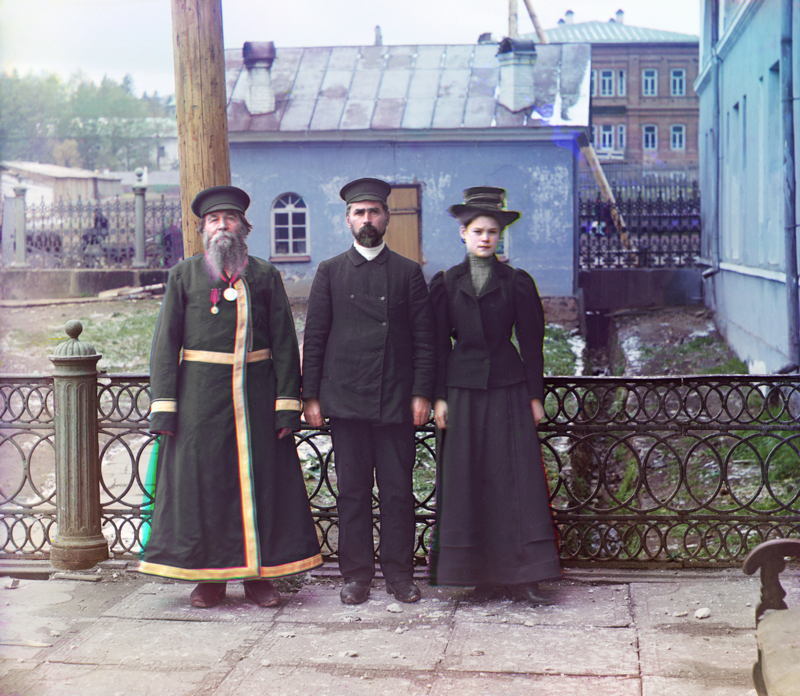
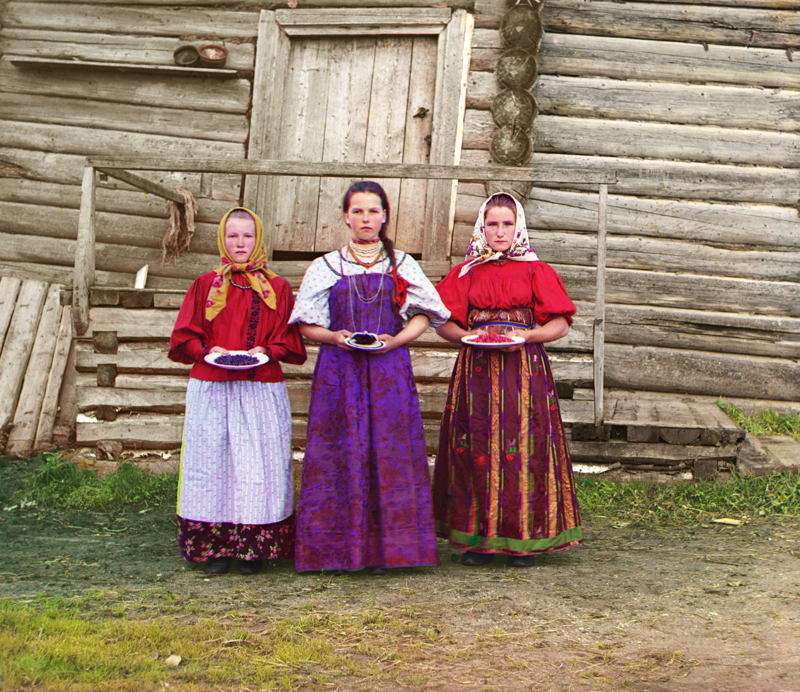
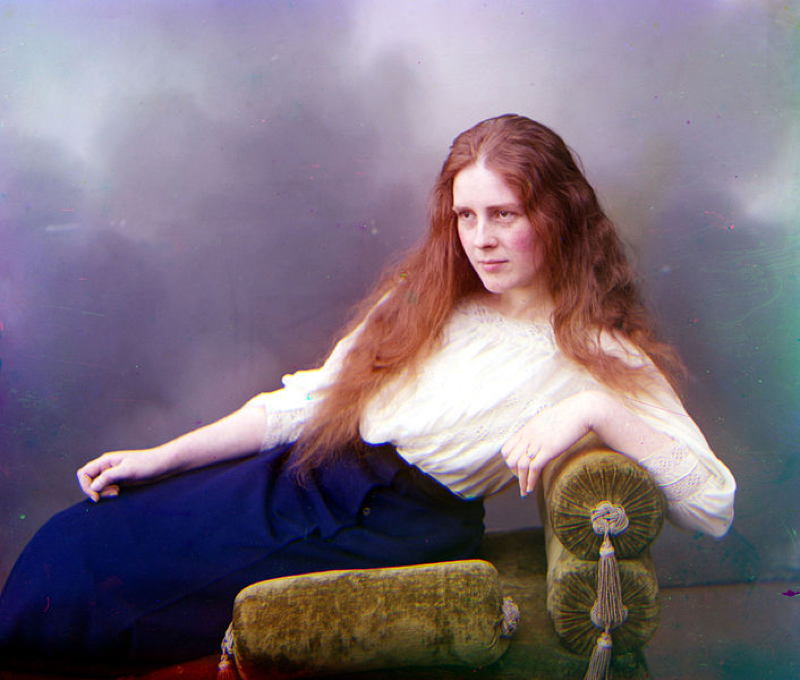
But not long before everything changed, two photographers, Sergey Prokudin-Gorsky and Piotr Vedenisov, managed to capture life as it was lived by the people of Russia before the revolution — and they did it in full color.

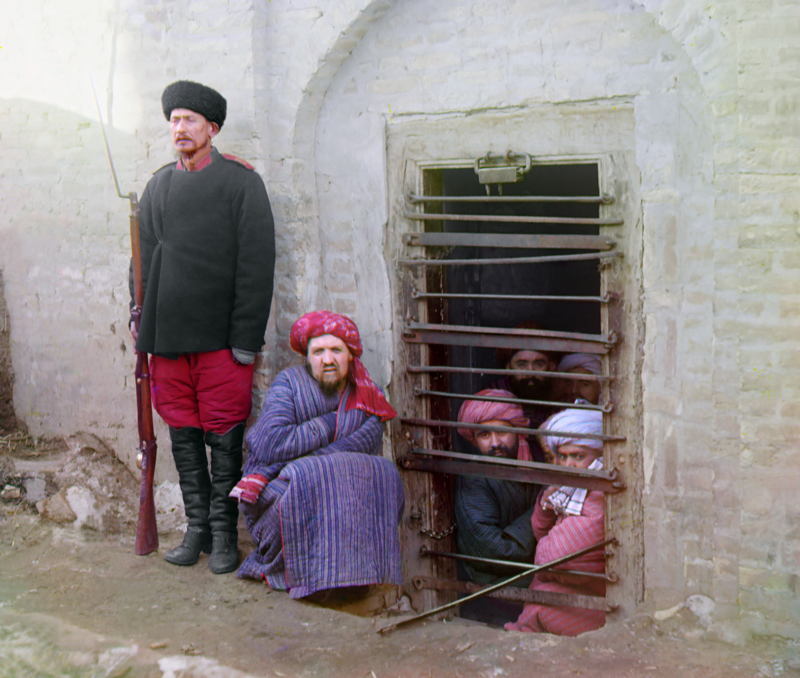
These photos show farmers, families, houses, places of worship, and altogether reveal a Russian way of life that would soon be lost to history. See some of the most stunning and eye-opening color photos that Produkin-Gorsky and Vedenisov ever took in the gallery below.

Caption: Sergey Prokudin-Gorsky was born in Vladimir Oblast, Russia in 1863. Combining his work in chemistry with art, he pioneered color photography by taking three photos in succession through red, green and blue filters that would become a composite color photo.
Gorsky’s photo of Leo Tolstoy would gain him fame among the royals, and he would soon receive funding to document Russia in color for Tsar Nicholas II from 1909 to 1915.
Gorsky’s work captured the diversity of the Russian Empire’s citizens, from rural peasants to royalty.
A zindan, or prison, in Bukhara, of modern day Uzbekistan. Zindans were typically built underground.
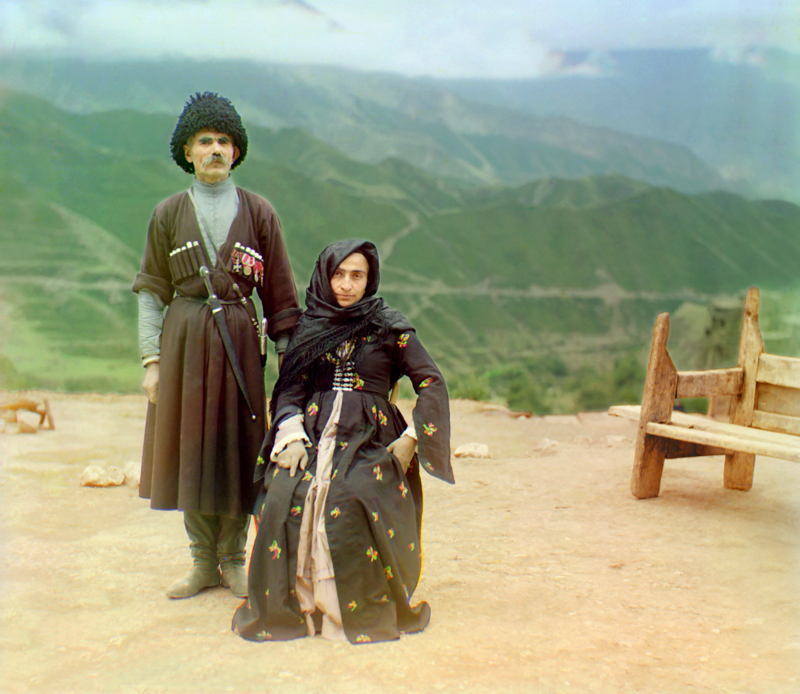
A couple wearing traditional clothing poses for Gorsky in Dagestan.
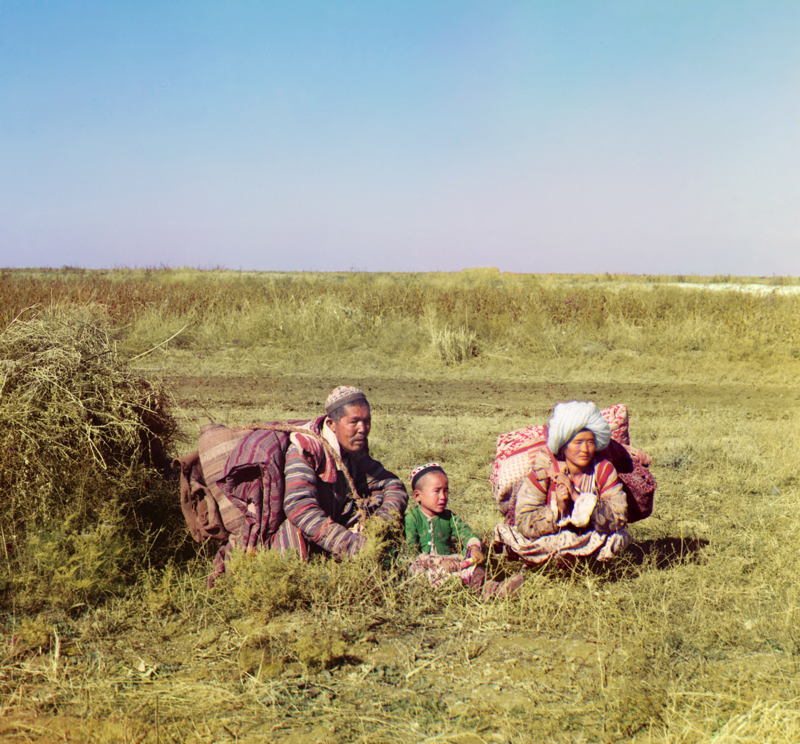
Gorsky was granted special access to restricted areas of the Empire. Here, he photographs a nomadic Kyrgyz family on the steppe.
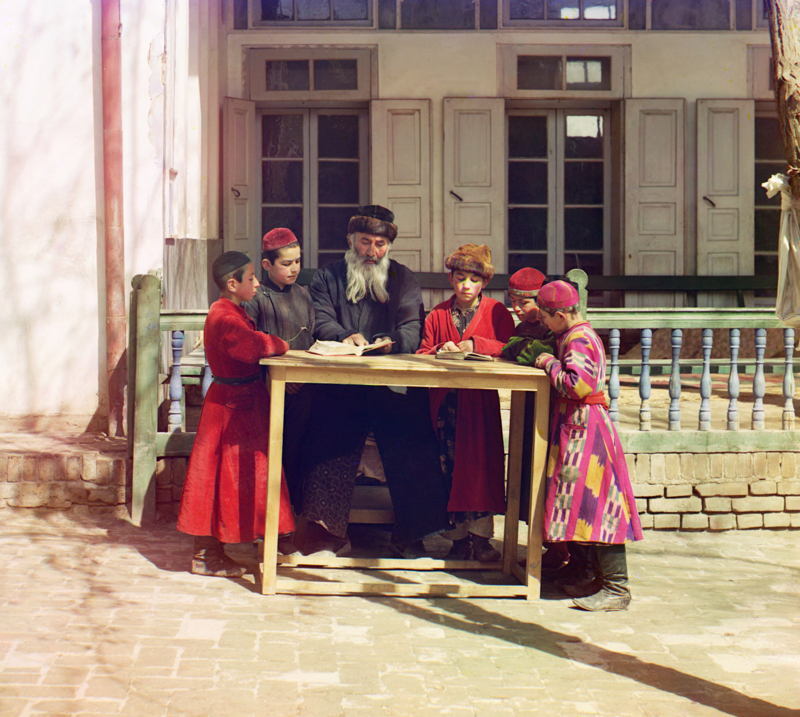
A Jewish teacher instructs his students in Samarkand, an intellectual and economic hub on the Silk Road. Samarkand is a highly diverse city, home to Tajiks, Persians, Arabs, Jews and Russians.
Russian children relax on a hillside near White Lake, in northern European Russia.
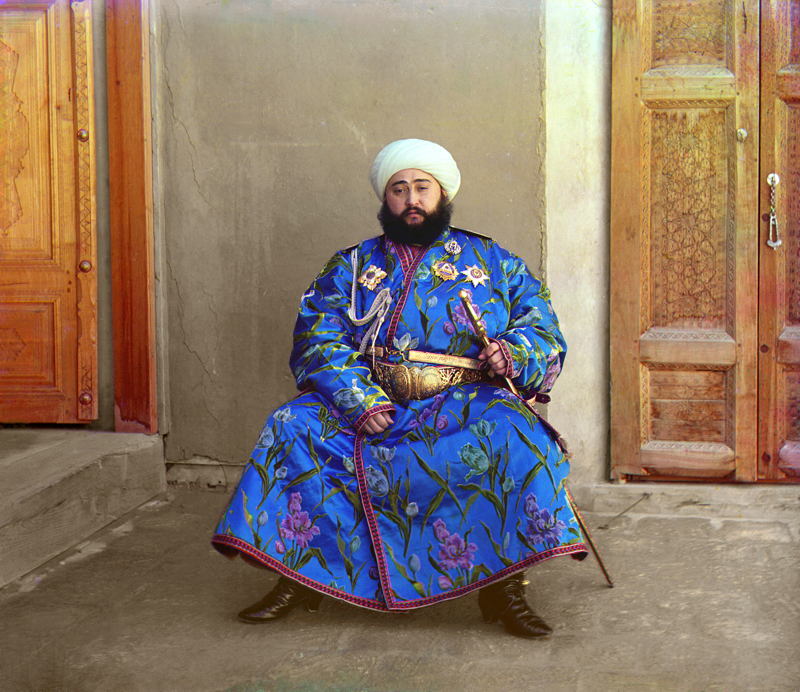
Shortly after his rise to power, Emir Khan of Bukhara posed for a portrait for Gorsky. Bukhara was a vassal state of the Russian Empire in Islamic Central Asia. The emir fled to Afghanistan after the Red Army sacked the city and abolished his dynasty.
Gorsky captures storks building a nest on what is most likely a mosque in Bukhara.
A fabric merchant poses among his wares on the Silk Road, which stretched from China and India to Central Asia, the Middle East and the Mediterranean.
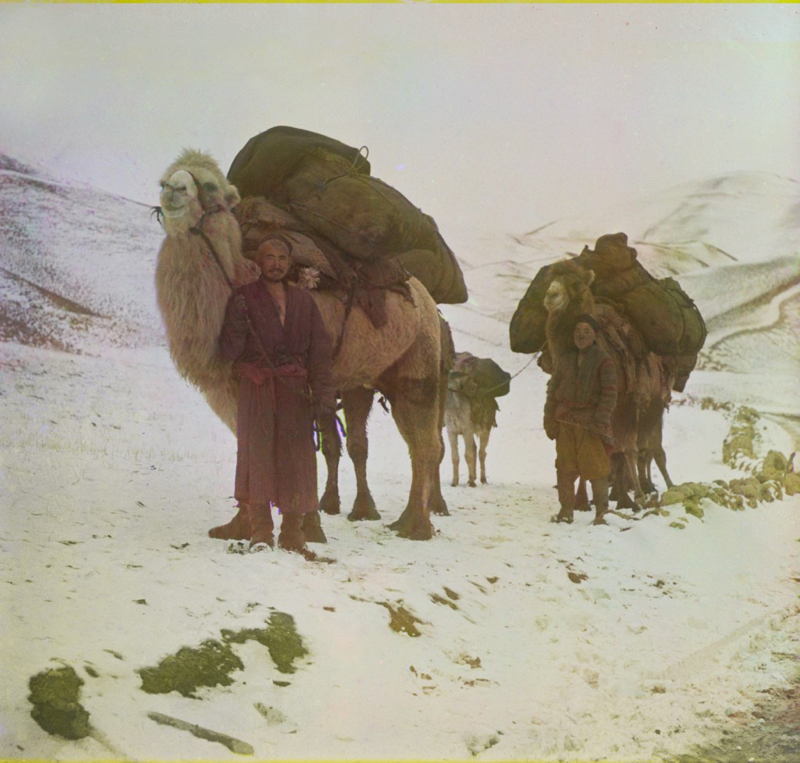
Gorsky documents travelers with their camels near Sulukta in modern day Kyrgyzstan.
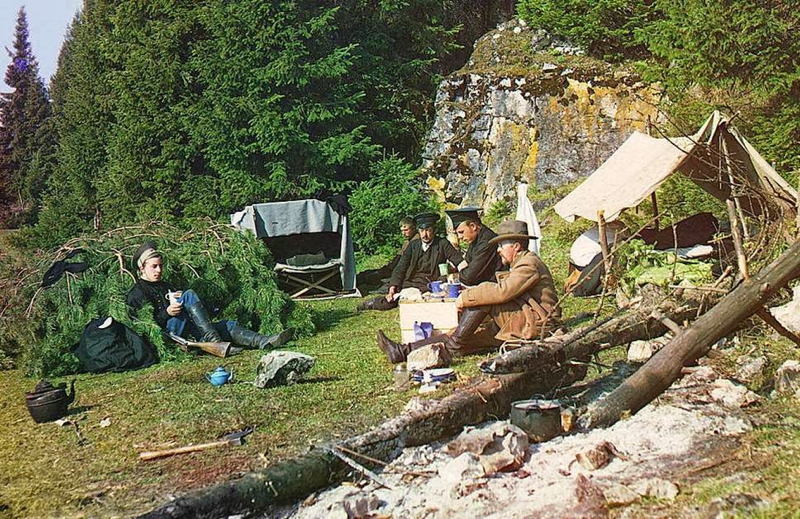
Gorsky catches himself in this photo on the right in 1912 at Chusovaya.
A Turkmen man crouches with camel laden with packs in Central Asia.
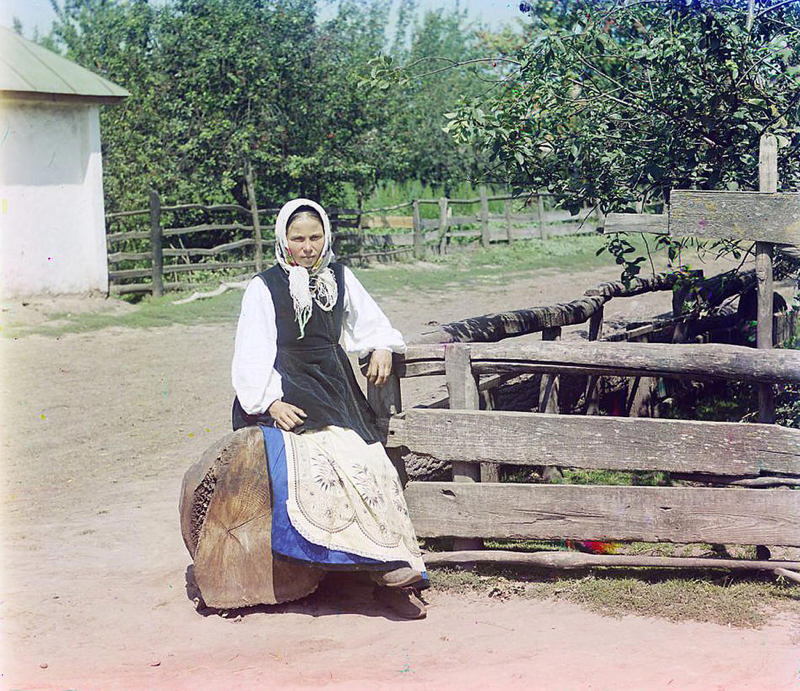
A young girl in traditional garb poses in what was referred to as Little Russia, now known as Ukraine.
Gorsky also catalogued buildings, houses and nature for his project, including this church in Nyrob.
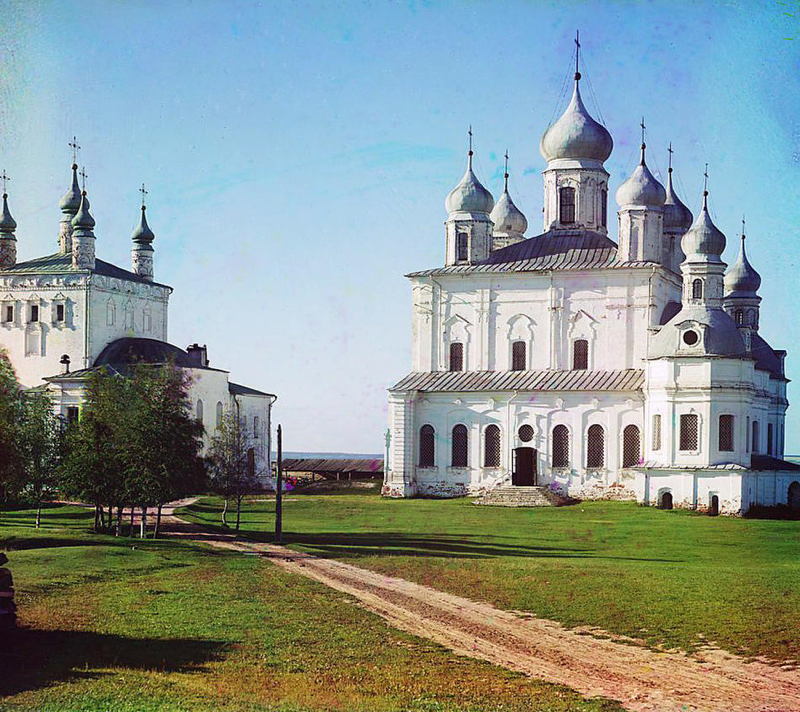
The Assumption Monastery in Pereiaslavl-Zalesskii display the peaked domes common in Russian church construction.
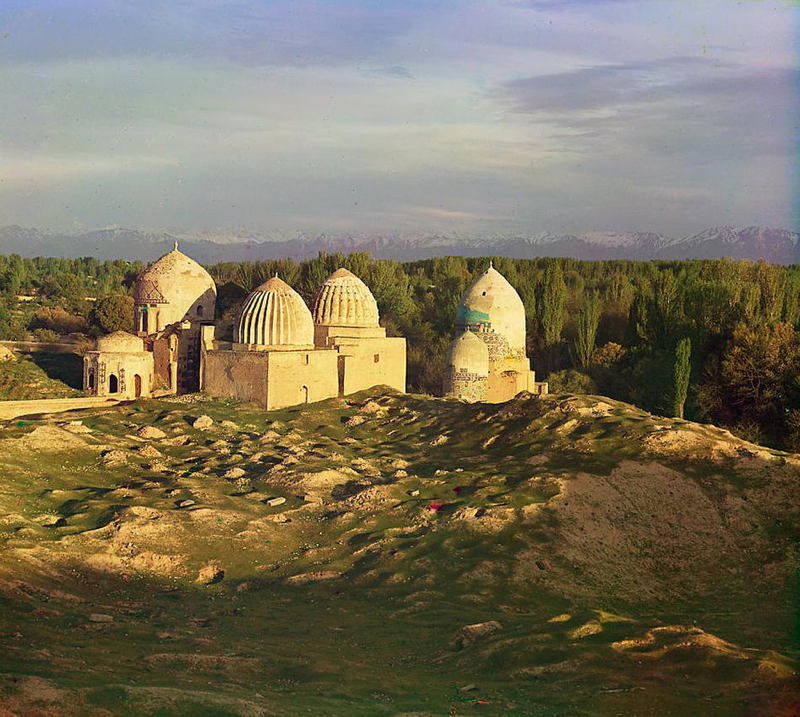
View of the Shakh-I Zindeh mosque in Samarkand as the sun sets. Currently, just over 11% of Russians identify as Muslim.
Gorsky also photographed members of upper class society.
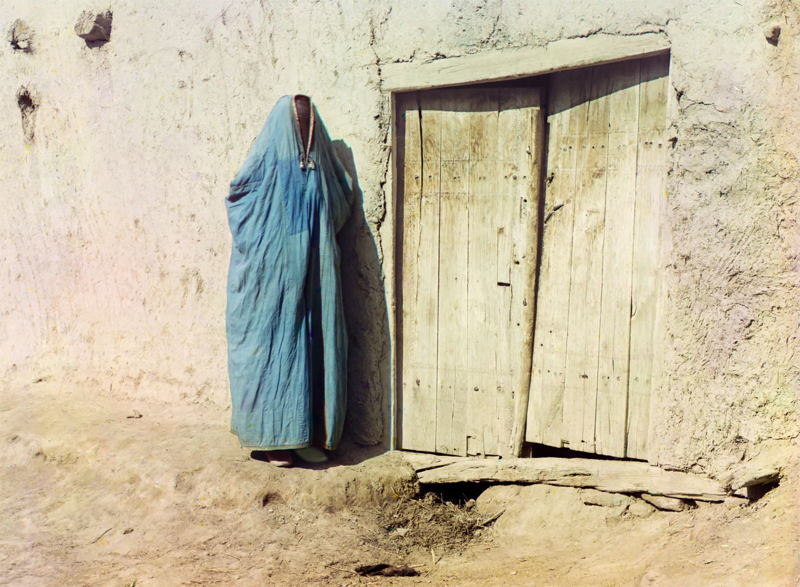
Sart woman wearing a paranja in Samarkand, which is now part of Uzbekistan.
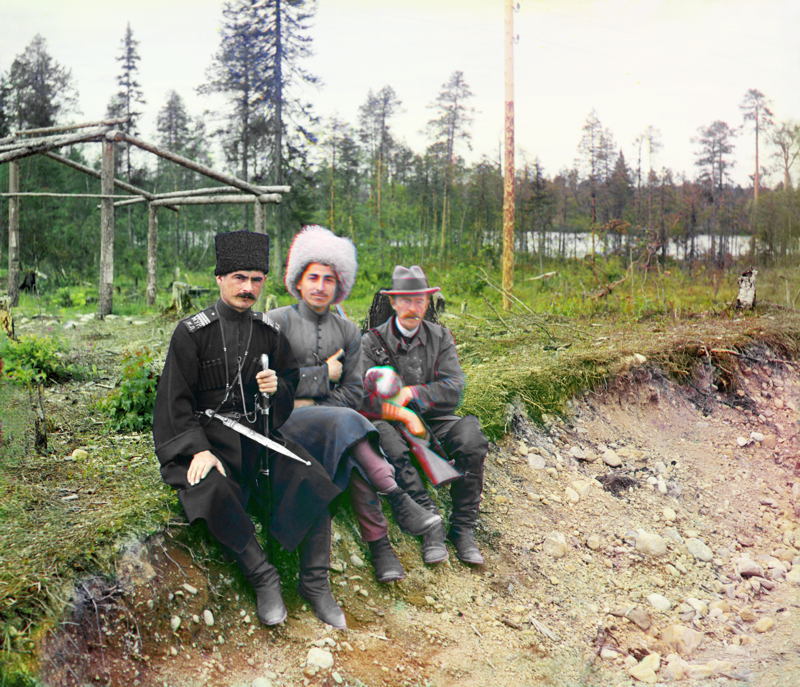
Gorsky sits to the right of two guards for the Murmansk railway.
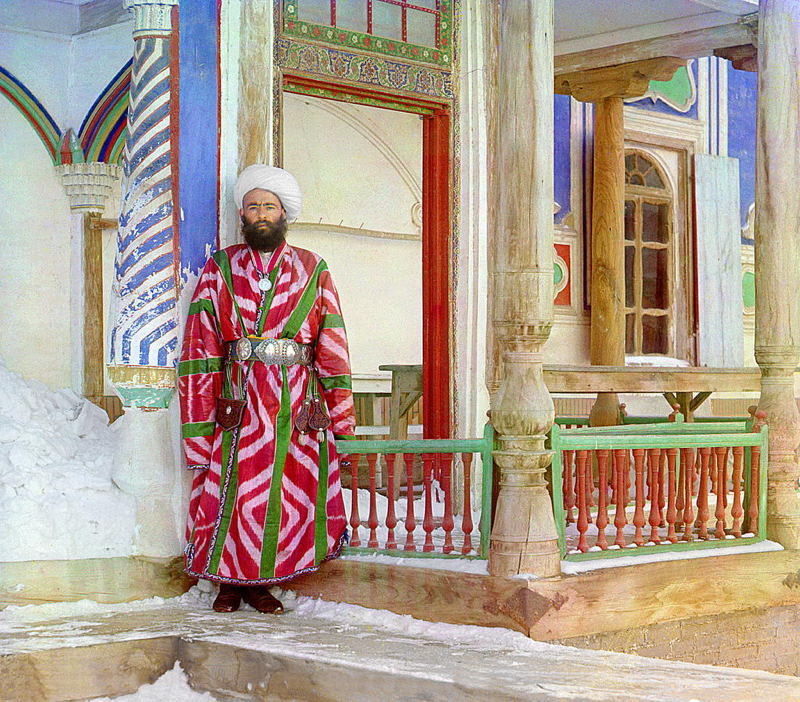
A bureaucrat in Bukhara poses in a brightly colored robe for Gorsky.
A Kurdish mother sits with her children in Artvin, now part of northeastern Turkey.
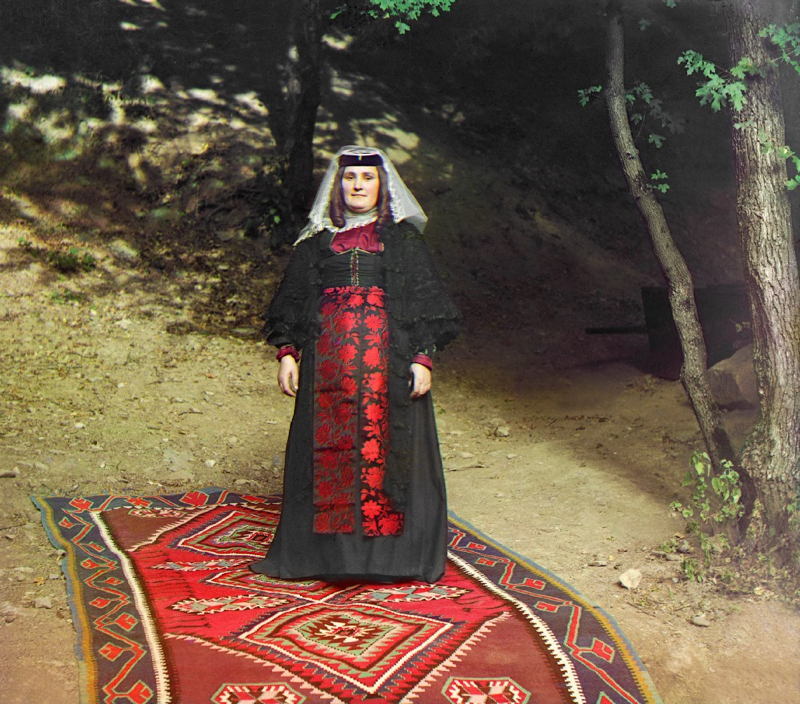
A Georgian woman dressed in regal attire poses on a rug in the forest.
Gorsky had the ability to capture both the strength and vulnerability of the peasant class without being judgmental. His photos are an eye-opening glimpse into an empire on the verge of revolution and war.
Peter Vedenisov was a pianist with an interest in color photography. He made color autochromes on glass that he could project onto a wall.
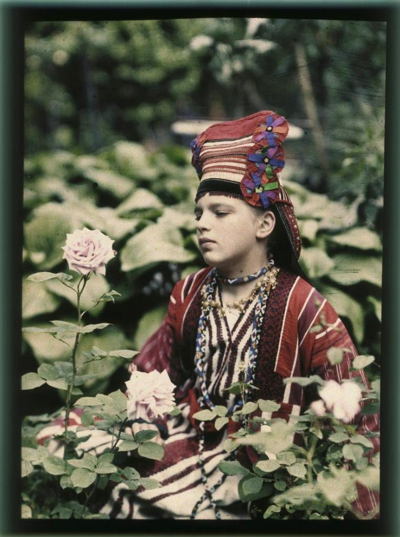
Vedenisov worked primarily with aristocratic families, particularly the Kosakovs, and managed to capture a different style of life from the peasants of the Russian Empire.
The Kosakovs were friends of the Vedenisovs. Here, the women and children of the family pose.
A Crimean patriarch sits for a photo, wearing an eye patch.
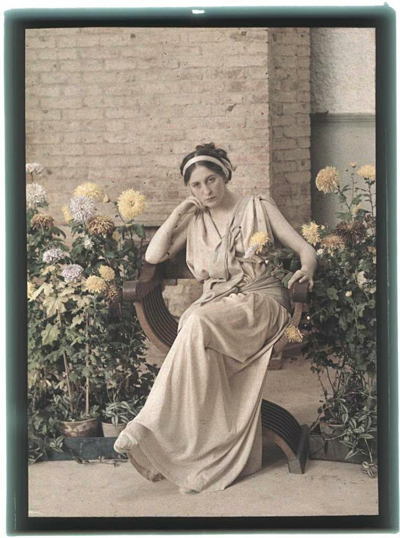
A Crimean woman of wealth poses in a garden, surrounded by opulent flowers.
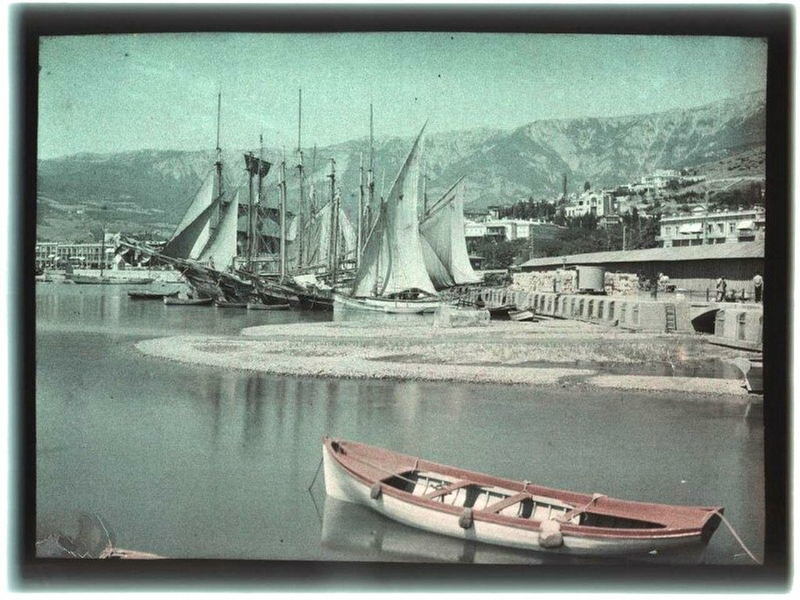
Vedenisov lived for years in Yalta and captured pictures of ships in the port. A resort town, Yalta sits in Crimea, a now disputed area of Ukraine.

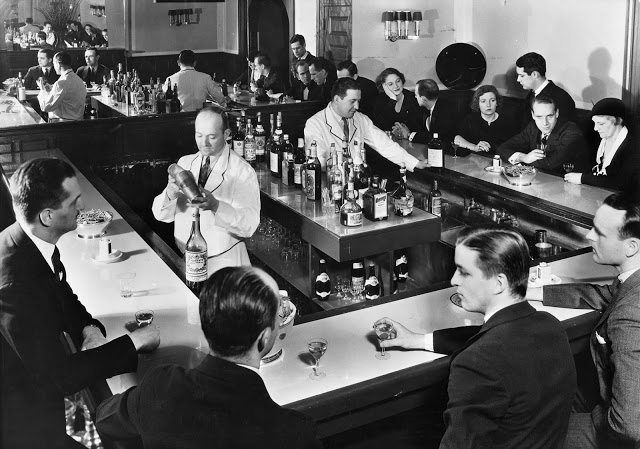
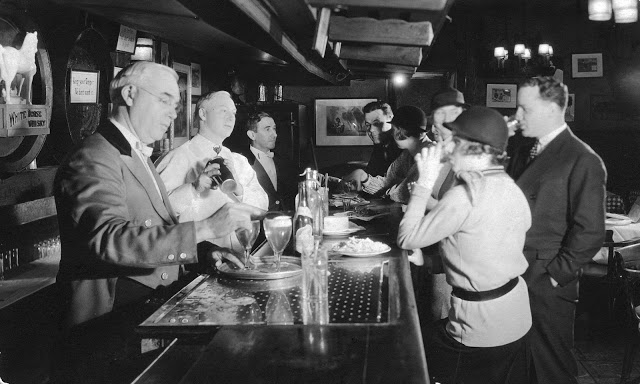
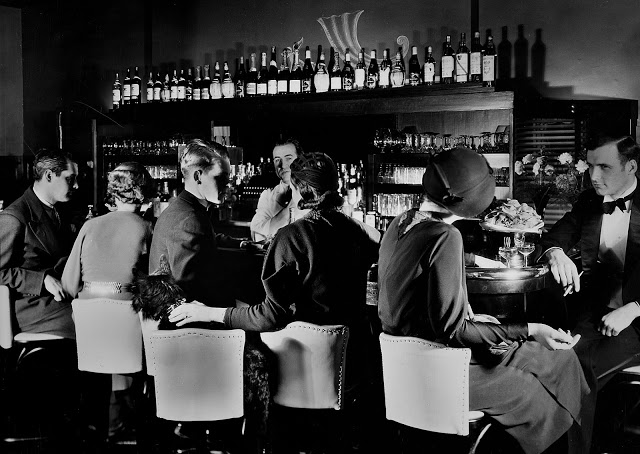
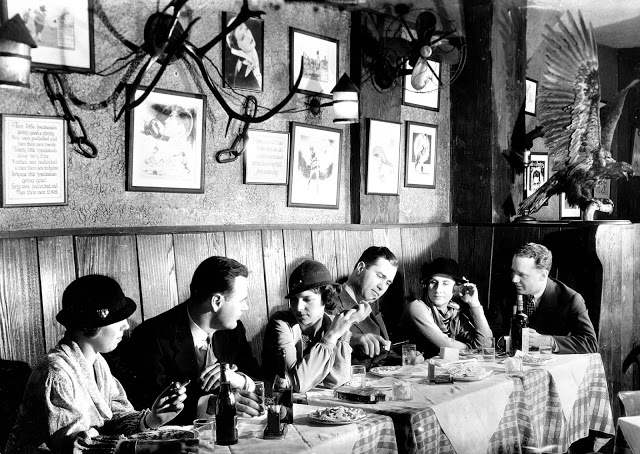
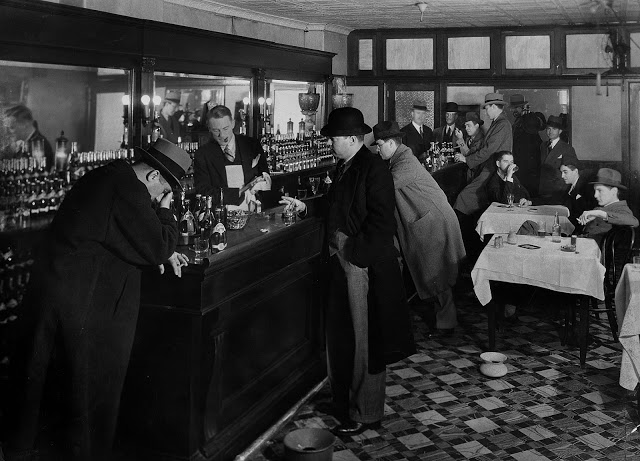
Inside the Speakeasies of New York in 1933

Prohibition in the United States lasted from 1920, when the 18th amendment prohibiting the sale of alcohol went into effect, until 1933, with its repeal via the 21st amendment.

During the Prohibition, and forbade any sale, production importation, and transportation of alcoholic beverages, the speakeasy became the place to socialize at. These speakeasies were bars that illegally sold booze to their customers behind locked doors. Some of these popular places were run by criminals, and even though the police would sometimes raid the bars and arrest both the owners and their customers, the speakeasies were so profitable they continued to flourish.

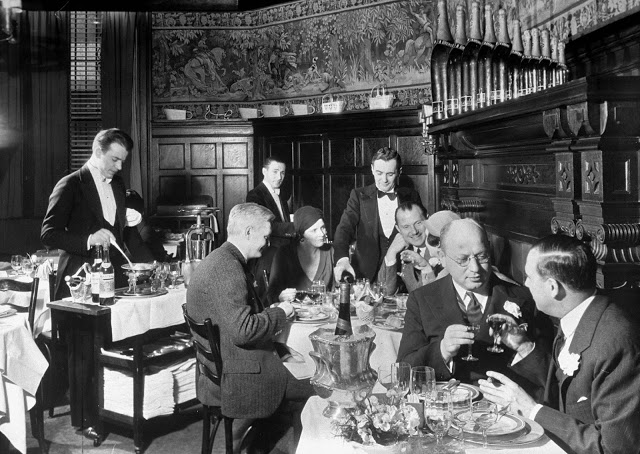
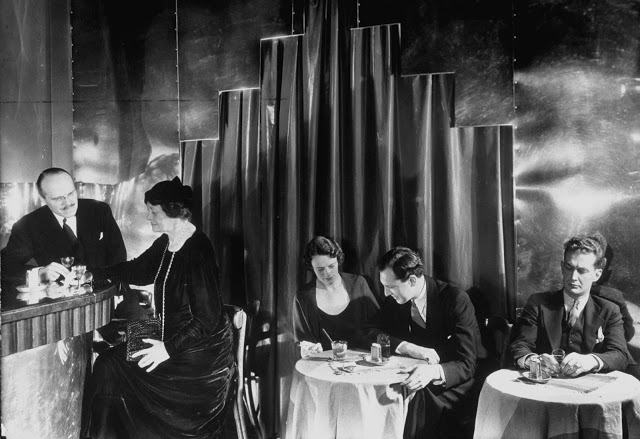
Photographer Margaret Bourke-White were able to take some photos at a few of these notorious bars in 1933 – the year the Prohibition ban was lifted, and therefor meant the speakeasies could take the locks off their doors. Bourke-White’s photos ran in the June 1933 issue of FORTUNE, under the simple and evocative title, “Speakeasies of New York.”

Patrons enjoying drinks at the Hunt Club. a speakeasy with a filing system listing their 23,000 eligible customers which is checked before a customer gets through the door at this venue that is protected from police prohibition raids.
Celebrity patrons enjoying drinks at this unidentified smart modern speakeasy , which is popular with Greta Garbo & Beatrice Lillie, where they can bring their dogs while eating & drinking without fear of police prohibition raids.
No speakeasy is as popular with aviators off duty as this quiet place. Its proprietor owns tow planes, is himself an expert pilot.
In the heart of a business section Thomas keeps this speakeasy on the second floor. Drinking starts at 8:30 A.M. when full-bellied Irish contractors drop in for a solidly comforting rye.
Champagne from right to left, on mantel: half nip, nip, pint, imperial pint, magnum, jeroboam, rehoboam, methuzelah, salmanazar, balthazar… Twenty-nine waiters and eight chefs are none too many for a popular place.
Social atmosphere has made the popularity of this speakeasy, which is full of gay chintz, red and white awnings, indirect lights. The barroom is gold and Victorian-green.
Scene inside a New York City speakeasy during Prohibition, 1933.

(Photos: Margaret Bourke-White—The LIFE Picture Collection/Getty Images)
Amazing Colorized Photos of Ireland’s Civil War, 1923-1924

The Irish Civil War was a conflict that followed the Irish War of Independence and accompanied the establishment of the Irish Free State, an entity independent from the United Kingdom but within the British Empire.

The civil war was waged between two opposing groups, Irish republicans and Irish nationalists, over the Anglo-Irish Treaty. The forces of the Provisional Government (which became the Free State in December 1922) supported the Treaty, while the Republican opposition saw it as a betrayal of the Irish Republic (which had been proclaimed during the Easter Rising). Many of those who fought on both sides in the conflict had been members of the Irish Republican Army (IRA) during the War of Independence.
The Civil War was won by the Free State forces, who benefitted from substantial quantities of weapons provided by the British Government. The conflict may have claimed more lives than the War of Independence that preceded it, and left Irish society divided and embittered for generations.

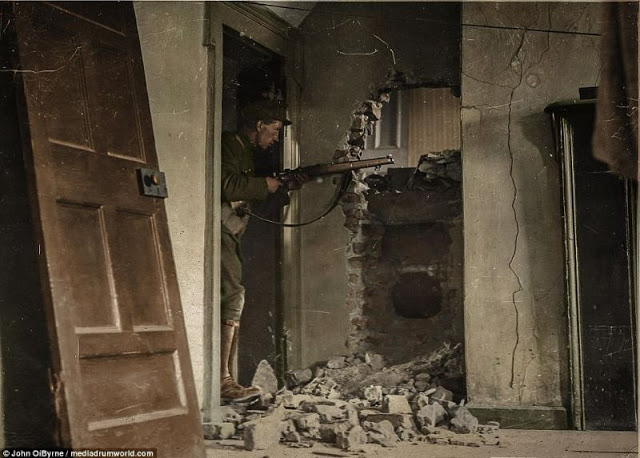
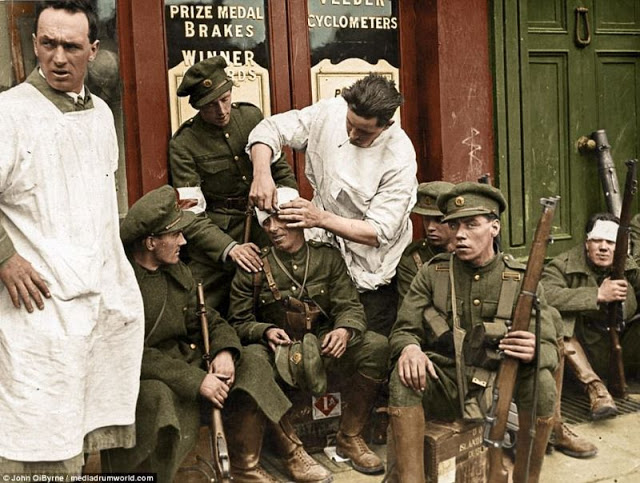
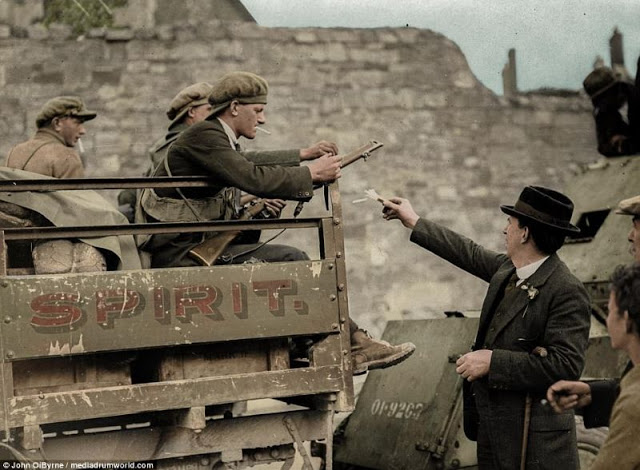
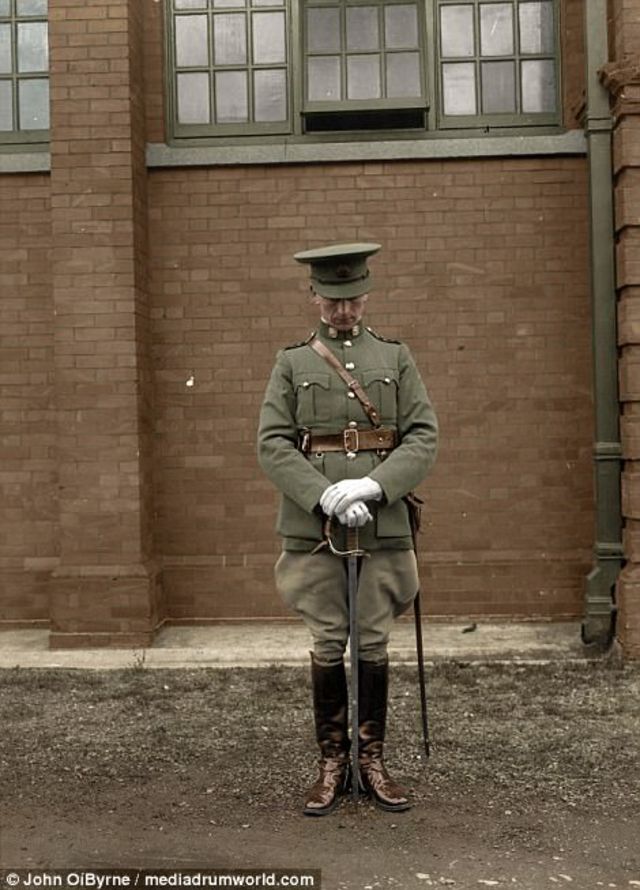
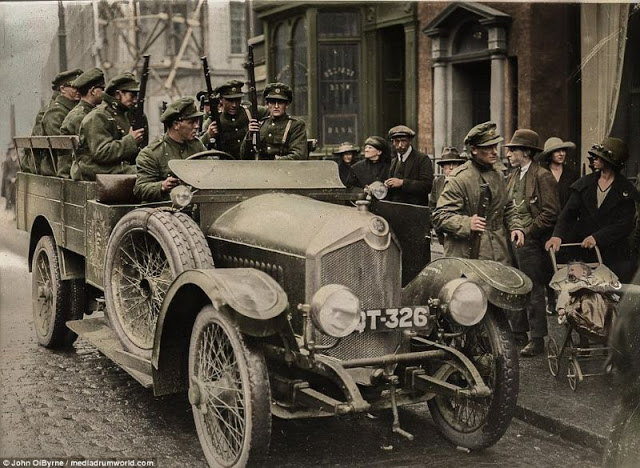
These war-time photographs were colourized by photographer and colourist John O’Byrne from Rathangan, Kildare, Ireland that show the Irish conflict which led to thousands of deaths and prisoners of war.

Irish Free State Army soldier in firing position inside a badly damaged house. His rifle is pointed through a hole in the wall of a room and debris is lying on the ground and a door has been kicked off its hinges. The treaty also stipulated that members of the new Irish parliament would have to take the following Oath of Allegiance: “I… do solemnly swear true faith and allegiance to the Constitution of the Irish Free State as by law established, and that I will be faithful to His Majesty King George V, his heirs and successors by law in virtue of the common citizenship of Ireland with Great Britain and her adherence to and membership of the group of nations forming the British Commonwealth of nations”
Free State Soldiers take a break from fighting on the street in Dublin possibly during the fighting of the four courts where wounded men are being tended to while others catch their breath. The Irish Civil War was a conflict that followed the Irish War of Independence and came alongside the establishment of the Irish Free State, an entity independent from the United Kingdom but within the British Empire. The civil war was waged between two opposing groups, Irish republicans and Irish nationalists, over the Anglo-Irish Treaty
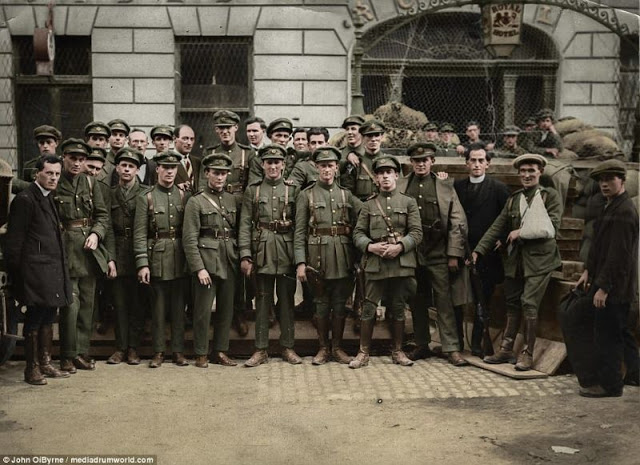
Irish Free State Army officers and men outside the Royal Hotel in Limerick. Some are smoking and one is sporting an injured arm. The group includes two clergymen and some civilians. The hotel was fortified with a barricade, wire and sandbags. The forces of the Provisional Government – which became the Free State in December 1922 – supported the Treaty, while the Republican opposition saw it as a betrayal of the Irish Republic, which had been proclaimed during the Easter Rising. Many of those who fought on both sides in the conflict had been members of the Irish Republican Army (IRA) during the War of Independence.
A man in civilian clothes reaching up with cigarettes to Irish Free State Army soldiers in a spirit merchant’s truck as locals stand by watching.
An unmounted officer stands with a drawn sword held at shoulder height in a sword drill under the supervision of Captain Flanagan and Captain Nolan at McKee Barracks Dublin.
A personnel carrier containing a group of Irish Free State Army soldiers drawing up outside the Belfast Banking Company in College Green, Dublin, watched by curious onlookers, including a woman with a baby in a pram. Exact casualties numbers have been hard to determine in the aftermath of the war, but it is estimated. Around 800 pro-Treaty fighters backed by the UK fighters are thought to have been killed while up to 3,000 anti-Treaty fighters are said to have died. Although the conflict lasted less than a year – from June 28, 1922 to May, 24 1923 – it is thought up to 12,000 were taken as prisoners of war by the British-backed forces.
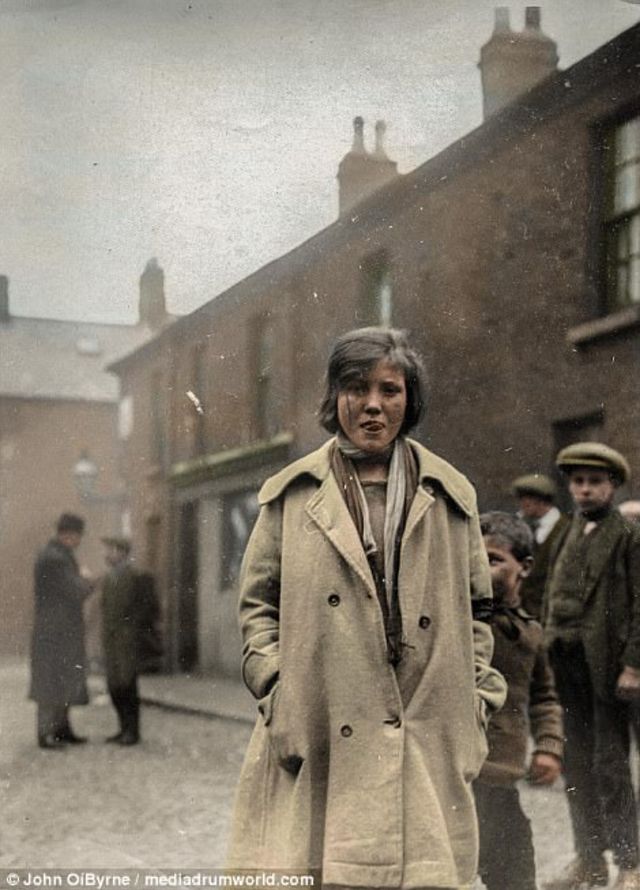
A young girl wearing an ill-fitting coat stands in a street of terraced houses thought to be in Belfast. Some boys are looking on and two men are having a conversation in the background.
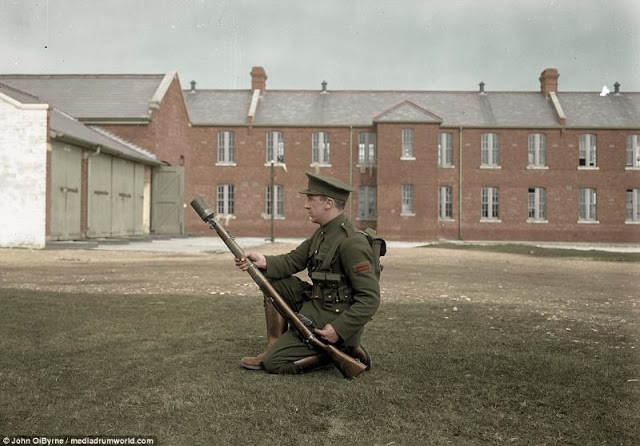
An infantry sergeant holding a grenade launcher in a glass plate negative showing an the infantry sergeant. The picture was printed to display how to fire a grenade from a Lee Enfield rifle from the kneeling position. This plate could have been used for instructional purposes and used in training manuals. The Anglo-Irish Treaty was agreed to end the 1919 to 1921 Irish War of Independence between the Irish Republic and the United Kingdom of Great Britain and Ireland. The treaty provided for a self-governing Irish state, having its own army and police and also allowed Northern Ireland’s counties of Fermanagh, Antrim, Tyrone, Derry, Armagh and Down where the majority population was of the Protestant religion to opt out of the new state and return to the United Kingdom – which it did immediately.
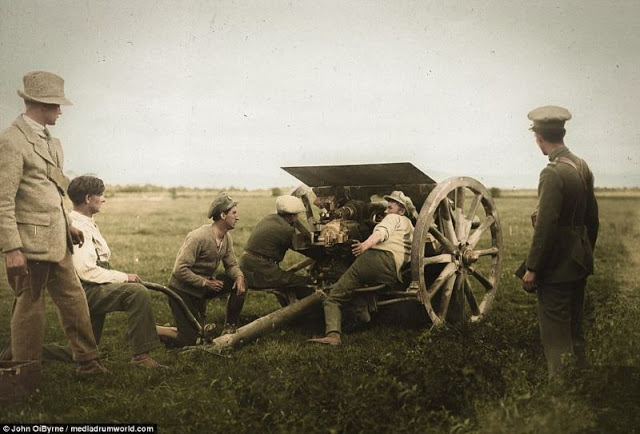
Group of Irish Free State Army soldiers grouped behind heavy field artillery. Two of the soldiers appear to be manoeuvring the gun into position watched by the others, including one wearing civilian tweeds. Rather than creating the independent republic favoured by most nationalists, the treaty meant the Irish Free State would be an autonomous dominion of the British Empire with the British monarch as head of state, similar to Canada and Australia. The British suggested this dominion in secret correspondence even before treaty negotiations began, but then Sinn Féin leader Éamon de Valera rejected it.
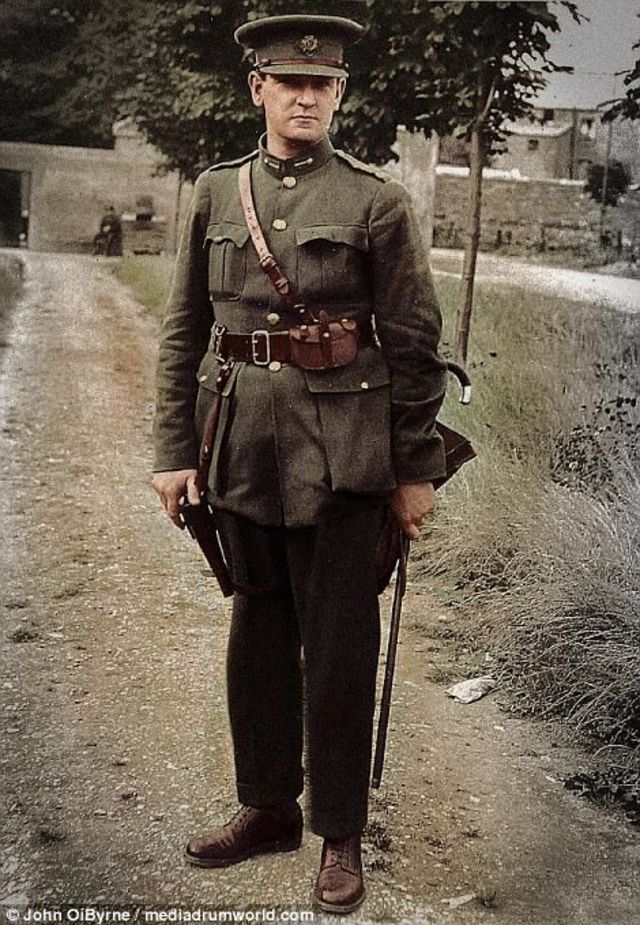
General Michael Collins
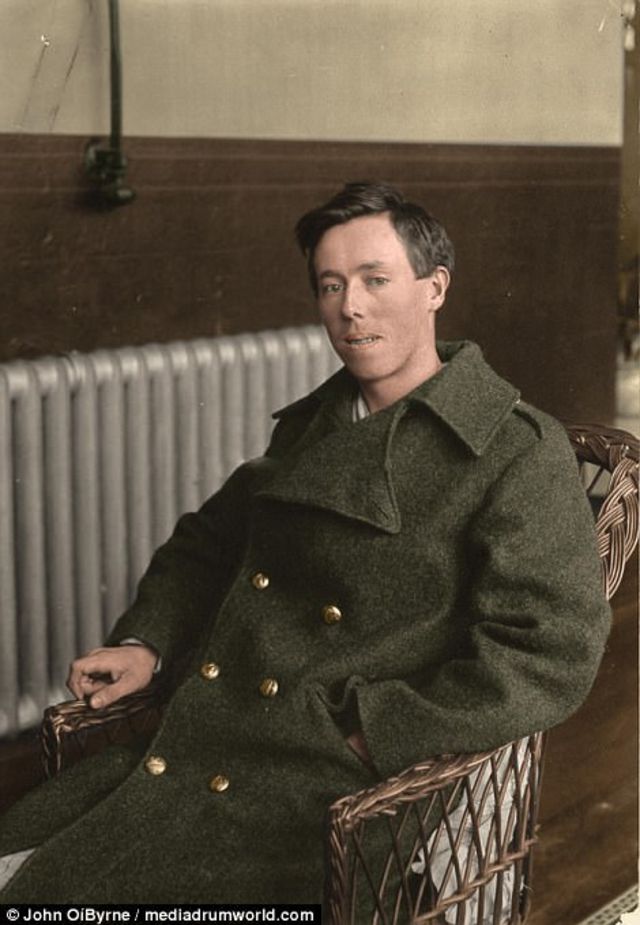
An Irish Free State Army soldier wearing his uniform coat but sitting in a wicker chair . He is identified in the caption as John Foley, third battalion, wounded in the thigh.
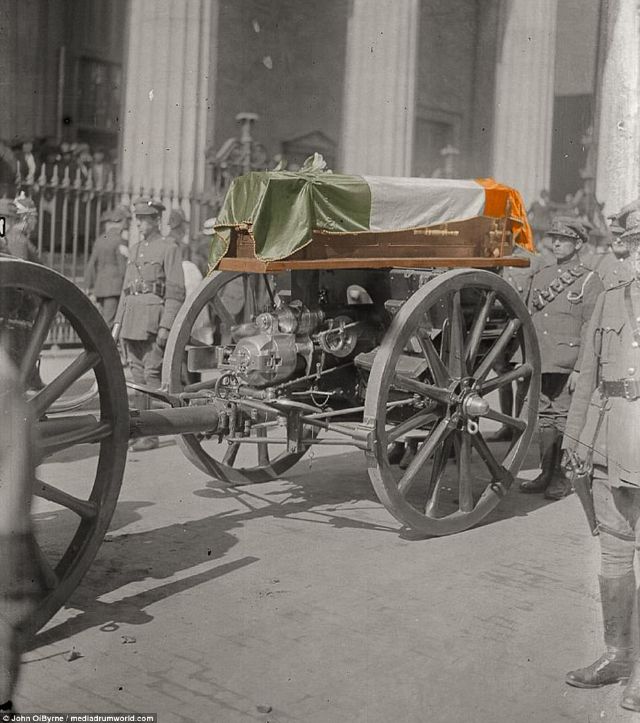
A photograph from the funeral of Michael Collins. The Irish flag is actually facing the wrong way – a mistake only noticed after it was placed on the coffin. The green should be at the head of the coffin. Michael Collins is an influential figure in the history of twentieth century Ireland. After the controversial treaty negotiations with Britain, he was appointed Chairman and Minister of Finance of the provisional government which was responsible for the establishment of the Irish Free State. He played a decisive role in devising a constitution, creating security forces and appointing a civil service. He was murdered while on an inspection tour of Munster and searching for a basis for peace with IRA leaders opposed to the Treaty.

The Iconic Photo of James Dean, Alone in the Rain, in the Middle of Times Square, 1955

James Byron Dean (February 8, 1931 – September 30, 1955) was an American actor. He is remembered as a cultural icon of teenage disillusionment and social estrangement, as expressed in the title of his most celebrated film, Rebel Without a Cause (1955), in which he starred as troubled teenager Jim Stark. The other two roles that defined his stardom were loner Cal Trask in East of Eden (1955) and surly ranch hand Jett Rink in Giant (1956).

After his death in a car crash, Dean became the first actor to receive a posthumous Academy Award nomination for Best Actor, and remains the only actor to have had two posthumous acting nominations. In 1999, the American Film Institute ranked him the 18th best male movie star of Golden Age Hollywood in AFI’s 100 Years…100 Stars list.

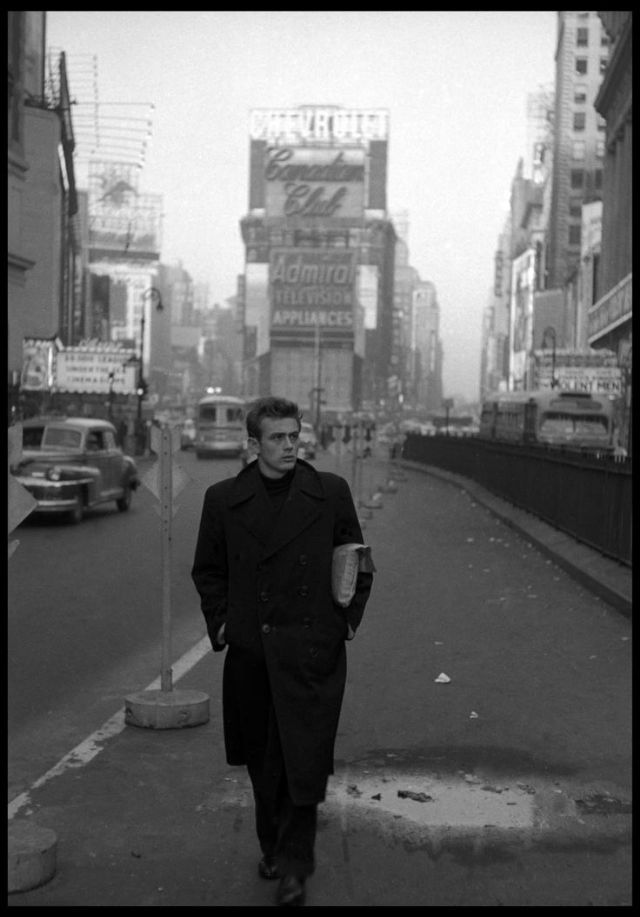
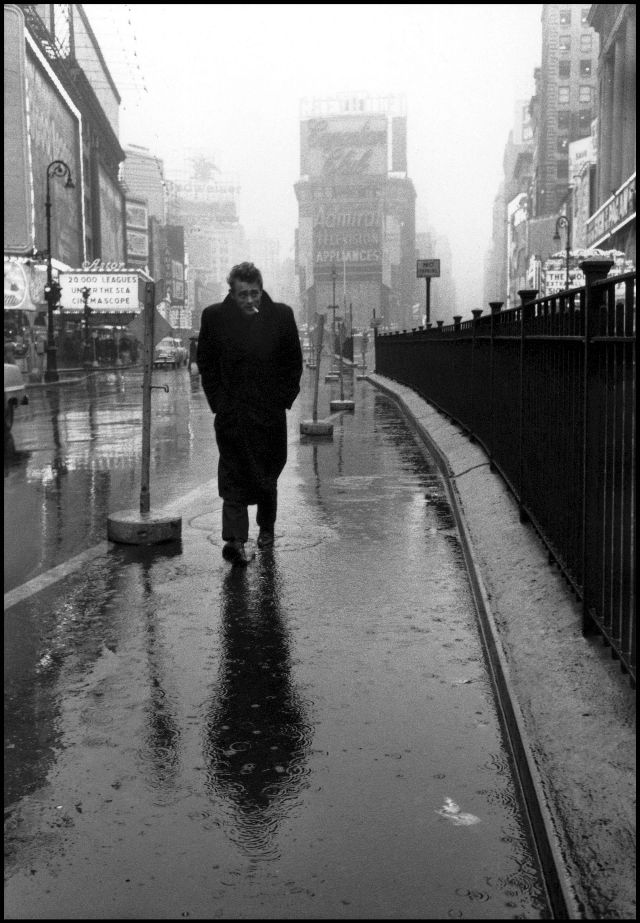
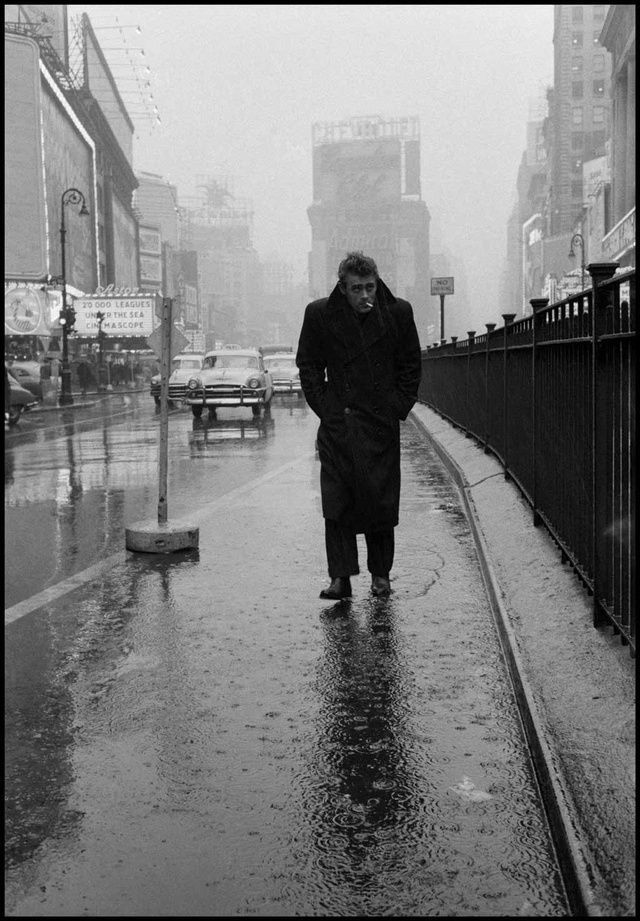
The picture, shot by Dennis Stock in early 1955, shows Dean walking alone in an eerily empty Times Square. It’s a lousy day. Wearing a long, wool coat, hunched against the chill, a cigarette loosely clamped in his lips, the actor is seen in mid-stride, stalking through the bleak Manhattan rain. At first glance, it might be a portrait of isolation, or even downright despair.

James Dean in New York City, 1955.

When the Magnum photographer Dennis Stock met actor James Dean in Hollywood in 1955, something about the rising star caught his attention. The young actor had yet to make what would be the defining film of his short career – Rebel Without a Cause – and, while not completely unknown, he was not the iconic figure he would soon become. Yet Stock, who at the time was making a steady living as a photographer for LIFE magazine, couldn’t get the actor out of his head. He saw something in Dean – charisma certainly, an untapped star quality – and was determined to capture him on film.

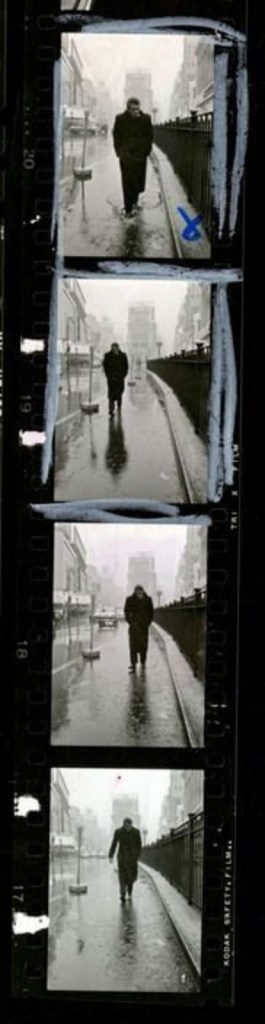
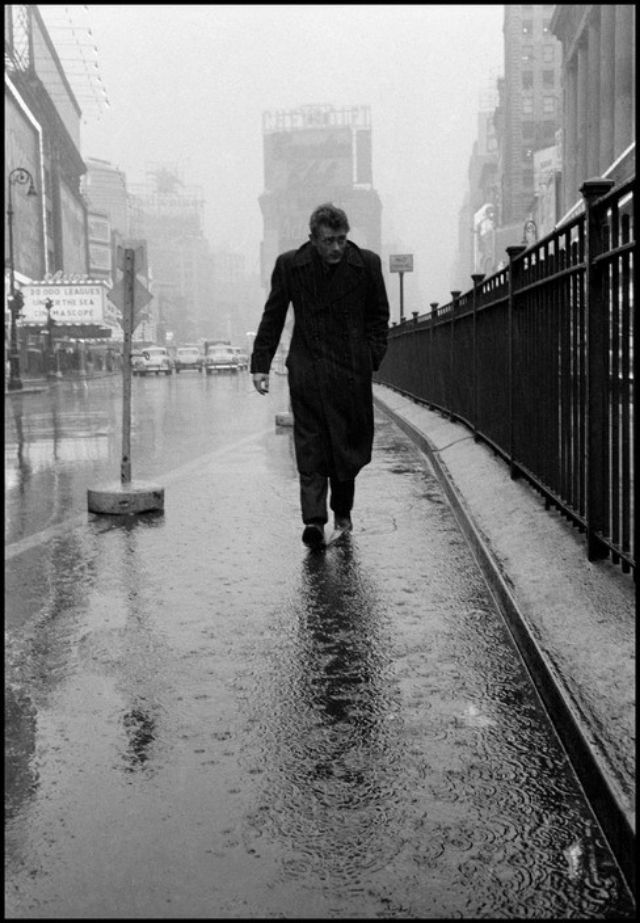
While in New York, Dean attended classes at the famous Actor’s Studio, directed by Lee Strasberg. While on the way to the studio one day, Stock photographed Dean in nearby Times Square. Rain was falling heavily and a light mist hung in the distance. Stock asked Dean to walk towards him a couple of times and shot just four frames with the actor at different distances from the camera.

Dennis Stock’s contact sheet.

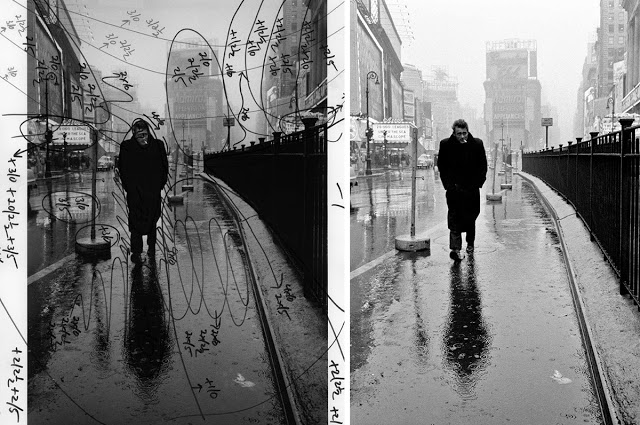
Three of the four frames showed Dean at the centre of the image, his outline conflicting with a building behind him. However, one of the shots was perfectly composed, with Dean placed against a clearer background and roughly one third of the way across the frame. Stock had instinctively used Dean’s reflection in the wet street as part of his composition, and further strengthened the image by using the pavement and railings on the right to lead into the subject.

James Dean in Times Square by Dennis Stock, dark room print notes by Pablo Inirio.

As well as having the ideal composition, the weather conditions lent the image a moody atmosphere that expressed something about Dean’s character. He looks solitary and battered by the elements, but at the same time looks coolly resilient to his surroundings. The picture also has a biographical element in that the background includes the awnings of cinemas where, as a young actor, he aspired to appear.

(Photos by Dennis Stock/Magnum Photos)

The Story Behind An Ashamed Mother Who Puts Her Four Children Up For Sale in Chicago in 1948

This devastating photograph from 1948 seems unreal. Surely people can’t sell their children in the United States, even in the 1940s?

04 Aug 1948, Chicago, Illinois, USA — Original caption: August 4, 1948 – Chicago, Illinois: They’re on the auction block. These small children of Mr. and Mrs. Ray Chalifoux of Chicago, Illinois. For long months 40 year old Ray and his wife, Lucille, 24, waged a desperate but losing battle to keep food in the mouth and a roof over their heads. Now jobless and facing eviction from their near barren flat, the Chalifoux have surrendered to their heart breaking decision. Photo shows mother sobbing as the children pose wonderingly on the steps. Left to right: Lana,6. Rae, 5. Milton, 4. Sue Ellen, 2 years old.

Family members accused the mother of being paid to stage the photo, which may have been part of the story, but unfortunately, she was dead serious about selling her children. Within two years all of the children pictures, as well as the baby she was carrying at the time, were sold off to different homes. Just a few years ago the scattered siblings tried to find each other, and their stories are of raw survival and heartbreak.

Before being picked up for national newspapers, the photo first appeared in The Vidette-Messenger of Valparaiso, Indiana on Aug. 5, 1948. The children looked posed and a bit confused as their pregnant mother hides her face from the photographer. The caption read:

“A big ‘For Sale’ sign in a Chicago yard mutely tells the tragic story of Mr. and Mrs. Ray Chalifoux, who face eviction from their apartment. With no place to turn, the jobless coal truck driver and his wife decide to sell their four children. Mrs. Lucille Chalifoux turns her head from camera above while her children stare wonderingly. On the top step are Lana, 6, and Rae, 5. Below are Milton, 4, and Sue Ellen, 2.”

“No one believes it,” Lance Gray said about his mother RaeAnn’s horrific and dramatic life story. In 2013 the then 70-year-old RaeAnn Mills reunited with her 67-year-old sister Sue Ellen Chalifoux for the first time since they were seven and four. By the time of their reunion Sue Ellen was dying of lung cancer but RaeAnn was grateful for the brief, bittersweet reunion. “It’s one of the happiest days of my life,” RaeAnn said of the trip she took with her son to visit Sue Ellen a few months before she passed away. Sue Ellen could no longer speak when they met, but she could write. “It’s fabulous. I love her,” she wrote of her sister RaeAnn, but minced no words about her birth mother: “She needs to be in hell burning.”

Sue Ellen, left, and her sister RaeAnn Mills were reunited at Chalifoux’s home in Hammond.

David McDaniel, who was in his mother’s womb at the time of photograph, never got to meet Sue Ellen before she passed away, or their older sister Lana, who died before the siblings started reconnecting.

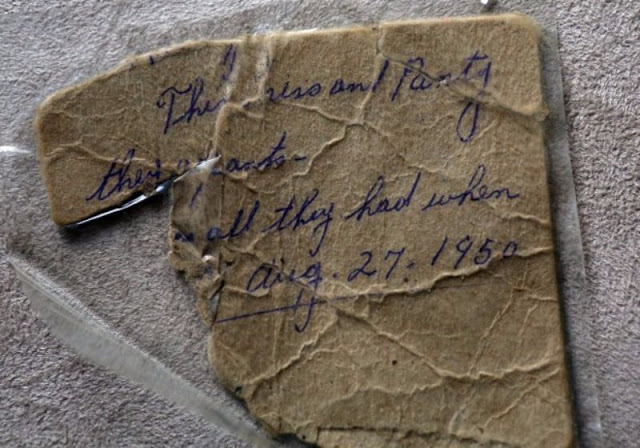
According to RaeAnn, she was sold for $2 to farmers John and Ruth Zoeteman on Aug. 27, 1950. Her brother Milton was crying nearby during the transaction, so the couple took him as well. Their names were changed to Beverly and Kenneth, and although their birth mother’s situation was dire, their new home wasn’t much of a salvation. They were often chained up in a barn and forced to work long hours in the field. Milton remembers being called a “slave” by his new father figure, a label he accepted at the time because he didn’t understand what it meant.

Although it seems that RaeAnn and Milton were never officially adopted by their abusers, their brother David (born Bedford Chalifoux) was legally adopted by Harry and Luella McDaniel, who only lived a few miles away. David, who says his adoptive parents were strict but loving and supportive, remembers riding out on his bike to see his siblings, and unchaining them before going back home.

RaeAnn Mills, left, and her brother were sold to the Zoeteman family.

RaeAnn left home at 17, shortly after undergoing a brutally traumatic situation. As a young teen she was kidnapped and raped, which resulted in a pregnancy. She was sent away to a home for pregnant girls, and had her baby adopted when she returned.

As Milton grew older, he reacted to the beatings, starving, and other abuses with violent rages. A judge deemed him a menace to society, and de spent a number of years in a mental hospital after being forced to choose between that and a reformatory (a juvenile detention center.)

The woman in the photograph remarried after selling/giving away her five children, and had four more daughters. When her other children eventually came to see her, she’s described as completely lacking love for her estranged children, or having any regret for letting them go.

A note sent with RaeAnn Mills when she was sold that describes her belongings, which was only the clothes she was wearing.

David McDaniel defended his mother’s coldness as evidence of a different, hardscrabble world. “As soon as my mom seen me, she said, ‘You look just like your father,’” McDaniel said. “She never apologized. Back then, it was survival. Who are we to judge? We’re all human beings. We all make mistakes. She could’ve been thinking about the children. Didn’t want them to die.”

Milton had a different perspective on the situation: “My birth mother, she never did love me. She didn’t apologize for selling me. She hated me so much that she didn’t care.”

Stunning Colorized Photographs of the Discovery of the Tutankhamun’s Tomb in the 1920s

Tutankhamun, commonly referred to as King Tut, was an ancient Egyptian pharaoh who was the last of his royal family to rule during the end of the 18th Dynasty (ruled c. 1332 – 1323 BC in the conventional chronology) during the New Kingdom of Egyptian history. His father is believed to be the pharaoh Akhenaten, identified as the mummy found in the tomb KV55. His mother is his father’s sister, identified through DNA testing as an unknown mummy referred to as “The Younger Lady” who was found in KV35.

Tutankhamun took the throne at eight or nine years of age under the unprecedented viziership of his eventual successor, Ay, to whom he may have been related. He married his paternal half-sister Ankhesenamun. During their marriage they lost two daughters, one at 5–6 months of pregnancy and the other shortly after birth at full-term. His names—Tutankhaten and Tutankhamun—are thought to mean “Living image of Aten” and “Living image of Amun”, with Aten replaced by Amun after Akhenaten’s death. A small number of Egyptologists, including Battiscombe Gunn, believe the translation may be incorrect and closer to “The-life-of-Aten-is-pleasing” or, as Professor Gerhard Fecht believes, reads as “One-perfect-of-life-is-Aten”.

Tutankhamun restored the Ancient Egyptian religion after its dissolution by his father, enriched and endowed the priestly orders of two important cults and began restoring old monuments damaged during the previous Amarna period. He reburied his father’s remains in the Valley of the Kings and relocated the capital from Akhetaten back to Thebes. Tutankhamun was physically disabled with a deformity of his left foot along with bone necrosis that required the use of a cane, several of which were found in his tomb. He had other health issues including scoliosis and had contracted several strains of malaria.

The 1922 discovery by Howard Carter of Tutankhamun’s nearly intact tomb, in excavations funded by Lord Carnarvon, received worldwide press coverage. With over 5,000 artifacts, it sparked a renewed public interest in ancient Egypt, for which Tutankhamun’s mask, now in the Egyptian Museum, remains a popular symbol. The deaths of a few involved in the discovery of Tutankhamun’s mummy have been popularly attributed to the curse of the pharaohs. He has, since the discovery of his intact tomb, been referred to colloquially as “King Tut”.

Some of his treasure has traveled worldwide with unprecedented response. The Egyptian Supreme Council of Antiquities allowed tours beginning in 1962 with the exhibit at the Louvre in Paris, followed by the Kyoto Municipal Museum of Art in Tokyo, Japan. The exhibits drew in millions of visitors. The 1972–1979 exhibit was shown in United States, Soviet Union, Japan, France, Canada, and West Germany. There were no international exhibitions again until 2005–2011. This exhibit featured Tutankhamun’s predecessors from the 18th Dynasty, including Hatshepsut and Akhenaten, but did not include the golden death mask. The treasures 2019–2022 tour began in Los Angeles and will end in 2022 at the new Grand Egyptian Museum in Cairo, which, for the first time, will be displaying the full Tutankhamun collection, gathered from all of Egypt’s museums and storerooms. (Wikipedia)

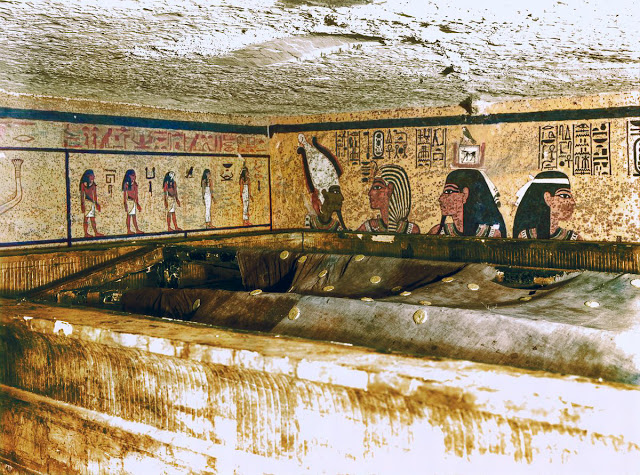
Harry Burton’s photographs capture Tutankhamun’s tomb at the moment of its discovery have enthralled the world for generations, enabling the viewer to witness the ‘Wonderful Things’ the discoverers of the tomb, Howard Carter and Lord Carnarvon, were fortunate to experience first-hand.

Burton’s iconic black and white photographs have illustrated the imagination of millions for almost a century, and now a selection of the original negatives and photographs, housed in the archive of the Griffith Institute, University of Oxford, has been digitally colourised by Dynamichrome on behalf of SC Exhibitions and the Griffith Institute.

29th/30th October 1925, Tutankhamun’s Tomb | Carter and an Egyptian workman examine the third (innermost) coffin (Carter no. 255) made of solid gold, inside the case of the second coffin. (Carter no. 254).
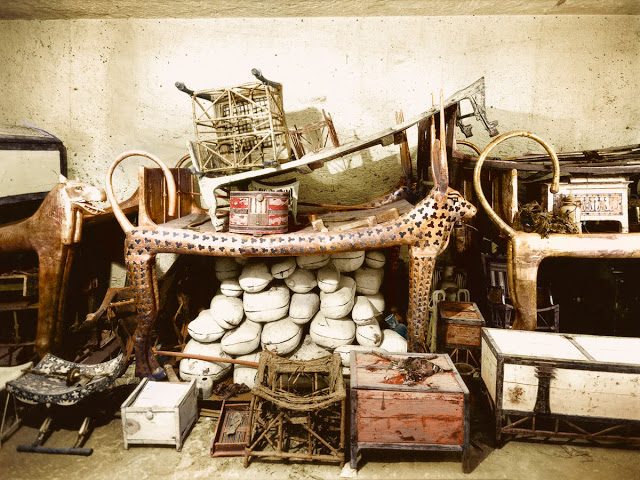
December 1922, Tutankhamun’s Tomb | Objects, including the cow-headed couch (Carter no. 73) and boxes containing joints of meat (Carter nos. 62a to 62vv) piled up against the west wall of the Antechamber.
December 1922, Tutankhamun’s Tomb | View of the northern wall of the Antechamber showing the sentinel statues (Carter nos. 22 & 29) guarding the sealed doorway leading to the King’s Burial Chamber.
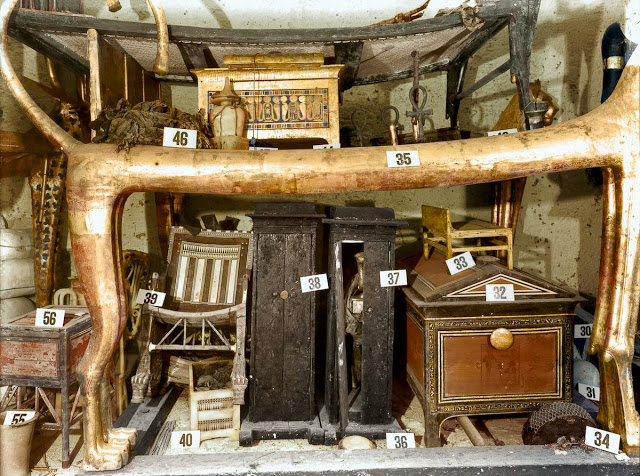
December 1922, Tutankhamun’s Tomb | Objects stacked under the lion couch (Carter no. 35) against the west wall of the Antechamber included an ivory and ebony chest (Carter no. 32), black ‘shrine-shaped boxes’ (Carter nos. 37 and 38) and a child’s chair made of ebony (Carter no. 39).
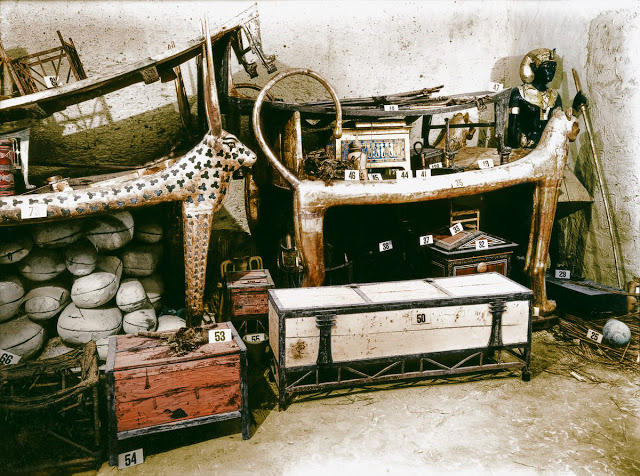
December 1922, Tutankhamun’s Tomb | The rectangular white box (Carter no. 50), in front of the lion couch (Carter no. 35) in the Antechamber, contained, amongst other items, linen garments (shirts, shawls and loin cloths), 18 sticks, 69 arrows and a trumpet.
29th November 1923, Tutankhamun’s Tomb | Howard Carter (on the left) working with his friend and colleague Arthur Callender on wrapping one of two sentinel statues of Tutankhamun (Carter no. 22) found in the Antechamber, before their removal to the ‘laboratory’ set up in the tomb of Sethos II (KV 15). These statues had been placed either side of the sealed entrance to the Burial Chamber.
December 1923, Tutankhamun’s Tomb | The linen pall, decorated with bronze ‘rosettes’ (Carter no. 209) inside the walls of the first (outermost) golden shrine (Carter no. 207) in the north west corner of the Burial Chamber.
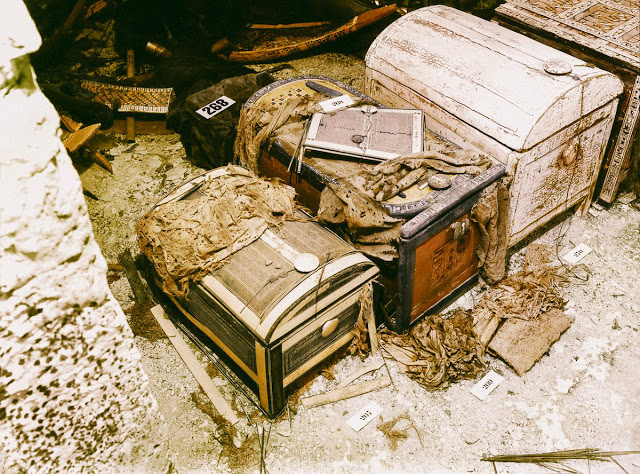
October 1926, Tutankhamun’s Tomb | A line of chests down the centre of the Treasury, ending with the canopic chest (Carter no. 266) which housed the king’s linen-wrapped stomach, intestines, liver and lungs in miniature gold coffins, inside an alabaster canopic box.
October 1926, Tutankhamun’s Tomb | Three wooden chests (the middle one in the shape of a cartouche) on the floor of the Treasury (Carter nos. 267, 269 and 270). Amongst other items these contained earrings, sandals and a wax model of a heron.
October 1925, Tutankhamun’s Tomb | Howard Carter working on the lid of the second (middle) coffin, still nestled within the case of the first (outermost) coffin in the Burial Chamber.
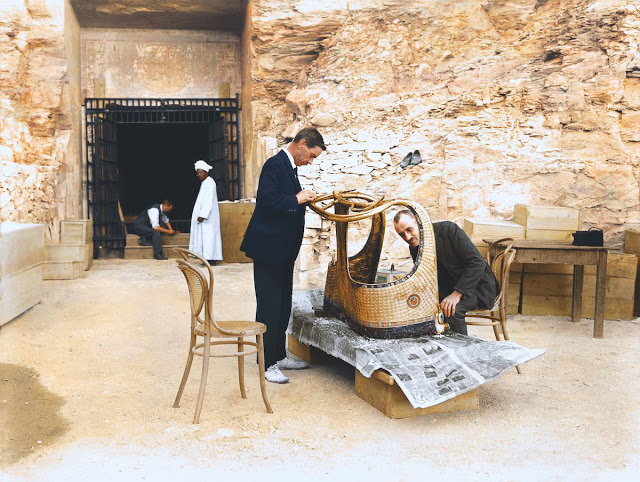
November/December 1923, Sethos II’s Tomb (‘laboratory’) | Arthur Mace (left) and Alfred Lucas working outside the ‘laboratory’ set up in the tomb of Sethos II (KV 15), stabilizing the surface of one of the state chariots (Carter no. 120) found in the Antechamber.
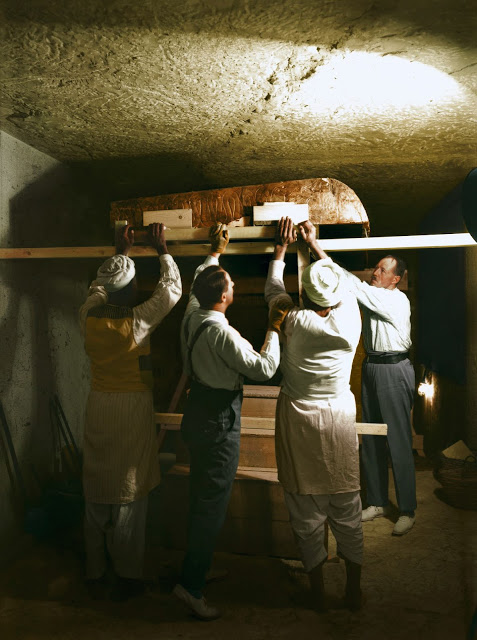
30th December 1923, Tutankhamun’s Tomb | Howard Carter (left), Arthur Mace and an Egyptian workman standing on scaffolding, roll back the linen pall (Carter no. 209) which lay over a gilded, wooden frame (Carter no. 208) between the first (outermost) and second shrines.
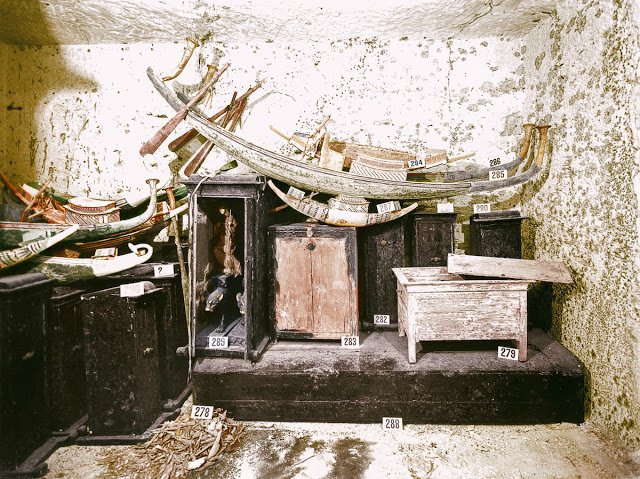
November 1926, Tutankhamun’s Tomb | Objects, including numerous model boats (Carter nos. 284 to 287), stacked against the southern wall of the Treasury.
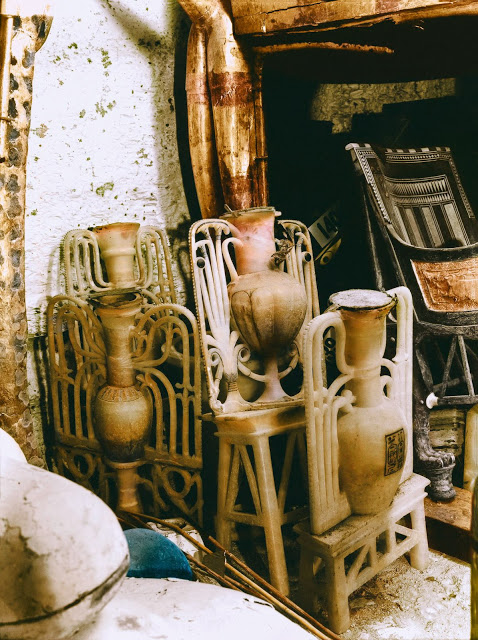
December 1922, Tutankhamun’s Tomb | Sealed alabaster ‘unguent’ vases (Carter nos. 57, 58, 60 and 61) between the cow-headed (Carter no. 73) and lion (Carter no. 35) couches against the west wall of the Antechamber.
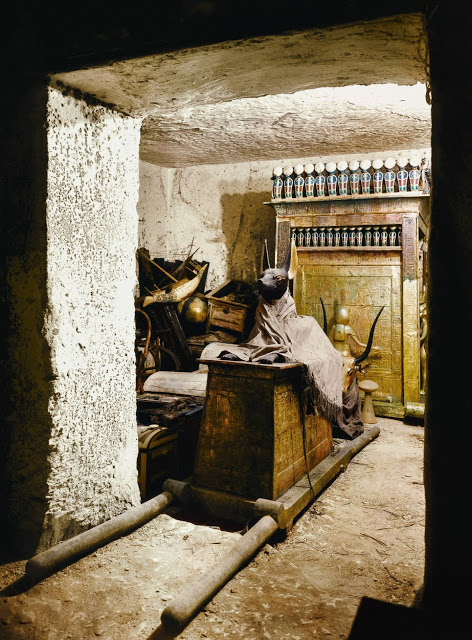
October 1926, Tutankhamun’s Tomb | The Anubis shrine (Carter no. 261) on the threshold of the Treasury viewed from the Burial Chamber. The figure of Anubis was covered with a linen shirt inscribed with the cartouche of Akhenaten.
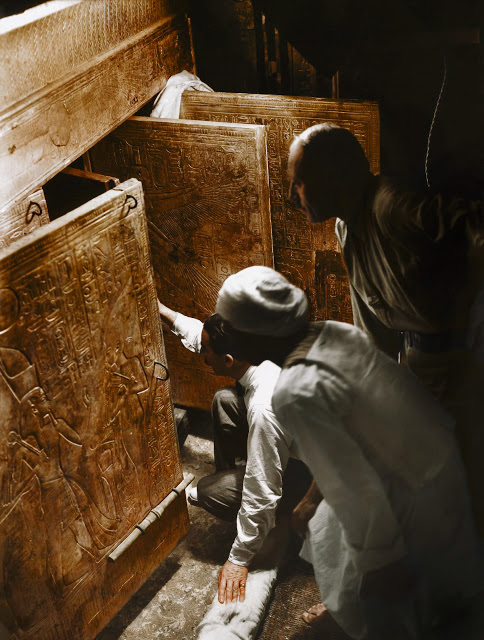
4th January 1923, Tutankhamun’s Tomb | Howard Carter (kneeling), Arthur Callender and an Egyptian workman in the Burial Chamber, looking through the open doors of the four gilded shrines towards the quartzite sarcophagus.
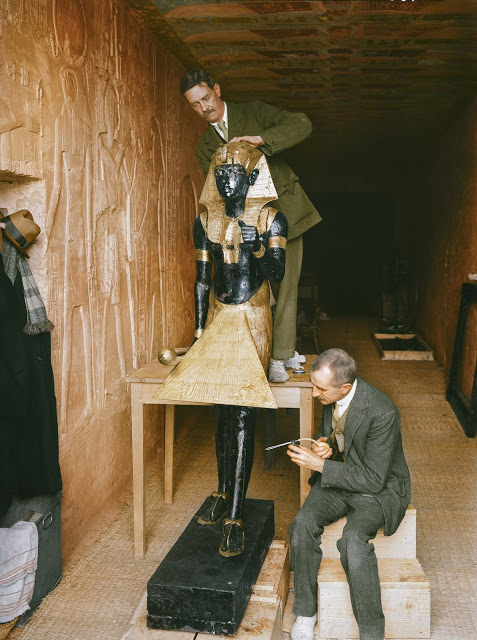
January 1924, Sethos II’s Tomb (‘laboratory’) | Arthur Mace (standing) and Alfred Lucas (sitting) working inside the makeshift ‘laboratory’ (set up in KV 15, the tomb of Sethos II) on the conservation of one of the two sentinel statues from the Antechamber (Carter no. 22). The statue shows the King wearing the nemes headdress, kilt and sandals, and carrying a mace and a staff.
29th/30th October 1925, Tutankhamun’s Tomb | The gold mask (Carter no. 256a) in situ on the mummy of the King, still inside the third (innermost) solid gold coffin (Carter no. 255).
December 1923, Tutankhamun’s Tomb | Howard Carter (centre), Arthur Callender and two Egyptian workmen lifting one roof section from the first, outermost shrine (Carter no. 207). With its double sloping roof, the shape of this shrine resembles that of a ‘sed festival pavilion’; it was made of from twenty separate oak sections, held together by a variety of different joints.
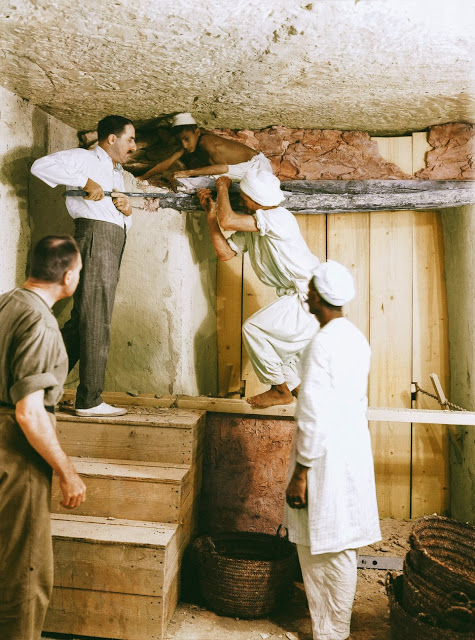
2nd December 1923, Tutankhamun’s Tomb | Howard Carter (at the top of the stairs), Arthur Callender and Egyptian workmen removing the wall between the Antechamber and the Burial Chamber to enable the dismantling of the four golden shrines enclosing the sarcophagus.
Herbert George Edward Stanhope Molyneux, 5th Earl of Carnarvon, reading on the verandah of ‘Castle Carter’, Carter’s house at Elwat el-Dibbân on the Theban West Bank.

(All photographs © Griffith Institute, University of Oxford; colorized by Dynamichrome)

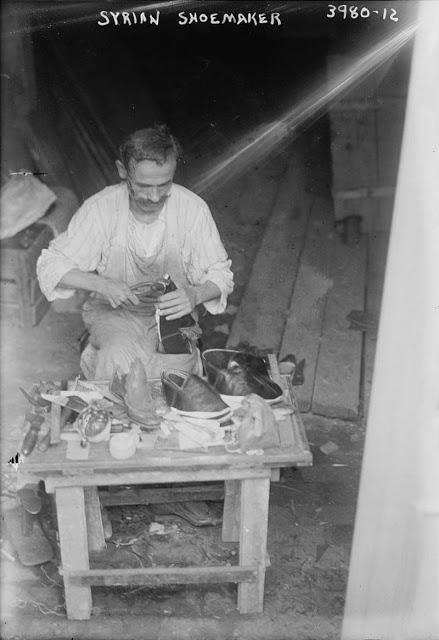
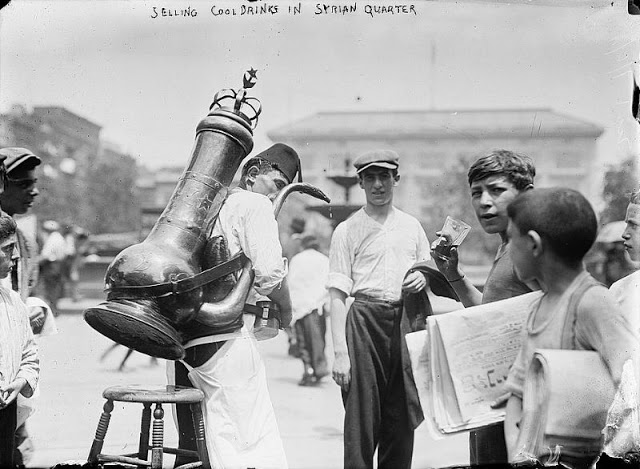
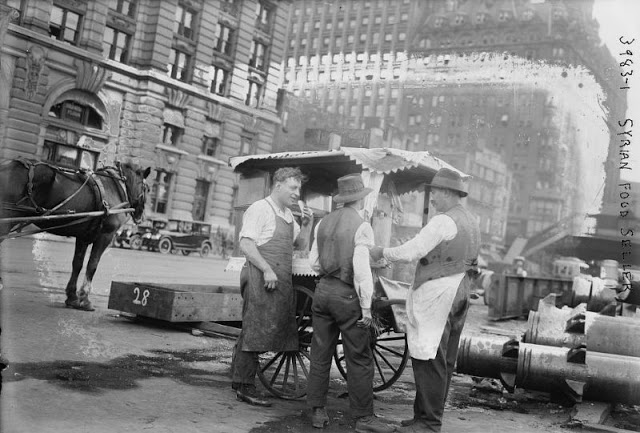
Little Syria: Portraits of Syrian Immigrants in Lower Manhattan in the Early 20 Century

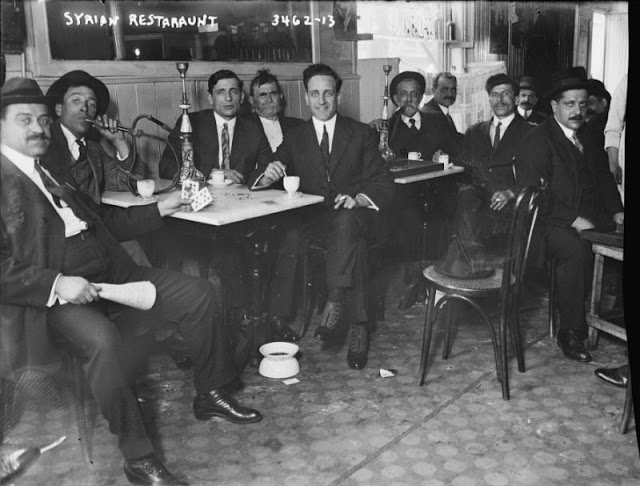
The Chinese have Chinatown. The Italians have Little Italy. And before the Brooklyn-Battery Tunnel pummeled its way into Manhattan, people from the Middle East also shared a slice of the city’s history. Little Syria, as it was known, was the cultural hub of America’s first middle eastern immigrant community and it was located just south of where the current World Trade Center stands today.

For 60 years between 1880 until the 1940s, Arab-Americans poured into New York City from Greater Syria made up of present-day countries including Lebanon, Syria, Jordan and Israel to escape religious persecution and poverty. They found homes in crowded tenements on a six block stretch of Washington Street from Liberty Street to Battery Park, alongside Armenians, Greeks, and other communities from the Middle East and the Mediterranean.

According to an 1899 article from the New York Times about the Syrian Quarter and its 3,000 residents, the newly arrived immigrants made a home for themselves in this “tousled unwashed section of New York”.

“Turks, Armenians, Syrians, when they ship for America, do not leave all their quaint customs, garments, ways of thinking at home. Nor do they become ordinary American citizens directly after landing. Just enough of their traits, dress, ideas remain, no matter how long they have been here, to give the colonies they form spice and a touch of novelty.”

Many of the early Syrian-Americans began their new lives as street vendors before saving up to establish their own businesses. According to the New York Public Library, over 300 Syrian businesses were listed in the 1908 Syrian Business Directory of New York.

Elizabeth Eckford and Hazel Bryan: The Story Behind the Famous Little Rock Nine ‘Scream Image’

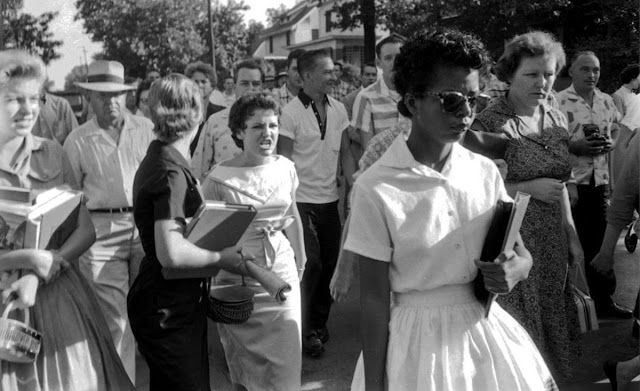
You’ve probably seen the photo: a young African-American girl walks to school, her eyes shielded by sunglasses. She is surrounded by a hateful crowd of angry white people, including a girl caught mid-jeer, her teeth bared and her face hardened with anger. It’s one of the most famous images of the civil rights era, but it turns out that the story of the young women in the photo is even more complicated than the racial drama their faces portray.

Elizabeth Eckford (right) attempts to enter Little Rock High School on Sept. 4, 1957, while Hazel Bryan (left) and other segregationists protest.

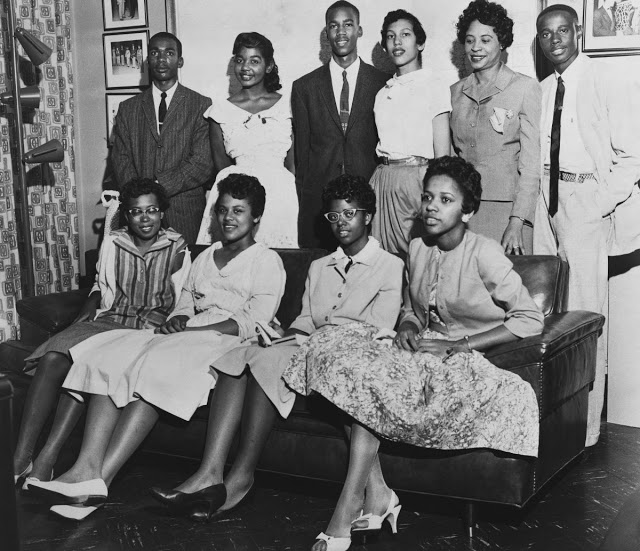
On September 4th, 1957, nine African-American students entered Little Rock Central High School as the school’s first black students, including Elizabeth Eckford. On her way to the school, a group of white teenage girls followed Eckford, chanting “Two, four, six, eight! We don’t want to integrate!” One of these girls was Hazel Bryan. Benjamin Fine of The New York Times later described her as “screaming, just hysterical, just like one of these Elvis Presley hysterical deals, where these kids are fainting with hysteria.” Bryan is also credited as shouting, “Go home, nigger! Go back to Africa!”

After the photo became public, Hazel started to receive “critical” mail, all from the north. Author David Margolick wrote that while Hazel only found the criticism “surprising”, “Hazel’s parents, though, found her sudden notoriety sufficiently alarming to pull her out of the school.”

Bryan left her new school when she was 17, got married to Antoine Massery and began a family. After that, her attitude toward Martin Luther King and the concept of desegregation changed. “Hazel Bryan Massery was curious, and reflective… One day, she realized, her children would learn that the snarling girl in their history books was their mother. She realized she had an account to settle.”

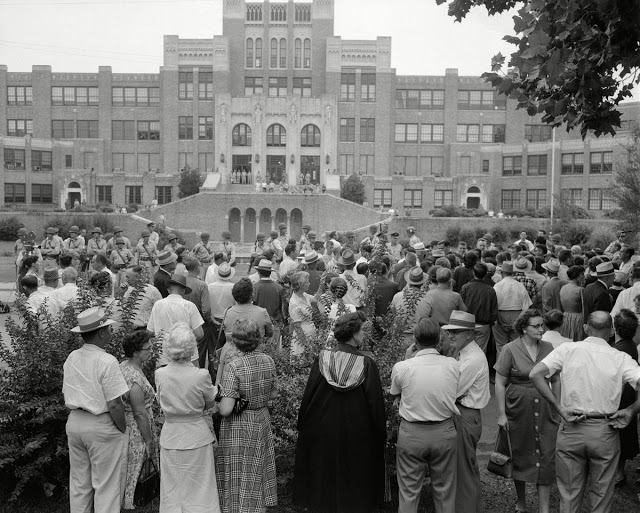
The crowd gathered outside Little Rock Central High School. The military men were ordered by Governor Orval Faubus to surround the school and prevent Black students from entering the grounds.

In 1963, having changed her mind on integration and feeling guilt for her treatment of Eckford, Bryan contacted Eckford to apologize. They went their separate ways after this first meeting, and Eckford did not name the girl in the picture when asked about it by reporters.

During the time after Little Rock, Hazel had become increasingly political, branching out into peace activism and social work. David Margolick discovered, “She taught mothering skills to unmarried black women, and took underprivileged black teenagers on field trips. She frequented the black history section at the local Barnes & Noble, buying books by Cornel West and Shelby Steele and the companion volume to Eyes on the Prize.”

These nine teenagers integrated the white high school in Little Rock, Arkansas. They were kicked, ridiculed, threatened, called every name, spat on, ignored, and had acid thrown in their faces. Bottom row (L-R): Thelma Mothershed, Minnijean Brown, Elizabeth Eckford, Gloria Ray; Top row (L-R): Jefferson Thomas, Melba Pattillo, Terrence Roberts, Carlotta Walls, Daisy Bates (NAACP President), Ernest Green, 1957.

Bryan hoped her reputation could be gained back, but this did not happen until the 40th anniversary of Central’s desegregation in 1997. Will Counts, the journalist who took the famous picture, arranged for Elizabeth and Hazel to meet again. The reunion provided an opportunity for acts of reconciliation, as noted in this editorial from the Arkansas Democrat-Gazette on the first day of 1998:

One of the fascinating stories to come out of the reunion was the apology that Hazel Bryan Massery made to Elizabeth Eckford for a terrible moment caught forever by the camera. That 40-year-old picture of hate assailing grace — which had gnawed at Ms. Massery for decades — can now be wiped clean, and replaced by a snapshot of two friends. The apology came from the real Hazel Bryan Massery, the decent woman who had been hidden all those years by a fleeting image. And the graceful acceptance of that apology was but another act of dignity in the life of Elizabeth Eckford.

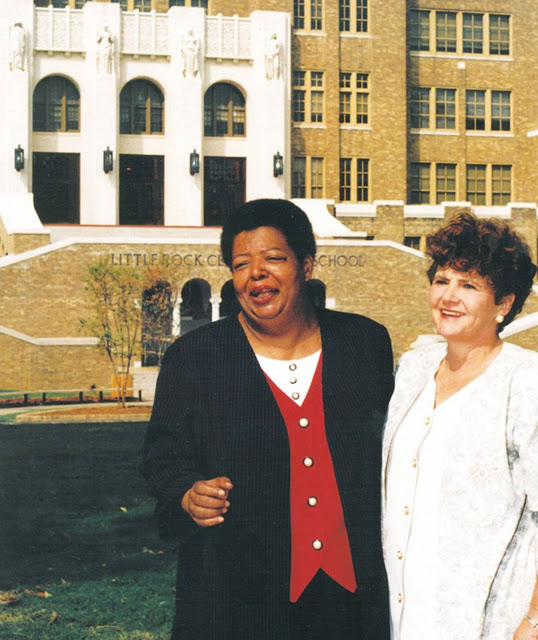
Elizabeth Eckford and Hazel Bryan Massery at Little Rock Central High School in 1997.

Feeling awkward when they first met, Eckford and Bryan surprisingly became friends afterwards:

They went to flower shows together, bought fabrics together, took mineral baths and massages together, appeared in documentaries and before school groups together. Since Elizabeth had never learned to drive, Hazel joked that she had become Elizabeth’s chauffeur. Whenever something cost money, Hazel treated; it was awkward for Elizabeth, who had a hard time explaining to people just how poor she was.

Soon after, the friendship began to fray. In 1999, David Margolick travelled to Little Rock and arranged to meet Elizabeth and Hazel. According to Hazel Bryan, she said, “I think she still… at times we have a little… well, the honeymoon is over and now we’re getting to take out the garbage.” As Eckford began to believe Bryan “wanted me to be cured and be over it and for this not to go on… She wanted me to be less uncomfortable so that she wouldn’t feel responsible anymore.” The other eight of the Little Rock Nine didn’t want this friendship to last any longer. The friendship quietly dissolved in 1999, when Elizabeth Eckford wrote “True reconciliation can occur only when we honestly acknowledge our painful, but shared, past” on the brick of Central High. This message affected their friendship.

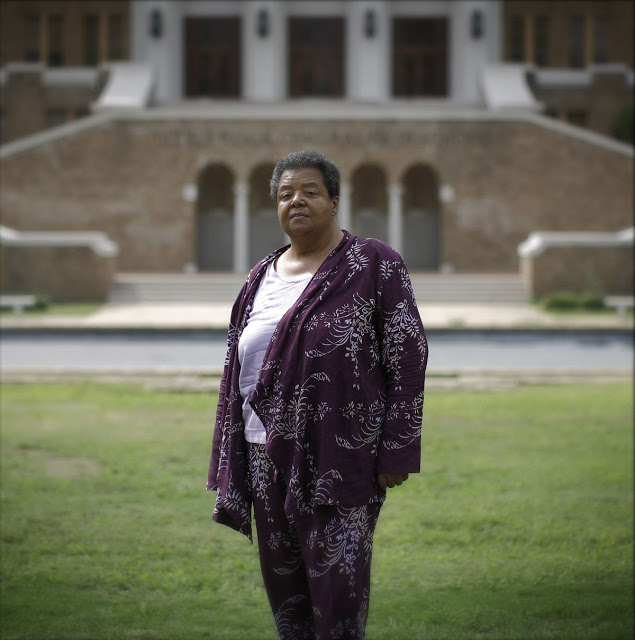
Elizabeth Eckford in front of the main entrance of Central High School in Little Rock, Arkansas, 2007. Eckford was the first of nine black schoolchildren to make history on September 4th, 1957 when she arrived, alone, for the first day of classes at the all-white high school.

The principal of Central High School stated “I just had hoped that I could show this picture and say, ‘This happened, and that happened, and now…’ and there is no ‘now’.” She added, “And that makes me sad. It makes me sad for them, it makes me sad for the future students at our school, and for the history books, because I’d like a happy ending. And we don’t have that.”

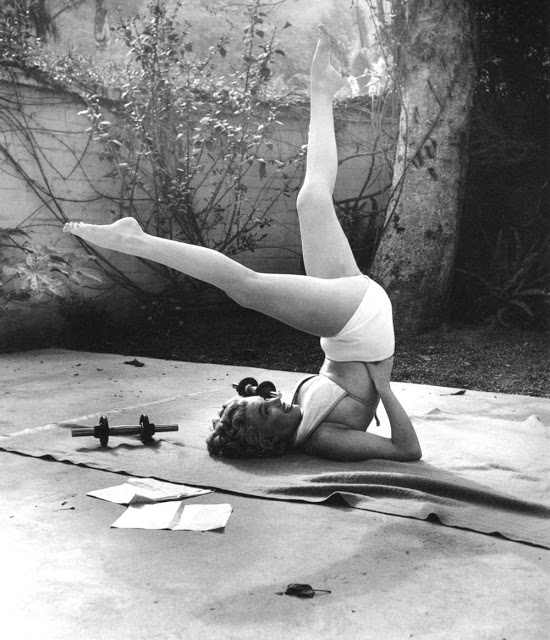
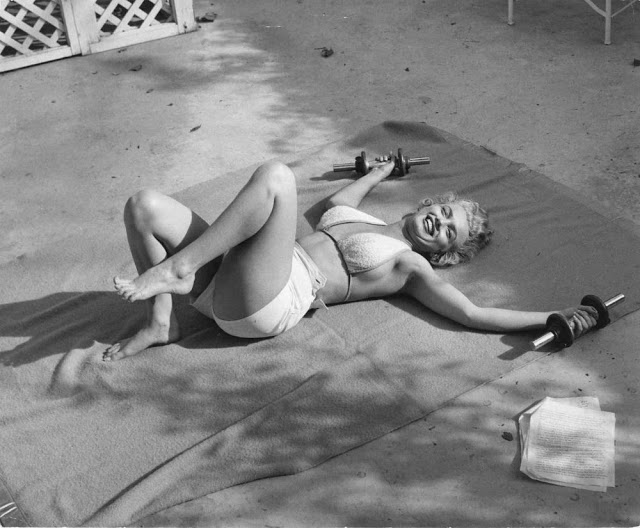
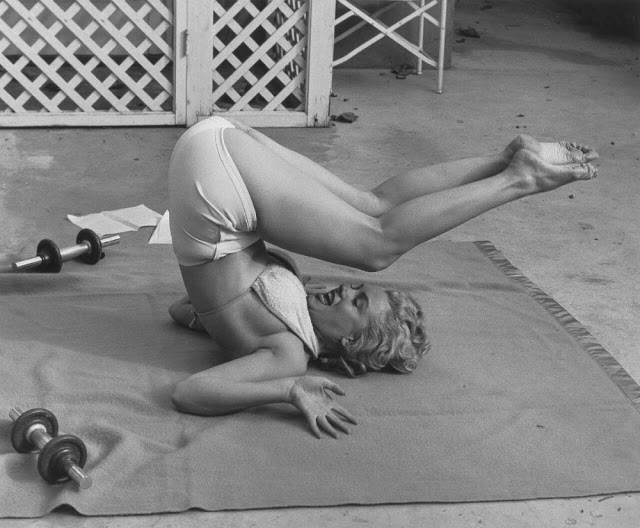
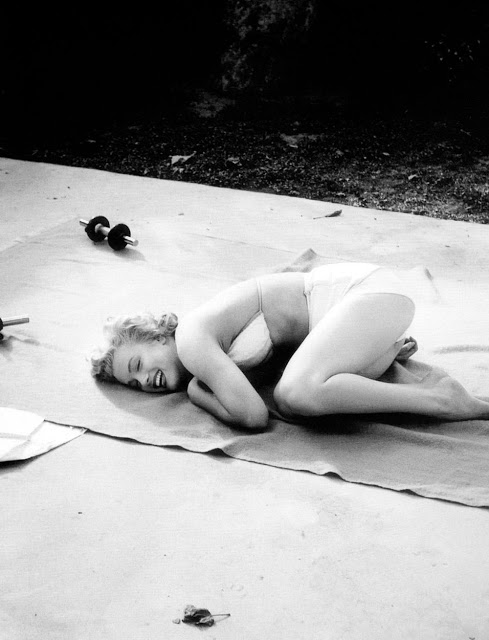
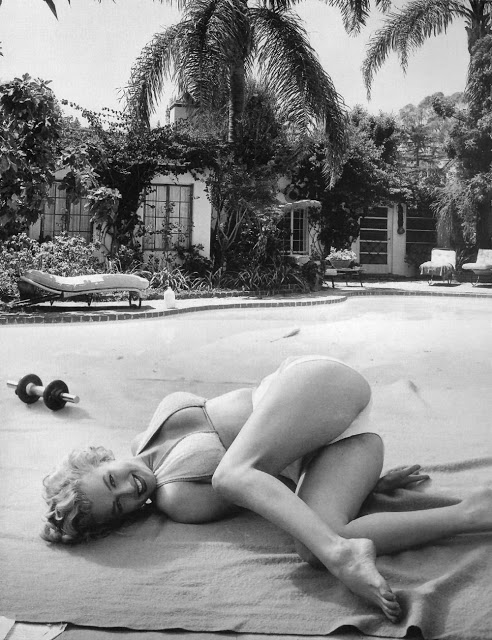
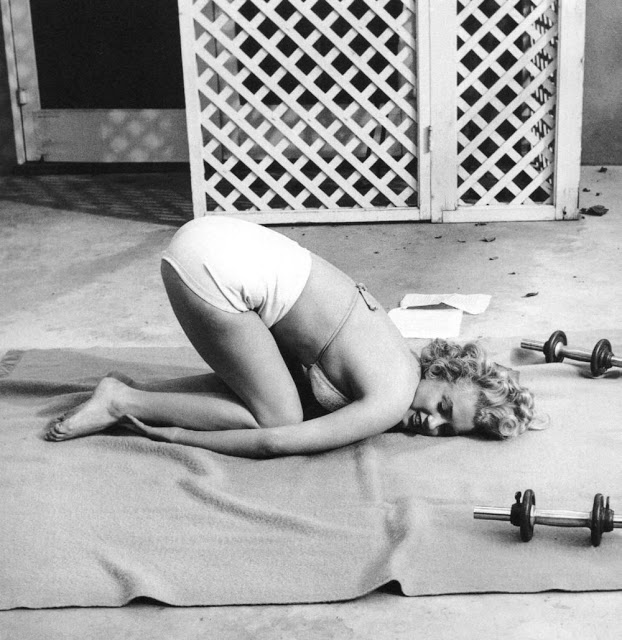
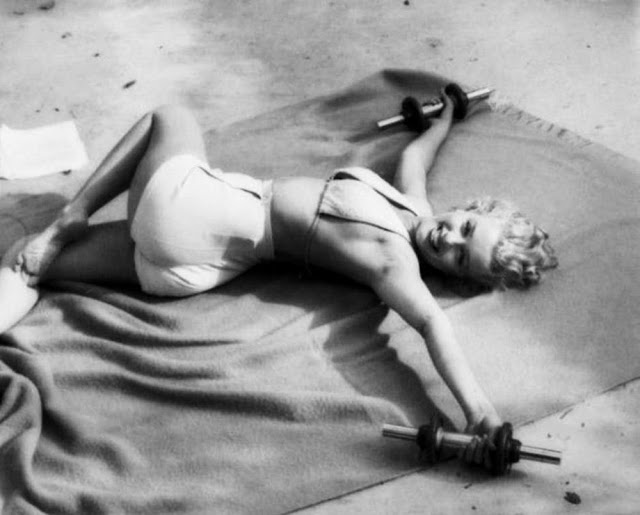
Marilyn Monroe Working Out at the Bel Air Hotel in 1953

In 1945 Hungarian-Romanian photographer Andre de Dienes met the nineteen-year-old Marilyn Monroe, then called Norma Jeane Baker, who was a model on the books of Emmeline Snively’s Blue Book Model Agency

Norma Jeane had recently separated from her husband, James Dougherty, and told Dienes of her wish to become an actress. Dienes suggested that they go on a road trip to photograph her in the natural landscapes, for which Dienes paid her a flat fee of $200.

Dienes next met her on Labor Day in 1946, with her new name of Marilyn Monroe, they next worked together in 1952, where he shot her at the Bel Air Hotel and 1953, where she telephoned him at 2am, and took him to a darkened street where he used his car headlights to illuminate her, taking pictures her wide-eyed and unmade up. Dienes last saw her alive in June 1961.

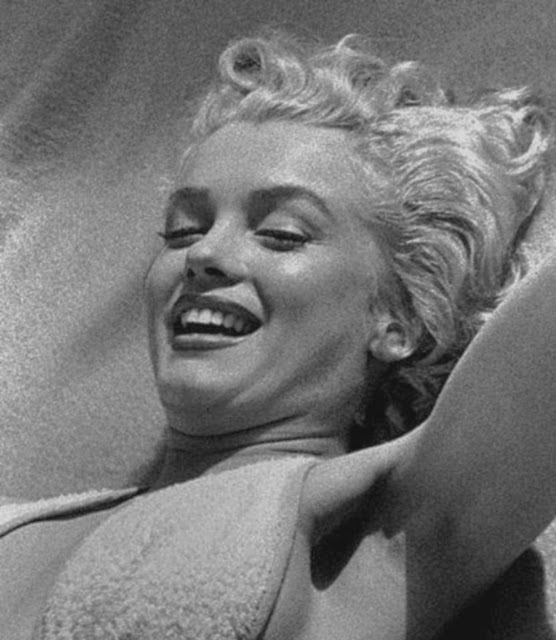
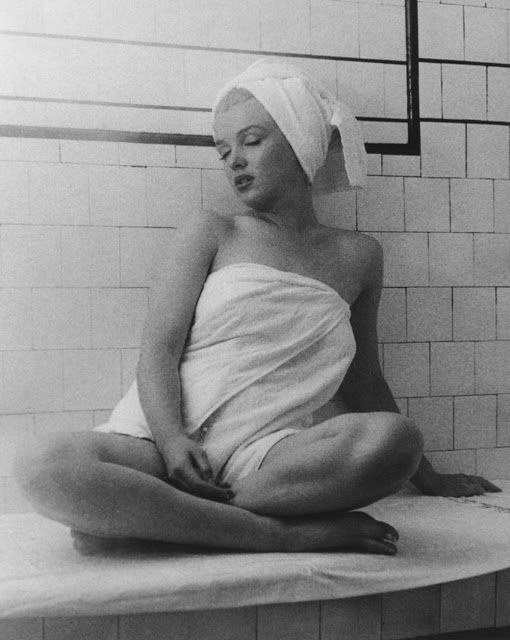
These photos were taken by Hungarian-Romanian photographer Andre de Dienes at Bel Air Hotel in 1953, showing the beautiful Marilyn Monroe working out — or not really — and keeping herself in tip-top shape. De Dienes was also among the first photographers who photographed Marilyn during her early modeling days, notably the 1949 pin-up series taken at Long Island’s Tobay Beach in New York.

Yesterday Today

Bringing You the Wonder of Yesterday - Today

Skip to content ↓