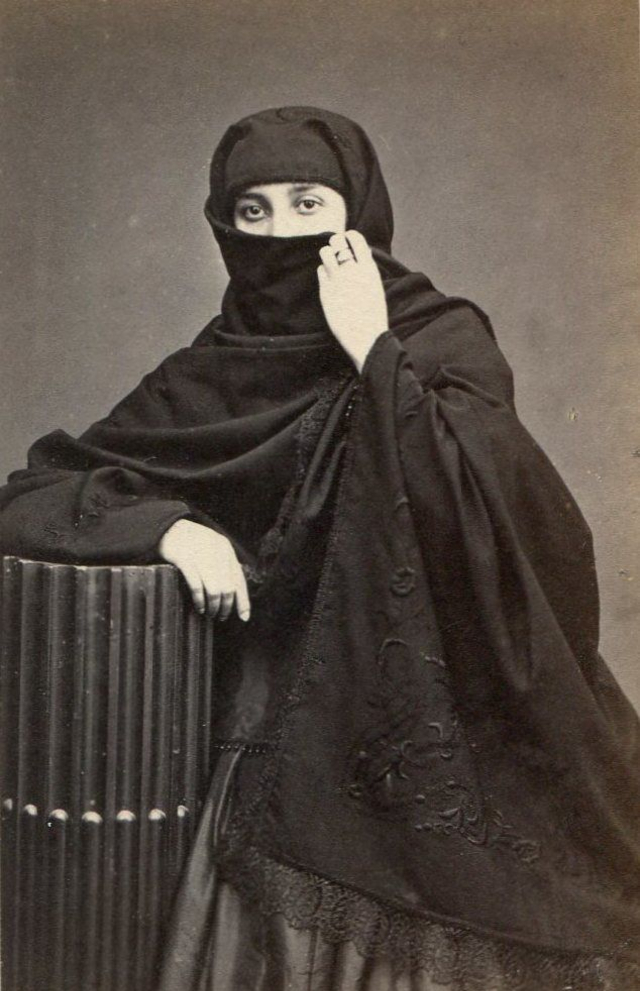
Images of people in typical local costume and vocations were among the standard offerings of any 19th century photographic studio. Many such themes are found in the cartes-de-visite produced in Peru during the 1860s, but by far the most important of these types was the tapada, the veiled one. The costume and manner of the tapada were peculiar even in Peru and were associated exclusively with Lima.
These days, society, including men and women, feel restricted by the fickle trends dictated from fashion’s elite. In Lima, however, there was a time when women felt freer, one could say, thanks to fashion and their choice to cover up. These women, who came to be known as Tapadas Limeñas, were even able to prevent a ban on their garments of choice: the saya (skirt) and manto (veil or wrap). The saya was an overskirt, worn tight at the waist and raised to show off feet and ankles. The manto was a thick veil fastened to the back of the waist; from there it was brought over the shoulders and head and drawn over the face so closely that all that was left uncovered was a small triangular space sufficient for one eye to peep through.
The Tapadas Limeñas were found exotic at that time and some men were even attracted by their mysterious appearance. As a consequence, the Church and some other laws prohibited these clothes. Still, women kept on wearing these clothes till deep in the 19th century. They believed it was ethical, but mainly because they didn’t want to give up their freedom.
Subscribe to continue reading
Become a paid subscriber to get access to the rest of this post and other exclusive content.
When the First World War broke out, the era of the horse bus drew to a close. London’s largest bus operator, the London General Omnibus Company (LGOC), had replaced all its horse buses with motor buses in 1911 and 1912. A few other bus operators continued to use horses until August 1914.
These new vehicles, especially the B type bus, manufactured first by the LGOC and later by the Associated Equipment Company (AEC), were of interest to the War Department because of their reliability. They were built of interchangeable parts, which made roadside repairs much easier. In the first few months of the war, the War Department requisitioned approximately 1,000 London buses, over a third of the LGOC’s fleet.
Some of these vehicles were used for war service in Britain. Others were shipped from large commercial ports, such as Avonmouth, and travelled mainly to France and Belgium, although some went as far as Greece.
The versatility of these motor buses meant they were put to a variety of uses. Many were converted into lorries, with others serving as ambulances, mobile workshops or even mobile pigeon lofts.
However, their most familiar use was as troop carriers, transporting troops between the camps and the front lines. The troop carriers had their windows replaced with wooden planks for safety. Each bus could carry 25 soldiers, which was fewer than the 34 passengers they carried in London. Numbers were halved on the top deck to prevent the bus becoming too top heavy on uneven roads.
Subscribe to continue reading
Become a paid subscriber to get access to the rest of this post and other exclusive content.
The Roaring Twenties was a golden era for criminals when rapid societal change led to the opening up of new illicit markets for entrepreneurial felons. Fast times bred new crimes creating policing challenges ranging from reckless joyriders to the emergence of the Mafia and razor gangs.
New South Wales Police Department photographers captured the zeitgeist of the era in these unexpectedly candid mug shots of cocaine sellers and addicts, sly-grog purveyors and small-time criminals, who frequented the cells of the Central Police Station in Sydney.
Hampton Hirscham, Cornellius Joseph Keevil, William Thomas O’Brien & James O’Brien, 1921
Subscribe to continue reading
Become a paid subscriber to get access to the rest of this post and other exclusive content.
Mexico, officially the United Mexican States, is a country in the southern portion of North America. It is bordered to the north by the United States; to the south and west by the Pacific Ocean; to the southeast by Guatemala, Belize, and the Caribbean Sea; and to the east by the Gulf of Mexico. Mexico covers 1,972,550 square kilometers (761,610 sq mi), making it the world’s 13th-largest country by area; with approximately 126,014,024 inhabitants, it is the 10th-most-populous country and has the most Spanish-speakers. Mexico is organized as a federal republic comprising 31 states and Mexico City, its capital. Other major urban areas include Monterrey, Guadalajara, Puebla, Toluca, Tijuana, Ciudad Juárez, and León.
Pre-Columbian Mexico traces its origins to 8,000 BCE and is identified as one of the world’s six cradles of civilization. In particular, the Mesoamerican region was home to many intertwined civilizations; including the Olmec, Maya, Zapotec, Teotihuacan, and Purepecha. Last were the Aztecs, who dominated the region in the century before European contact. In 1521, the Spanish Empire and its indigenous allies conquered the Aztec Empire from its capital Tenochtitlan (now Mexico City), establishing the colony of New Spain. Over the next three centuries, Spain and the Catholic Church played an important role expanding the territory, enforcing Christianity and spreading the Spanish language throughout. With the discovery of rich deposits of silver in Zacatecas and Guanajuato, New Spain soon became one of the most important mining centers worldwide. Wealth coming from Asia and the New World contributed to Spain’s status as a major world power for the next centuries, and brought about a price revolution in Western Europe. The colonial order came to an end in the early nineteenth century with the War of Independence against Spain.
Mexico’s early history as an independent nation state was marked by political and socioeconomic upheaval, both domestically and in foreign affairs. The country was invaded by two foreign powers during the 19th century: first, by the United States as a consequence of the Texas Revolt by American settlers, which led to the Mexican–American War and huge territorial losses in 1848. After the introduction of liberal reforms in the Constitution of 1857, conservatives reacted with the war of Reform and prompted France to invade the country and install an Empire, against the Republican resistance led by liberal President Benito Juárez, which emerged victorious. The last decades of the 19th century were dominated by the dictatorship of Porfirio Díaz, who sought to modernize Mexico and restore order. However, the Porfiriato era led to great social unrest and ended with the outbreak in 1910 of the decade-long Mexican Revolution (civil war). This conflict had profound changes in Mexican society, including the proclamation of the 1917 Constitution, which remains in effect to this day. The remaining war generals ruled as a succession of presidents until the Institutional Revolutionary Party (PRI) emerged in 1929. The PRI in turn governed Mexico for the next 70 years, first under a set of paternalistic developmental policies of considerable economic success. During World War II Mexico also played an important role for the U.S. war effort. Nonetheless, the PRI regime resorted to repression and electoral fraud to maintain power; and moved the country to a more US-aligned neoliberal economic policy during the late 20th century. This culminated with the signing of the North American Free Trade Agreement in 1994, which caused a major indigenous rebellion in the state of Chiapas. PRI lost the presidency for the first time in 2000, against the conservative party (PAN).
Mexico is a developing country, ranking 74th on the Human Development Index, but has the world’s 15th-largest economy by nominal GDP and the 11th-largest by PPP, with the United States being its largest economic partner. Its large economy and population, cultural influence, and steady democratization make Mexico a regional and middle power; it is often identified as an emerging power but is considered a newly industrialized state by several analysts. Mexico ranks first in the Americas and seventh in the world for the number of UNESCO World Heritage Sites. It is also one of the world’s 17 megadiverse countries, ranking fifth in natural biodiversity. Mexico’s rich cultural and biological heritage, as well as varied climate and geography, makes it a major tourist destination: as of 2018, it was the sixth most-visited country in the world, with 39 million international arrivals. However, the country continues to struggle with social inequality, poverty and extensive crime. It ranks poorly on the Global Peace Index, due in large part to ongoing conflict between the government and drug trafficking syndicates, which violently compete for the US drug market and trade routes. This “drug war” has led to over 120,000 deaths since 2006. Mexico is a member of United Nations, the G20, the Organisation for Economic Co-operation and Development (OECD), the World Trade Organization (WTO), the Asia-Pacific Economic Cooperation forum, the Organization of American States, Community of Latin American and Caribbean States, and the Organization of Ibero-American States. (Wikipedia)
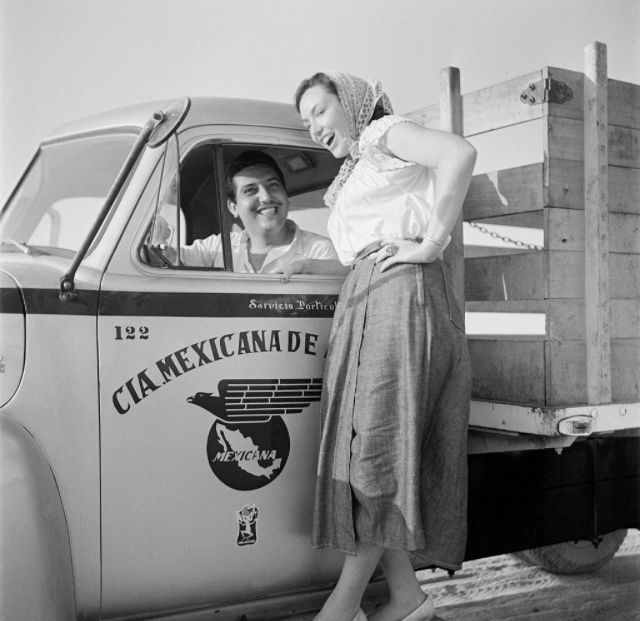
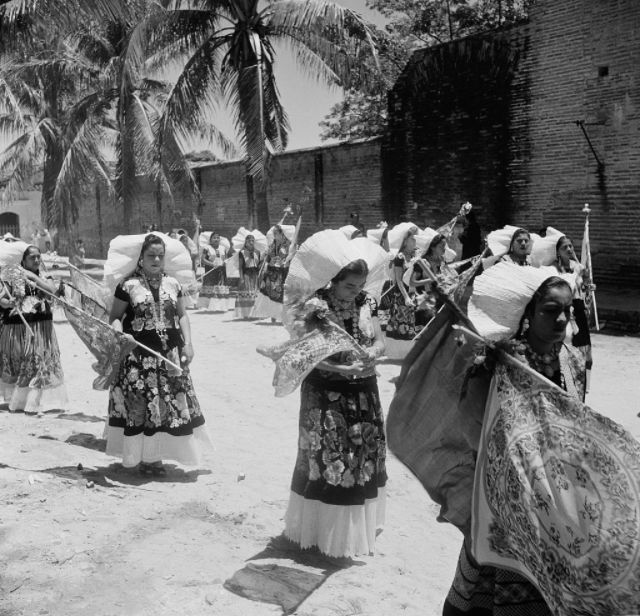
Below are 25 photographs depicted local life in Mexico taken in 1952:
Subscribe to continue reading
Become a paid subscriber to get access to the rest of this post and other exclusive content.
Red River is a 1948 American Western film, directed and produced by Howard Hawks and starring John Wayne and Montgomery Clift. It gives a fictional account of the first cattle drive from Texas to Kansas along the Chisholm Trail. The dramatic tension stems from a growing feud over the management of the drive, between the Texas rancher who initiated it (Wayne) and his adopted adult son (Clift).
The film’s supporting cast features Walter Brennan, Joanne Dru, Coleen Gray, Harry Carey, John Ireland, Hank Worden, Noah Beery Jr., Harry Carey Jr. and Paul Fix. Borden Chase and Charles Schnee wrote the screenplay, based on Chase’s original story (which was first serialized in The Saturday Evening Post in 1946 as “Blazing Guns on the Chisholm Trail”).
Upon its release, Red River was both a commercial and a critical success and was nominated for two Academy Awards. In 1990, Red River was selected for preservation in the United States National Film Registry by the Library of Congress as being “culturally, historically, or aesthetically significant.” Red River was selected by the American Film Institute as the 5th greatest Western of all time in the AFI’s 10 Top 10 list in 2008.
Edward Montgomery Clift (October 17, 1920 – July 23, 1966) was an American actor. A four-time Academy Award nominee, The New York Times said he was known for his portrayal of “moody, sensitive young men”.
He is best remembered for his roles in Howard Hawks’s Red River (1948), George Stevens’s A Place in the Sun (1951), Fred Zinnemann’s From Here to Eternity (1953), Stanley Kramer’s Judgment at Nuremberg (1961), and John Huston’s The Misfits (1961).
Along with Marlon Brando and James Dean, Clift was considered one of the original method actors in Hollywood (though Clift distanced himself from the term); he was one of the first actors to be invited to study in the Actors Studio with Lee Strasberg and Elia Kazan. He also executed a rare move by not signing a contract after arriving in Hollywood, only doing so after his first two films were a success. This was described as “a power differential that would go on to structure the star–studio relationship for the next 40 years”. A documentary titled Making Montgomery Clift was made by his nephew in 2018, to clarify many myths that were created about the actor.
On July 22, 1966, Clift was in his New York City townhouse, located at 217 East 61st Street. He and his private nurse, Lorenzo James, had not spoken much all day. After midnight, shortly before 1:00 a.m., James went to his own bedroom to sleep, without saying another word to Clift.
At 6:30 a.m., James woke up and went to wake Clift, but found the bedroom door closed and locked. Concerned and unable to break the door down, James ran down to the back garden and climbed up a ladder to enter through the second-floor bedroom window. Inside, he found Clift dead: he was undressed, lying in his bed still wearing his eyeglasses and with both fists clenched by his side. James then used the bedroom telephone to call some of Clift’s personal physicians and the medical examiner’s office before an ambulance arrived.
Clift’s body was taken to the city morgue about 2 miles (3.2 km) away at 520 First Avenue, and autopsied. The autopsy report cited the cause of death as a heart attack brought on by “occlusive coronary artery disease”. No evidence was found that suggested foul play or suicide.
It is commonly believed that drug addiction was responsible for Clift’s many health problems and his death. In addition to lingering effects of dysentery and chronic colitis, an underactive thyroid was later revealed during the autopsy. The condition (among other things) lowers blood pressure; it could have caused Clift to appear drunk or drugged when he was sober. Underactive thyroids also raise cholesterol, which might have contributed to his heart disease.
Following a 15-minute funeral at St. James’ Church on Madison Avenue in Manhattan, which was attended by 150 guests, including Lauren Bacall, Frank Sinatra, and Nancy Walker, Clift was buried in the Friends Quaker Cemetery, Prospect Park, Brooklyn. Elizabeth Taylor, who was in Rome, sent flowers, as did Roddy McDowall (who had recently co-starred with Clift in The Defector), Judy Garland, Myrna Loy, and Lew Wasserman. (Wikipedia)
Take a look at these vintage photos to see handsome portraits of a young Montgomery Clift during the filming of Red River in 1948.
Subscribe to continue reading
Become a paid subscriber to get access to the rest of this post and other exclusive content.
A daguerreotype is a single reversed image, made as a direct positive onto a silvered copper plate. Its reflective surface is an easy way to tell the difference between a daguerreotype and an early photograph taken using a different technique. The image is made of a combination of silver and mercury, resting on that plate. It is extremely vulnerable to damage, and can easily be brushed off, even after being ‘fixed’. Because they were so fragile, they were usually protected with a cover-glass and held in small leather-bound cases as treasured objects, in many ways similar to miniature painted portraits.
Nowadays we often refer to any old-looking, sepia-tinted photograph as a ‘daguerreotype’. But the word daguerreotype in fact refers to a specific photographic process, invented by the flamboyant Parisian inventor and entrepreneur Louis Jacques Mandé Daguerre (1787-1851).
Daguerre was the first person to publicly announce a successful method of capturing images. His invention was an immediate hit, and France was soon gripped by ‘daguerreotypomania’. Daguerre released his formula and anyone was free to use it without paying a license fee – except in Britain, where he had secured a patent.
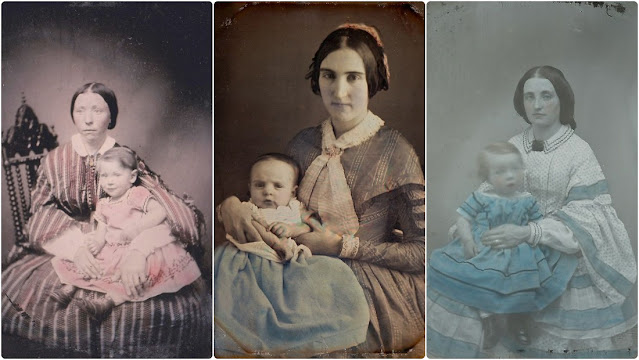
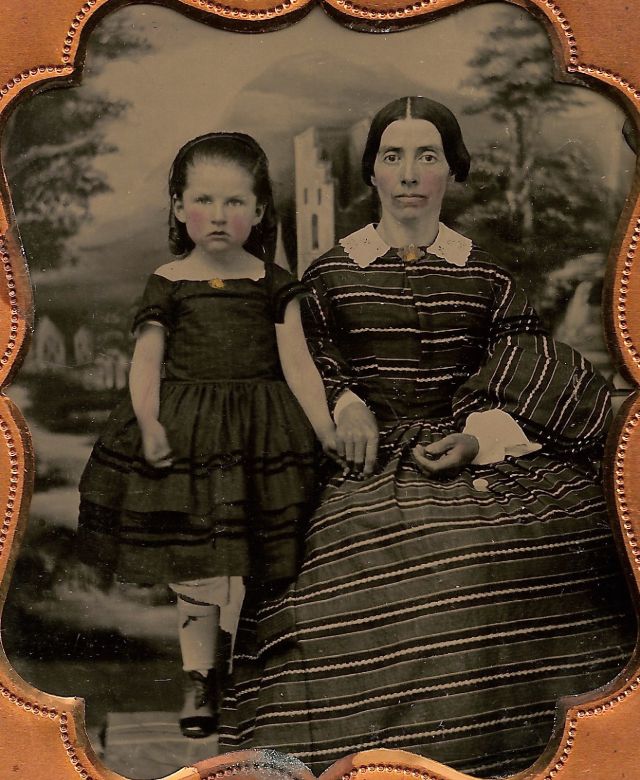
Here below is a set of early daguerreotypes that shows portraits of mothers with their little children from between the 1840s and 1860s.
Subscribe to continue reading
Become a paid subscriber to get access to the rest of this post and other exclusive content.