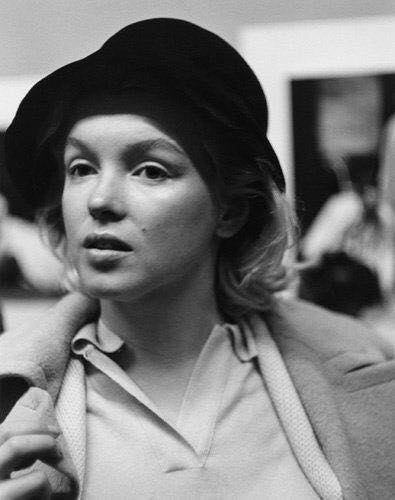
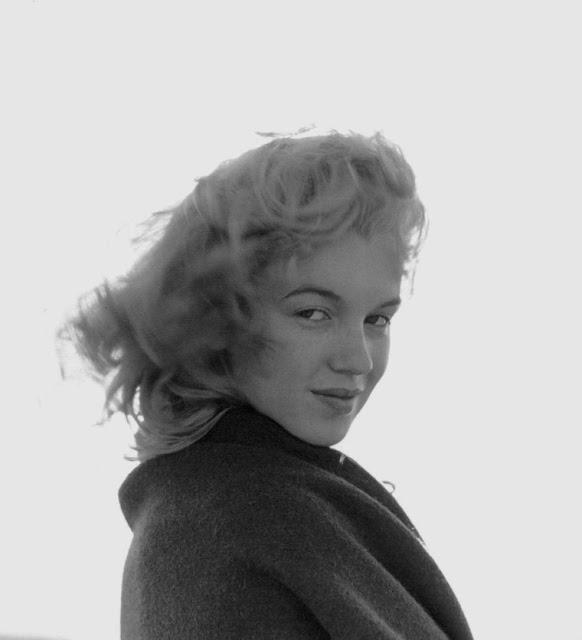
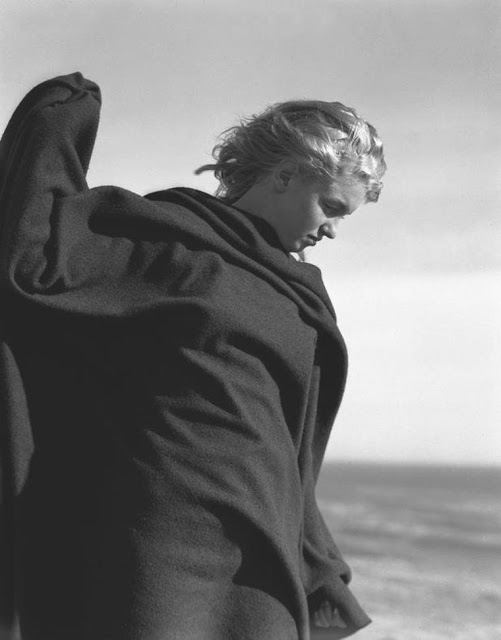
Before there was Marilyn Monroe there was a girl named Norma Jeane Dougherty who met André de Dienes in 1945. Together they travelled as lovers taking photographs that would help catapult the cherub-faced redhead into superstardom.
These black and white photographs of Marilyn on Malibu beach covered in a blanket wearing no make-up are accompanied with the below text: “She was twenty and had never experienced the intoxication of success, yet already there was a shadow over her radiance, in her laughter. One day when we were relaxing on the beach between photo sessions, I decided to capture some new expressions I had glimpsed on Marilyn’s face. Getting her in close-up, I asked her to react instinctively, without giving herself time to think, to the words happiness, surprise, reflection, doubt, peace of mind, sadness, self-torment… and death. When I said ‘death’ she took hold of the folded dark-cloth and covered her head with it. Death to her was blackness, nothingness. I tried to coax another reaction from her. Death might be a beginning, the hope of an everlasting light. She shook her head: ‘That’s what death is for me.’ She turned towards me, her face set and despairing, eyes dulled, her mouth suddenly bereft of colour. To her, death was the end of everything.” – André de Dienes
Subscribe to continue reading
Become a paid subscriber to get access to the rest of this post and other exclusive content.
A good studio for an artist is a very important place. Our creative studios might sometimes look like a pile of rubbish or a mixed-up room, but this is where great creations are born!
These photos are not glamorous and they show the artists in a very natural and raw state. This is the behind the scenes stuff. The photos give you an insight into how the artists work behind the scenes and what exactly goes into creating great artworks. It is not always pretty and organized. In fact, it seems to be usually quite the opposite!
Claude Monet
Subscribe to continue reading
Become a paid subscriber to get access to the rest of this post and other exclusive content.
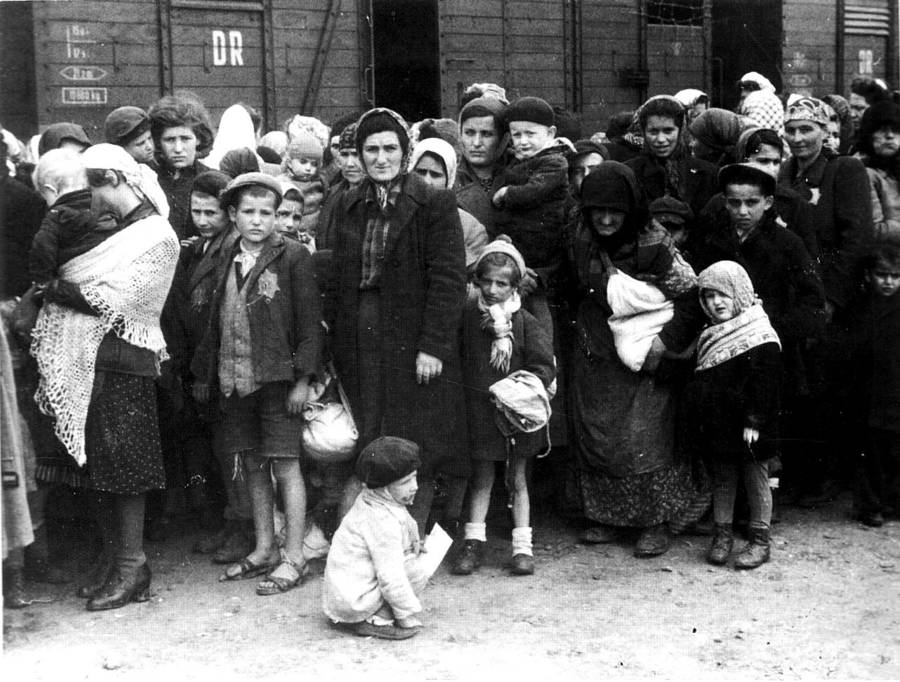
The Holocaust, also known as the Shoah, was the genocide of European Jews during World War II. Between 1941 and 1945, Nazi Germany and its collaborators systematically murdered some six million Jews across German-occupied Europe, around two-thirds of Europe’s Jewish population. The murders were carried out in pogroms and mass shootings; by a policy of extermination through labor in concentration camps; and in gas chambers and gas vans in German extermination camps, chiefly Auschwitz-Birkenau, Belzec, Chelmno, Majdanek, Sobibór, and Treblinka in occupied Poland.
Germany implemented the persecution in stages. Following Adolf Hitler’s appointment as chancellor on 30 January 1933, the regime built a network of concentration camps in Germany for political opponents and those deemed “undesirable”, starting with Dachau on 22 March 1933. After the passing of the Enabling Act on 24 March, which gave Hitler dictatorial plenary powers, the government began isolating Jews from civil society; this included boycotting Jewish businesses in April 1933 and enacting the Nuremberg Laws in September 1935. On 9–10 November 1938, eight months after Germany annexed Austria, Jewish businesses and other buildings were ransacked or set on fire throughout Germany and Austria on what became known as Kristallnacht (the “Night of Broken Glass”). After Germany invaded Poland in September 1939, triggering World War II, the regime set up ghettos to segregate Jews. Eventually, thousands of camps and other detention sites were established across German-occupied Europe.
The segregation of Jews in ghettos culminated in the policy of extermination the Nazis called the Final Solution to the Jewish Question, discussed by senior government officials at the Wannsee Conference in Berlin in January 1942. As German forces captured territories in the East, all anti-Jewish measures were radicalized. Under the coordination of the SS, with directions from the highest leadership of the Nazi Party, killings were committed within Germany itself, throughout occupied Europe, and within territories controlled by Germany’s allies. Paramilitary death squads called Einsatzgruppen, in cooperation with the German Army and local collaborators, murdered around 1.3 million Jews in mass shootings and pogroms from the summer of 1941. By mid-1942, victims were being deported from ghettos across Europe in sealed freight trains to extermination camps where, if they survived the journey, they were gassed, worked or beaten to death, or killed by disease, medical experiments, or during death marches. The killing continued until the end of World War II in Europe in May 1945.
The European Jews were targeted for extermination as part of a larger event during the Holocaust era (1933–1945), in which Germany and its collaborators persecuted and murdered millions of others, including ethnic Poles, Soviet civilians and prisoners of war, the Roma, the disabled, political and religious dissidents, and gay men. (Wikipedia)
Jewish prisoners arrive at the Auschwitz concentration camp, mid-1944.
Subscribe to continue reading
Become a paid subscriber to get access to the rest of this post and other exclusive content.
The photograph of Winston Churchill with the Thompson submachine gun was taken during his visit to the coastal defense positions near Hartlepool on 31 July, 1940. The interesting thing about this picture is that both the British and the Germans used it for propaganda purposes. The British edited out two soldiers standing next to Churchill, making him look statesmanlike, determined and menacing. On the other hand, the Germans compared it to those of the gangsters of the American West. The Nazis used this photo in their propaganda leaflets airdropped onto Britain during the Battle of Britain.
Subscribe to continue reading
Become a paid subscriber to get access to the rest of this post and other exclusive content.
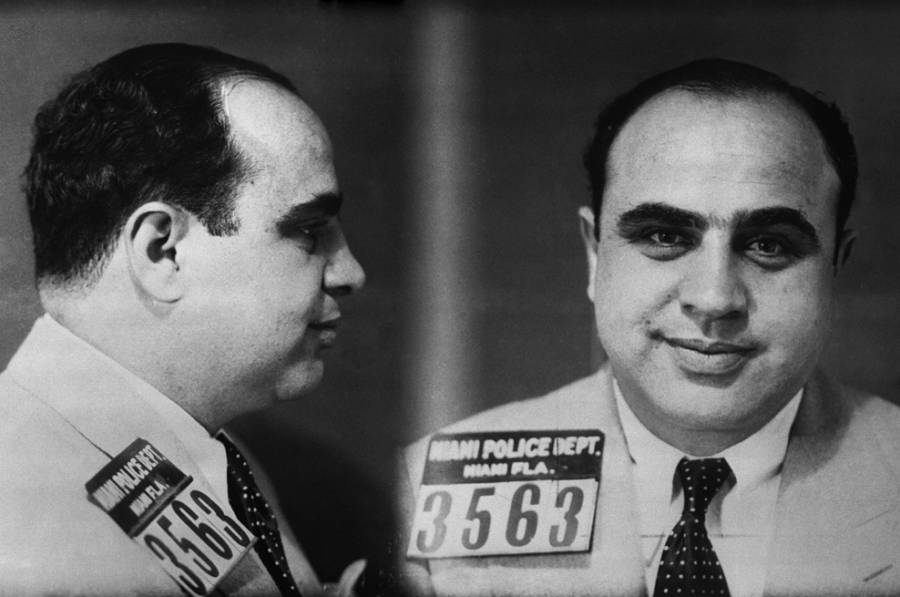
David Bowie, arrested after a performance in Rochester, New York along with three other people (including fellow musician Iggy Pop) for marijuana possession. March 25, 1976. The charges soon disappeared, but Bowie never performed in Rochester again.
Subscribe to get access
Read more of this content when you subscribe today.
On July 20, 1969, the astronaut Neil Armstrong became the first human being to walk on another world, famously marking the moment with the phrase: “That’s one small step for man, one giant leap for mankind.” After months of preparation, preceded by years of development and testing, the crew of NASA’s Apollo 11 lifted off from Florida on July 16, arriving at the moon on July 19. While Command Module Pilot Michael Collins remained in lunar orbit, Armstrong and Lunar Module Pilot Edwin “Buzz” Aldrin descended to the surface and spent two and a half hours on the moon, setting up experiments, taking photos, and gathering samples. After their safe return home, the crew were celebrated by politicians and the public as they embarked on a 45-day goodwill tour, visiting a total of 27 cities in 24 countries. Below, 50 photos of the historic Apollo 11 mission.
A portrait of the Apollo 11 astronaut Buzz Aldrin, taken by his fellow astronaut Neil Armstrong, standing on the lunar surface on July 20, 1969. Aldrin has his left arm raised and is likely reading the checklist sewn on the wrist cover of his glove.
Subscribe to continue reading
Become a paid subscriber to get access to the rest of this post and other exclusive content.
These pictures will definitely make you appreciate where you came from and also make you appreciate where you are now. Life was quite a bit different back in the 1910s. People had way more pressing things to worry about other than being able to connect to wifi!
Talk about perspective. We really do live an exceedingly comfortable life compared to those who lived 100 years ago. Check it out.
The average life expectancy for men was 47 years.
14% of the homes had a bathtub.
Subscribe to continue reading
Subscribe to get access to the rest of this post and other subscriber-only content.
If a picture is worth a thousand words, then Leonard McCombe’s image that inspired the Marlboro Man campaign is worth over $15 billion.
The photograph above shows Clarence Hailey Young, a foreman at the JA Ranch in Texas. McCombe had set out on assignment by Life magazine to document the real way of life of these cowboys, dispelling the glamorous image of most Hollywood movies at that time for the harsh and difficult work of ranching reality.
Something in that 1949 photo must have caught the eye of legendary advertising executive Leo Burnett who later used it as his template for the Marlboro Man. Young’s wrinkled and unshaven face framed by a large cowboy hat and bandana around his neck looked perfect to the ad executive. The fact that he had a lit cigarette on his lips probably convinced Mr. Burnett to choose the cowboy lifestyle for his advertising campaign.
The campaign for Marlboro was meant to include other macho professions, but the cowboy image emerged to be the clear winner. The choice obviously worked for Phillip Morris as the original filtered cigarettes which were first advertised for women as “Mild as May” became the winning ingredient when one tried to picture the place “Where the Flavor is.” Within two years, sales of the cigarette increased three-fold.
Darren Winfield was the first commercial Marlboro Man, with many other actors and real cowboys following in his footsteps. Similarly, many photographers, including Jim Krantz and Sam Abell were commissioned to make the iconic ads.
While most tobacco companies nowadays have shifted their advertising campaigns away from the cowboy image, the original idea has been considered to be one of the most successful ad campaigns of all time. And to think that McCombe’s Marlboro Man shot sparked the idea that would be worth millions of dollars from what was originally a ladies’ cigarette.
Subscribe to continue reading
Become a paid subscriber to get access to the rest of this post and other exclusive content.
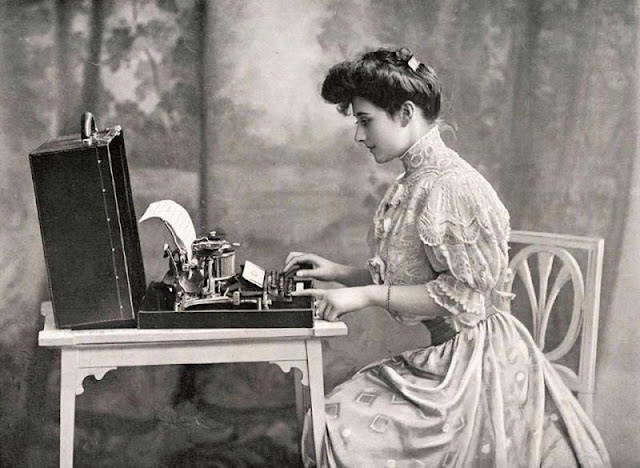
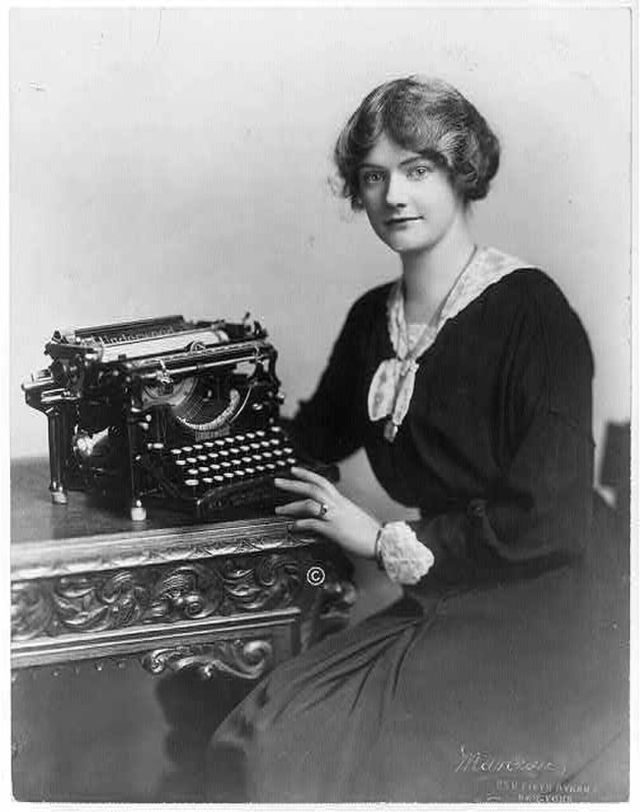
A typewriter is a mechanical or electromechanical machine for typing characters. Typically, a typewriter has an array of keys, and each one causes a different single character to be produced on paper by striking an inked ribbon selectively against the paper with a type element. At the end of the nineteenth century, the term ‘typewriter’ was also applied to a person who used such a device.
The first commercial typewriters were introduced in 1874, but did not become common in offices until after the mid-1880s. The typewriter quickly became an indispensable tool for practically all writing other than personal handwritten correspondence. It was widely used by professional writers, in offices, business correspondence in private homes, and by students preparing written assignments.
Typewriters were a standard fixture in most offices up to the 1980s. Thereafter, they began to be largely supplanted by personal computers running word processing software. Nevertheless, typewriters remain common in some parts of the world. The QWERTY keyboard layout, developed for typewriters in the 1870s, remains the standard for computer keyboards.
Before computer, here is a set of vintage photos that shows people from the past with their typewriters.
Subscribe to continue reading
Become a paid subscriber to get access to the rest of this post and other exclusive content.